
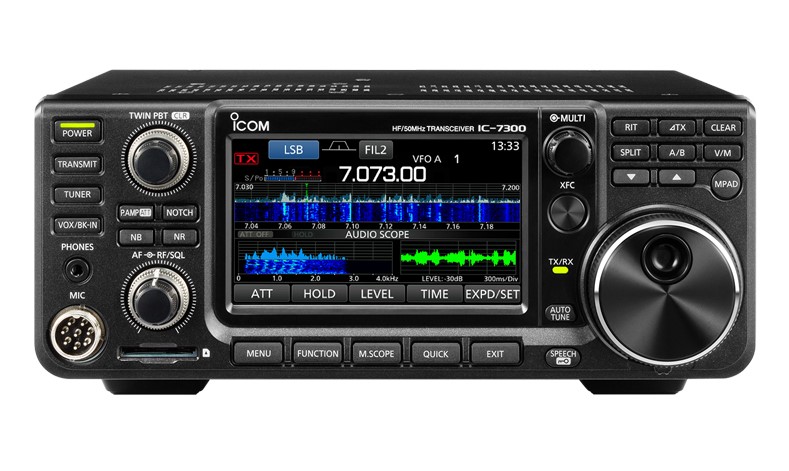
Keď Icom v roku 2016 predstavil IC-7300, nikto nečakal, že tento kompaktný TCVR rewrite the rules of the entire entry-level device segment as radically as it did. Today, almost a decade after its launch, its global sales have surpassed 100,000 units. In a segment where models come and go within two or three years, this is a result worth thinking about. Is the IC-7300 still relevant, or is it just living off past glory? And how does it compare to the above IC-7300MK2 and growing competition from Yaesu, Kenwood and Chinese SDR TCVR?
In the article you will read
Technical architecture that changed the market
The essence of the IC-7300 lies in its RF direct Sampling system - direct sampling of the RF signal without a traditional superheterodyne chain. The RF signal is directly converted to digital data and processed in the FPGA, which significantly simplifies the circuit and eliminates noise from multiple IF stages. In 2016, it was the first amateur TCVR with such an architecture on the market in an affordable price range, and this is what caused a series of effects that are still visible today.

RMDR (Reciprocal Mixing Dynamic Range) typically reaches a value of around 97 dB at 1 kHz frequency separation – a figure that at the time of its launch was in the higher category, not the entry-level segment. The phase noise is improved by around 15 dB at 1 kHz separation compared to its predecessor, the IC-7200, which results in a cleaner signal on both transmit and receive. The IP+ function dynamically optimizes the ADC against intermodulation distortion when receiving a weak signal in the presence of a strong neighboring signal – this is relevant in real pile-up conditions, when a strong station is located next to the target QRP signal.
An interesting detail for technically minded operators: The IC-7300 contains 15 discrete bandpass filters that select the RF signal before it enters the ADC. This significantly reduces out-of-band energy, reducing the load on the converter. High-Q windings minimize losses in these filters. This is an architectural feature that distinguishes the IC-7300 from the simpler approach of some Chinese SDR TCVRs.
Spectroscope and waterfall: a real working tool

4,3-palcový farebný TFT LCD dotykový dsiplej so spektroskopom a waterfall funkciou bol v roku 2016 výsadou drahých modelov. IC-7300 ho priniesol do dostupnej cenovej kategórie. Spektroskop pracuje simultánne s príjmom – no je potrebné prepínať medzi počúvaním a sledovaním pásma. Dotykom na zobrazenú časť spektra sa daná oblasť priblíži, druhým dotykom sa VFO nastaví na zvolenú frekvenciu. V praxi to znamená, že DX cluster spot možno rýchlo overiť vizuálne a rozhodnúť, či má cenu pokúsiť sa o QSO, bez slepého ladenia.

Audio scope function allows you to display FFT analysis of the transmitted or received audio signal, including waterfall display - a practical tool for setup ALC, kompresora, notch filtra alebo pri ladení CW keying waveformu. Multi-function meter zobrazuje S-meter, ALC, power, SWR and IP+ activity on one screen.
Konektivita a digitálne módy
The IC-7300 has a built-in USB audio codec and CAT interface on a single USB-B port, meaning that FT8, FT4, WSPR, PSK31, RTTY, MSK144 or SSTV operation requires only one cable between the TCVR and the computer – no external audio interface required. This feature is one of the reasons for its extreme popularity in the digital modding community. QSO records, voice memories, RTTY/CW decode logs and screenshots can be saved to an SD card.

The built-in automatic antenna tuner covers common impedance mismatches and remembers settings for each band, so changing bands is quick and easy. For CW operators, Full break-in, CW reverse and CW auto-tuning are available. Remote control is possible via the optional RS-BA1 software.
Európska verzia IC-7300 pokrýva okrem štandardných HF pásiem aj 50 MHz (6 m) a 70 MHz (4 m), čo rozširuje možnosti prevádzky na VHF pásma, vrátane SOTA aktivácií alebo sporadickej vrstvy (Es) a meteor scatter prevádzky na 6 metroch.
IC-7300 vs. IC-7300MK2: Evolution, not revolution
V auguste 2025 Icom na JARL Ham Fair odhalil IC-7300MK2 and first deliveries began in late 2025. It is a direct successor with the same basic RF direct sampling architecture, but with several fundamental improvements that operators have been waiting for years.
What else does MK2 bring?

RMDR is improved to a typical 105 dB at 2 kHz separation – an increase of approximately 8 dB over the original model. Transmit Phase noise is reduced to –139 dBc/Hz at 1 kHz offset, an improvement of more than 12 dB. In practice, this means a cleaner transmitted signal and better immunity to blockage from neighboring strong stations, which operators will appreciate during contests with high station density on the band.
Current consumption in RX standby mode has been reduced from 0.9 A to 0.7 A, which reduces thermal output and contributes to more stable long-term operation during DX expeditions or multi-hour contests.
The new feature is the HDMI output, which allows you to connect an external monitor and display the frequency, spectroscope, waterfall and menu in much higher resolution. At the same time, it is possible to output audio to the monitor speaker via HDMI. The USB Type-C port replaces the original USB-B and also supports two simultaneous virtual COM ports, which allows for the simultaneous operation of, for example, FT8 and a logging program via one cable. A LAN port has been added, thanks to which remote control via RS-BA1 does not require a base server computer. Separate RX antenna connectors (SMA) allow you to connect external receiving antennas, bandpass filters or LNBs.
The built-in CW decoder – a first in the history of Icom HF TCVRs – decodes Morse code directly on the screen without the need for external software, while the decoder automatically adjusts the filter and keying rate. APF (Audio Peak Filter) on CW improves the readability of a specific signal in a busy band. The MK2 also supports the newly allocated 5 MHz band in the European version.
| Parameters | IC-7300 | IC-7300MK2 |
|---|---|---|
| RMDR (typical value) | ~97 dB at 1 kHz | ~105 dB at 2 kHz |
| TX phase noise | basic level | –139 dBc/Hz at 1 kHz (improvement >12 dB) |
| RX power consumption (standby) | ~0.9A | ~0.7 A (~23% drop) |
| USB interface | USB-B (1× COM + audio) | USB-C (2x COM + audio) |
| HDMI output | no | yes |
| LAN port | no | yes (direct RS-BA1) |
| Separate RX input | no | yes (SMA connectors) |
| Built-in CW decoder | no | yes |
| APF filter | no | yes |
| 5 MHz band (EUR) | no | yes |
| 70 MHz band (EUR) | yes | yes |
Comparison conclusion: buy IC-7300 or MK2?

The IC-7300MK2 is not a comprehensive redesign, but rather Icom's focused response to long-identified shortcomings of the original model. For the operator planning active contest operation, SO2V or SO2R setup, regular DX expeditions or intensive use of digital modes with logging, HDMI, dual COM, LAN and better phase noise bring real benefits. For the regular operator focusing on SSB ragchewing, SOTA activities and occasional FT8 or POTA operation, the IC-7300 remains a fully functional and functional device, at a lower price.
Competition: Yaesu, Kenwood and Chinese SDR TCVR
Yaesu FT-710 AESS and FT-991A

Yaesu FT-710 AESS is a direct competitor in the same price category and also uses a full-fledged SDR architecture, derived from the flagship models FT-DX101 and FT-DX10. In independent tests (Sherwood Engineering receiver test list), the FT-710 achieves slightly better results in the receive dynamic range in dense DX pile-up or under conditions of high K-index and increased atmospheric activity. The Acoustic Enhanced Speaker System (AESS) version integrates an external speaker with significantly higher audio performance, which you will appreciate during long operations without headphones.
On the other hand, the IC-7300 has a more intuitive user interface – and that is a real asset in everyday operation. The IC-7300’s spectral range has smooth averaging, which the FT-710 lacks. Setting up digital modes via a single USB cable is more straightforward on the IC-7300. The FT-710 also does not have a built-in CW decoder (unlike the MK2). The FT-710 AESS is priced at the same price as the IC-7300, or slightly higher depending on the retailer and region.
The Yaesu FT-991A remains an interesting alternative for operators who need both HF and VHF/UHF in one TCVR – it adds 144 MHz and 430 MHz including FM, C4FM (Fusion) and SSB, which the IC-7300 does not cover. However, for a pure HF Shack, the IC-7300 is technically more advanced in most parameters.
Kenwood TS-590SG

The Kenwood TS-590SG is based on a traditional superheterodyne architecture with advanced DSP. It has a reputation as an exceptionally clean receiver with excellent AGC control and is still highly rated in the contest environment for its stability and resistance to strong signals on the band. It covers only the HF bands up to 60 MHz - excluding 6 m and 70 MHz. It is physically larger (270 × 96 × 291 mm, 7.4 kg compared to 240 × 94 × 238 mm and 4.2 kg of the IC-7300) and lacked a color touchscreen display with a scoping at the time of its introduction. The price is generally higher than the IC-7300. For operators who prefer classic controls and the proven superheterodyne architecture, the TS-590SG remains a respected choice, but from the point of view of modern SDR workflow and band visualization, the IC-7300 is more practical.
Čínske SDR TCVR: Xiegu, QRP Labs a ďalší
In recent years, Chinese SDR TCVRs have entered the market – primarily Xiegu G90, X6100 and other models from smaller manufacturers. These devices are significantly cheaper (the G90 is around 400–500 EUR), have an integrated antenna tuner and basic amplifier. For QRP operations, SOTA activities or novice operators, they are an attractive alternative.
However, compared to the IC-7300, the differences are measurable. Dynamic range, phase noise, TX signal quality and long-term reliability do not reach the Japanese level. Service network and firmware support after years of operation are incomparably weaker. For long-term QSO activities, contest operation or difficult DX conditions, Chinese SDR TCVRs are limited. On the other hand, in combination with an external QRO amplifier or as a backup station, they can be a practical solution.
| TCVR | Architecture | VHF/UHF | Spteroscope / Waterfall | CW decoder | Approximate price (EUR) |
|---|---|---|---|---|---|
| Icom IC-7300 | RF direct sampling SDR | no (6 m + 4 m EUR) | yes | no | ~990–1,100 |
| Icom IC-7300MK2 | RF direct sampling SDR | no (6 m + 4 m EUR) | yes + HDMI | yes | ~1,350–1,450 |
| Yaesu FT-710 AESS | SDR (FT-DX series) | no (6m + 4m) | yes | no | ~950–1,100 |
| Yaesu FT-991A | SDR + DSP | yes (144 / 430 MHz) | yes | no | ~1,200–1,350 |
| Kenwood TS-590SG | Superhet + DSP | no (max. 60 MHz) | limited | yes | ~1,200–1,400 |
| Xiegu G90 | SDR (QRP) | no | basic | no | ~400–500 |
Prices are indicative based on the European market in the first half of 2026 and may vary by retailer and country. The IC-7300MK2 price is derived from the listed UK market price (approx. £1,360 including VAT).
IC-7300 Price: Where is it in 2026?
Since 2016, the IC-7300 has had an interesting price trajectory. The original suggested retail price in Europe was around 1,100–1,200 EUR. With the arrival of the IC-7300MK2 and the sale of the original model, the price of the IC-7300 has dropped below 1,000 EUR in many European countries, in some cases down to around 990 GBP (including a 30A power supply as a bonus) in the UK market. In the US, a rebate campaign is running until the end of June 2026 with a 100 USD cashback on the purchase of a new unit.
As a result, the IC-7300 today represents an extremely advantageous compromise: SDR architecture, real-time SCO, waterfall, 15 bandpasses, built-in antenna tuner, USB audio and CAT over a single cable – all at a price that is one of the lowest in the mid-tier category. On the used market, the IC-7300 in good condition is around 600–800 EUR, depending on condition and accessories – and even at this price level it is a technically competitive TCVR.
The IC-7300MK2 entered the European market with a price tag of around 1,350–1,450 EUR. So, we are talking about a premium of 300–400 EUR over the IC-7300, which is a common trend for successor models in the amateur TCVR sector. The question when making a purchase decision is whether the MK2's innovations – especially HDMI, LAN, dual COM, RX antenna input and better phase noise – correspond to the given price difference for a specific operational profile.
Conclusion: Still relevant – but with conditions
IC-7300 je po takmer desiatich rokoch na trhu stále relevantný TCVR – a to no vďaka nostalgii, ale vďaka konkrétnym technickým vlastnostiam. RF direct sampling architektúra s 15 diskrétnymi filtrami, RMDR okolo 97 dB, plnohodnotný realtimový skop a waterfall, jedno-káblová integrácia pre digitálne módy a intuitívne rozhranie sú vlastnosti, ktoré majú reálnu prevádzkovú hodnotu v roku 2026 rovnako ako v roku 2016.
Pre operátora vstupujúceho do sveta HF prevádzky, pre SOTA a POTA aktivátora hľadajúceho spoľahlivý základ, alebo pre skúseného operátora, ktorý chce dostupný contest TCVR bez zbytočných kompromisov – IC-7300 zostáva odôvodnenou voľbou. A to najmä pri aktuálnej cene pod 1 000 EUR.
For an operator who plans to invest in new equipment and make the most of modern connectivity options, an integrated CW decoder, HDMI output for a large monitor or an independent RX input for filtering local QRM – the IC-7300MK2 is a logical step forward. It is not a revolution, but an evolution that addresses specific and long-articulated community requirements.
Chinese SDR TCVRs at the lower end of the price range are interesting for the QRP community and beginners, but they are not a direct replacement for an active licensed operator who needs consistent performance in a variety of wave propagation conditions. And the Yaesu FT-710 or Kenwood TS-590SG are legitimate alternatives with their own advantages - but neither of them set the price bar as high as the IC-7300 did in 2016 and partially still holds today.
Legend? Maybe. Still relevant? Definitely yes.