


2006 is the centenary of the first ITU conference. During all these years, amateur radio has played a significant role in the process of developing knowledge, culture and rapprochement between nations. We believe that the acceptance of these proposals will help to create modern and high-quality licensing conditions, which will be a significant landmark in the further process of self-education of radio amateurs and will allow access to the possibility of education to a larger number of interested parties than before.
The described proposals and additions to the Permit Conditions and Measures of the Slovak Radio Communications Office were compiled on the basis of documents from the European Radiocommunications Office, the International Telecommunication Union ITU, the current licensing conditions of the Slovak Radio Broadcasting Authority for ARS, the license conditions of developed amateur radio countries in Europe and comments from the radio amateur public.

Creation of two operator classes of amateur radio stations (hereafter ARS), namely: Extra and Novice.
Change of classes from the current four classes to two classes based on the recommendation of the Electronic Communications Committee (ECC) on simplifying the process of access to amateur radio frequencies. The change of classes corresponds to the trend of the development of licensing conditions in Europe and other developed amateur radio countries of the world.
Abolition of telegraphy knowledge requirement for short wave (HF) access.
The ITU leaves the decision on this requirement to national telecommunication authorities. The request to cancel the telegraphy exam is in line with the trend of development of licensing conditions in Europe. Due to the development of new, especially digital modes (PSK, FSK, JT65, EchoLink a pod.) zahrnúť tento okruh do otázok na skúškach osobitnej odbornej spôsobilosti.
Those interested in taking the telegraphy exam will be tested and issued a certificate upon request.

Dokument ECC/REC 05-06 CEPT Novice radio amateur licence obsahuje odporúčanie by the National Telecommunications Authority for the content of the exams for the issuance of the CEPT Novice permit. The National Telecommunications Authority therefore has the right to decide on the content of the exam, on the basis of which it will issue a CEPT Novice permit to the applicant.
Dokument CEPT T/R 61-01 CEPT Amateur radio licence stanovuje podmienky, for which ARS can be assigned a CEPT permit. Based on the revision of Article 25 of the ITU Radio Regulations, not to require a telegraphy exam for the issuance of a CEPT T/R 61-01 permit.

Transform the current operator classes in the following way: A, B and C classes will go to the Extra class and D class operators will go to the Novice class.
Considering that the current examinations according to the special professional competence for class D differ only minimally in the scope (not the areas) of the required knowledge required by the document ECC/REC 05-06, we recommend to the national telecommunications authority to grant Class D operators a Novice class permit without the requirement to supplement the KV examination, since this document nerozlišuje medzi obsahom skúšky na KV a VKV pásma.

Given that the range of required knowledge according to the current tests of special professional competence for classes C, B and A places higher demands on the knowledge and skills of the ARS operator, the operators of these classes should also be assigned the Extra class without further examination.
Establish one of the requirements for obtaining the Extra class as one year of experience in the Novice class and the establishment of at least 500 connections, of which at least a quarter (125 connections) would be compulsorily established during amateur radio competitions. Novice class operators to recognize experience and established connections in class D.
The criterion of a year of experience on amateur bands and the establishment of a minimum number of connections is intended to confirm the practical knowledge of the applicant for the Extra class.
Due to the fact that amateur radio races place increased demands on operator skills (connections with an emphasis on speed and accuracy, connections using a non-native language), technical skills (improvement of ARS in order to meet the criterion faster), operation of ARS from a temporary station (assembly and disassembly on the elevation in order to meet the criterion faster) - it is mandatory to require the establishment of at least a minimum number of connections during radio amateur races. Last but not least, this will result in an increase in participation in the race and a better representation of Slovak radio amateurs.
Due to the difficulty of achieving the criterion of 500 connections and at least a quarter of the connections in amateur radio competitions, for class D operators on VHF bands, all connections achieved and experience in this class should be recognized as a requirement for the Extra class exam.
Addition of the 122 GHz band to the frequency table.
Supplement the frequency table with the range 122.25-123.0 GHz for ARS.

Check whether it is not possible to supplement the frequency table with a band of 4m (70 MHz).
In several countries of the world, this band is being allowed for ARS. If the frequency range 70.0-70.5 MHz is not used by other services, allow operation in this band with a power of 25W, provided that there is no interference with other services.
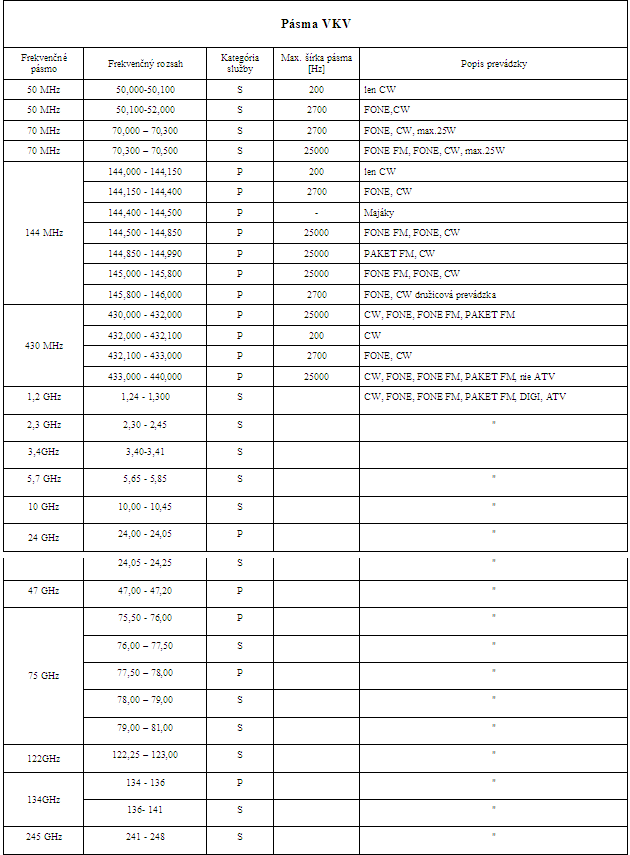
In the Extra class, allow a maximum power of 750W PEP. In the case of using several output stages excited in phase, the total power is determined by simply adding the outputs of all output stages. Proposed frequencies according to table No. 1 of KV and VHF bands for the Extra class.
Define a maximum power of 750W PEP (peak power). Due to the trend of using several phase-excited final stages, especially in amateur radio competitions, define exactly the method of determining the total power.
The proposed frequency table is based on the current frequency table. Due to the definition of ITU-RR HF (KV) bands, move the 50.00-52.00 MHz band between the VHF bands. The proposal is supplemented by a band of 70.00-70.50 MHz with a power of 25W and a band of 122.25-123 GHz.

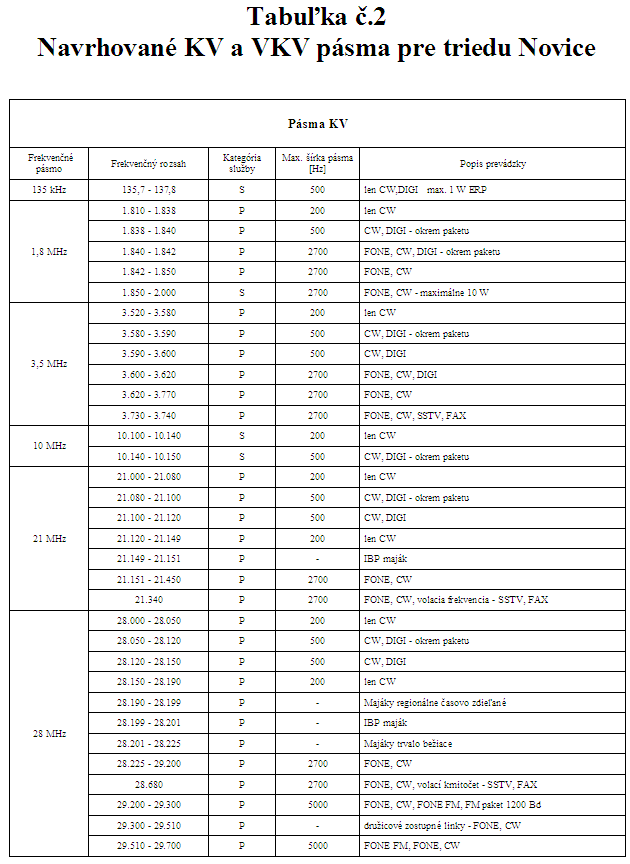
In the Novice class, allow a maximum power of 100W PEP. In the case of using multiple phase-excited output stages, the total power is determined by simply adding the outputs of all output stages. Proposed frequencies according to table no. 2 of KV and VHF bands for the Novice class.
Define the maximum power of 100W PEP (peak power). Due to the trend of using several phase-excited final stages, especially in amateur radio competitions, define exactly the method of determining the total power.
The proposed frequency table would allow operators of the Novice class to access the HF and VHF bands so that they can develop as efficiently as possible in self-education, mutual communication and technical study. These are bands or segments of 136 kHz bands; 1.8 MHz; 3.5 MHz; 10 MHz; 21 MHz; 28 MHz and the entire range of VHF bands, which would allow this class to develop not only in the operational field, but also in the technical field in the area of lower HF bands as well as higher HF bands.
Conducting amateur radio exams in a transparent form of written test and oral examination. Setting the limit of 75% of correct answers in the written test as a prerequisite for admission to the oral exam, which will be a verification of the knowledge of the applicant for the issuance of a certificate of special professional competence for the operation of ARS.
Navrhujeme vykonávanie rádioamatérskych skúšok formou písomného testu zostaveného podľa the range of areas in the proposal ECC/REC 05-06 for the Novice class and for the Extra class in accordance with the range of required knowledge according to the document CEPT T/R 61-01.
An applicant who demonstrates knowledge by correctly answering at least 75% of the questions will be admitted to the oral exam, during which the examiner will verify the knowledge of the applicant for the issuance of a certificate of special professional competence for the operation of the ARS system.
Lowering the age limit for issuing a Novice radio amateur license to 10 years of age with the maximum output power allowed to 10W from a single output stage. After reaching the age of 15, cancel the performance restriction. Mark this fact in the permit. Likewise, after the age of 15, it is possible to take a test of special professional competence for the Extra class.
Due to the trend of lowering the age limit to a certain level of the educational process, it is possible to obtain the ARS Novice class concession for children and youth aged 10-15. Limit the power to 10W, as a limit for trouble-free EMC compatibility with other services, as children and young people have limited options for solving EMC compatibility problems with other services. The condition for issuing a permit would be the consent of the legal representative.
Amend the TÚ SR Directive on the method of assigning radio amateur brands. Set a fee for assigning a suffix in an over-the-top way.
Navrhujeme jednopísmenkové sufixy rezervovať pre špeciálne a contestové stanice. Operátorom triedy Extra umožniť pridelenie ľubovolného voľného dvojpísmenkového sufixu podľa vlastného výberu pre bežnú prevádzku. Operátorom triedy Novice umožniť pridelenie ľubovoľného voľného trojpísmenkového sufixu according to your choice. The only exception is suffixes starting with the letter Q (possible confusion with Q-code, not allowed by ITU).
Set a reasonable fee for assigning a one-, two- and three-letter suffix to applicants of their own choice. In the event that the applicant is not interested in a specific suffix or does not pay the specified fee, the call sign will be assigned by TÚ SR
It is a similar principle to the allocation of ČEV of motor vehicles, where the applicant for a super-standard ČEV pays a fee for its issuance.
William Petrik, OM0AAO
In Tatranská Lomnica on January 26, 2007
I am asking for a reasonable and factually based justification, if you know of facts that contradict this proposal. Also, if you have suggestions on what else you would like to help me improve the proposal, please provide a broader rationale.
WARNING: any nonsensical and unsubstantiated comments will be deleted in order to better navigate the discussion. Thank you for your understanding.