
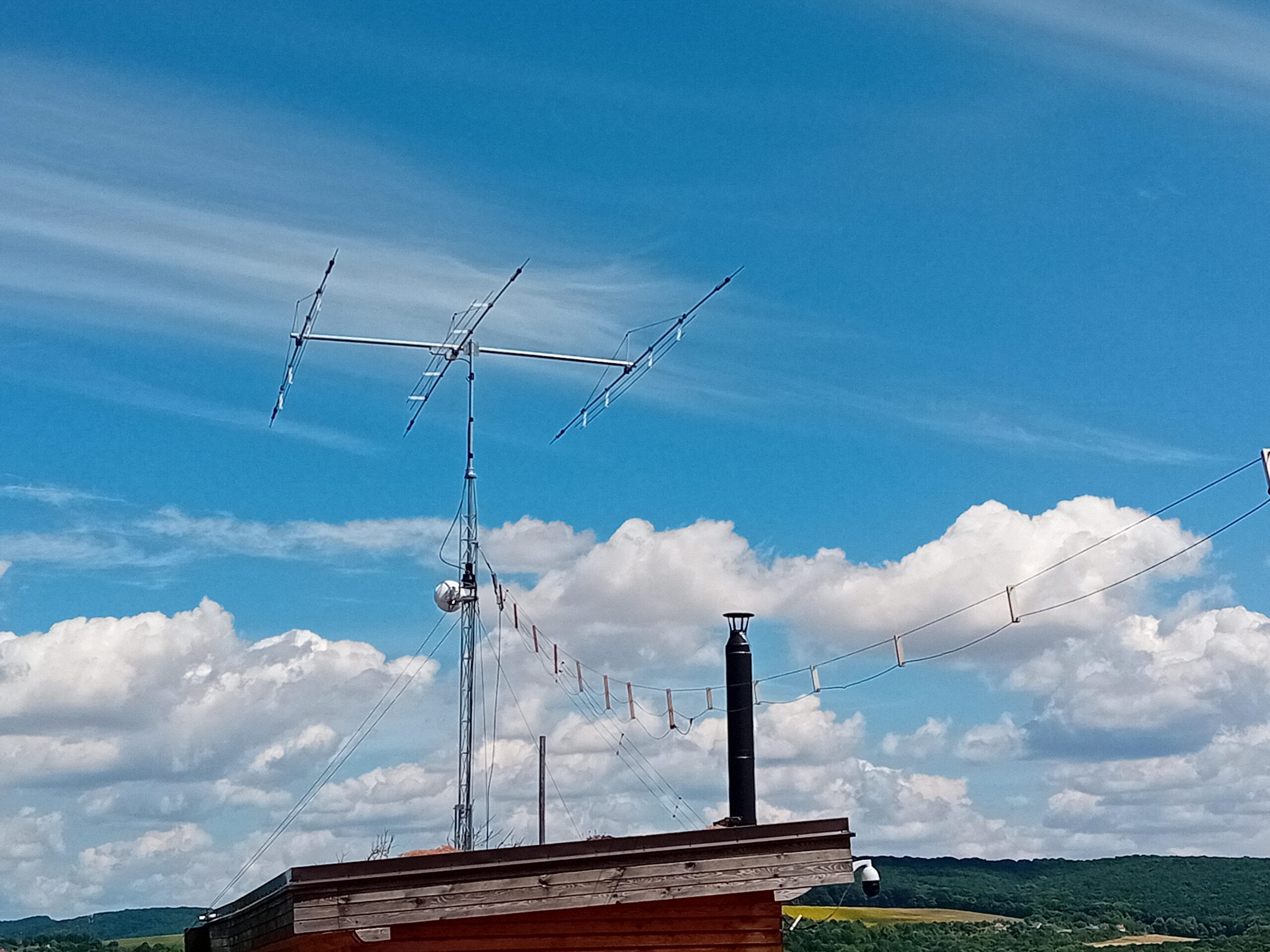
The fan dipole is one of the most popular multiband HF antennas among radio amateurs. Its popularity stems from its simple construction, low cost, and very good operating characteristics. Unlike other multiband antennas, it does not use tuned traps, but several separate dipoles connected to a single feed point.
For the radio amateur who wants to cover multiple HF bands without using an antenna tuner or complicated antenna switching, the fan dipole is an interesting solution. With the right design, it can reliably operate on multiple amateur bands with parameters comparable to single-band dipoles.
In the article you will read
Operating principle

The name "fan dipole" comes from the arrangement of the conductors, which when viewed from the side resemble an open fan. Several dipoles of different lengths, designated for individual bands, are connected to one feeding point.
Each dipole is tuned to a specific band. When transmitting or receiving, the energy is naturally distributed so that the branch that is resonant at a given frequency operates dominantly. The other conductors have high impedance and contribute only minimally to the operation.
The simplest fan dipole can be designed for the 40 m and 20 m bands, for example. Extended designs often cover the 80 m, 40 m, 20 m, 15 m and 10 m bands using a single coaxial feed.
Advantages over trap antennas
The most common alternative to the fan dipole is the trapped dipole. They use resonant traps formed by a combination of a coil and a capacitor. The trap electrically isolates part of the radiator at one frequency and allows operation on multiple bands.
However, the fan dipole does not have any traps. This brings several significant advantages.
The first advantage is lower losses. Each trap contains real components with a finite quality factor Q. At higher powers, losses occur and some of the energy is converted to heat. The fan dipole uses only conductors, so additional losses are minimal.
Druhou výhodou je širšia pracovná šírka pásma. Trapované antény bývajú na niektorých pásmach pomerne úzkopásmové, zatiaľ čo fan dipól sa správa podobne ako klasický rezonančný dipól.
The third advantage is higher reliability. Traps are exposed to weather conditions and mechanical stress. In the fan dipole, such an element is completely absent.

An important factor is also the simpler construction. The radio amateur does not need to design or tune resonant traps. It is enough to prepare individual dipoles of the correct lengths and gradually fine-tune them to the desired bands.
Fan dipole design
The basis is a central insulator with a coaxial cable connection. To this point, individual dipoles designed for different bands are connected in parallel.

The longest dipole is designed for the lowest operating frequency. The other dipoles are successively shorter. The conductors are spread apart using plastic or fiberglass spacers.
The distance between the conductors is usually a few tens of centimeters. Too small a distance can cause stronger mutual influence and more complicated tuning.
In construction, copper or stranded copper conductors with UV-resistant insulation are most often used. The mechanical stress is similar to that of a classic dipole.
Antenna tuning
Tuning a fan dipole is a bit more difficult than a single-band dipole. The individual conductors interact with each other, and changing the length of one branch can slightly affect the resonance of the other bands.
The length of individual emitters is reduced by the conductor shortening factor and the influence of the ground (parasitic capacitance). If you use a wire with PVC insulation, expect emitters to be 4 to 7% shorter.
It is recommended to start with the lowest band and then work your way up to higher frequencies. After each adjustment, it is advisable to measure all bands using an antenna analyzer.
After several iterations, a very good fit can be achieved on all desired bands.
Power supply and balun

As with the classic dipole, it is recommended to use 1:1 current balunIts role is to limit the common current flowing through the coaxial cable braid.
Without a balun, the coaxial line radiation can be significant, leading to radiation pattern distortion and unstable PSV measurements.
For outputs up to several hundred watts, ferrite current baluns with type 31 or 43 cores have proven to be effective.
Practical results
Many published measurements show that a well-designed fan dipole achieves parameters very close to those of a single-band dipole. Both the gain and the radiation pattern remain practically unchanged.
The advantage is the ability to cover multiple bands without the need for an antenna switch or separate power supplies. This gives the radio amateur a universal HF antenna at a relatively low cost.
In practice, fan dipoles are often used in permanent home installations, field days, and QRP operations. The 80/40/20/15/10m or 40/20/15/10m configurations are very popular.
Fan dipole limitations
The biggest disadvantage is the need for sufficient space. The number of conductors increases with the number of bands and the antenna becomes mechanically more complex and heavier. Therefore, in some locations it may be more practical to use a trapped dipole or vertical antenna.
With a large number of bands, more time needs to be spent on tuning, because the individual emitters affect each other.
Conclusion
The fan dipole is one of the best solutions for the radio amateur who wants to operate multiple HF bands using a single antenna. Compared to trapped designs, it offers lower losses, simpler construction, and high reliability.
Although it requires more space and patience during tuning, the result is an effective multiband antenna capable of providing parameters very close to those of a single resonant dipole. This is why the fan dipole remains one of the most popular home-made designs among radio amateurs worldwide.
Videos
The video shows the practical construction of a multiband fan dipole, including the mechanical solution of the spacers and the process of tuning individual bands.