
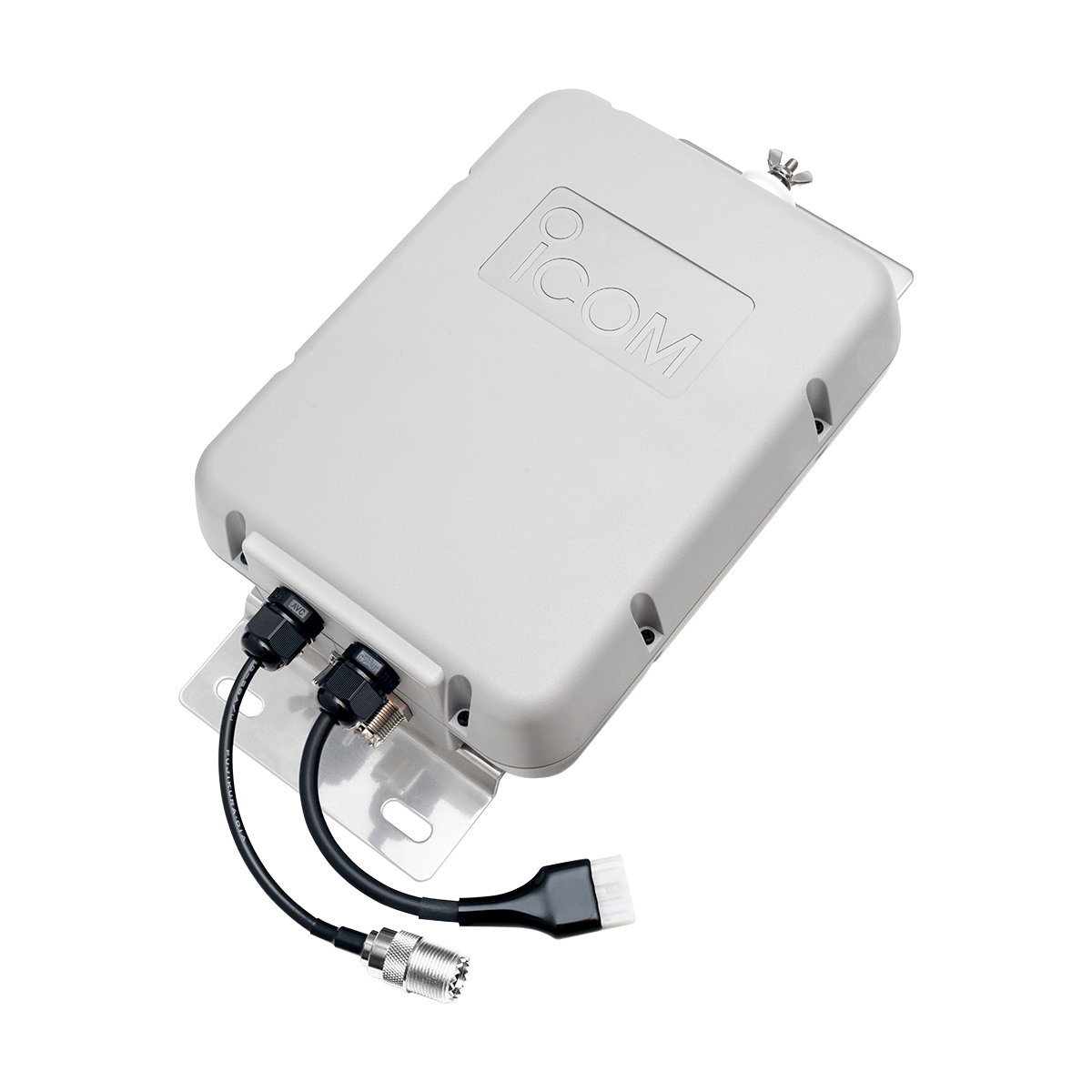
Automatické anténne tunery už dávno nie sú len doplnkom pre operátorov, ktorí nechcú manuálne ladiť anténu pri každom QSY. Pri dnešnej Multiband prevádzke, portable aktiváciách typu POTA či SOTA a improvizovaných anténnych systémoch ide často o praktickú nevyhnutnosť. Nový Icom AH-6 cieli presne na túto skupinu – rádioamatérov, ktorí potrebujú kompaktný externý tuner pre HF a 6 meters, schopný spolupracovať s long wire aj 50 Ω anténami.
In the article you will read
Advantages of the AH-6 tuner
A real remote tuner, not just a "hamshack add-on"
The biggest practical advantage of the AH-6 is the remote tuner architecture. This means that you don't place the tuner next to the TCVR in the hamshack, but as close as possible to the antenna feed point. From an RF technology perspective, this is a fundamental difference.
If you tune a long wire to the shack via Coaxial, cable losses increase dramatically at high PSV. A remote tuner at the antenna eliminates this problem. For portable or fixed installations with a non-harmonic antenna, this is a significantly more efficient solution.
Support for long wire and 50 Ω antennas
The AH-6 is not strictly for random wire configurations. Icom has implemented a pluggable mode between:
- long wire antenna,
- 50 Ω antenna via SO-239.
This means that the tuner can be used not only with end-fed wire, but also with verticals or dipoles, as long as they fit within the working range of the tuner. This is a practical advantage over some older solutions with narrower application flexibility.
Quick tuning with memory
When tuning for the first time, the average tuning time is approximately 2 to 3 seconds, with a maximum of up to 15 seconds. The tuner has 200 memory positions, so repeated return to frequency is significantly faster.
V praxi to znamená komfortné contest QSY medzi segmentmi, rýchle prepínanie FT8 frekvencií alebo bezproblémovú expedičnú prevádzku.
Outdoor construction
IP54 is not a military standard, but for a typical outdoor installation it is a reasonable compromise. The housing is designed to be waterproof and dustproof, including resistance to weather and saltwater environments.
This is an important parameter for remote mounting on a vertical, mast or portable QTH.
Use in amateur radio practice
Random wire / end-fed
The most natural scenario is to use it with a long wire antenna.
Conditions according to the manufacturer:
- for 160 m at least 30 m of conductor,
- from 80 m upwards, at least 7 m of conductor.
A good quality RF ground or counterbalance is required. Without this the tuner may behave unpredictably and tuning may not be successful. This is not a magic box that will fix a poorly designed antenna without any physical compromises.
Portable / POTA / WWFF
Compact dimensions and a weight of approximately 1.25 kg make the AH-6 an interesting candidate for portable use.
Imagine a simple fiberglass mast, 10–20 m of wire, a counterweight and IC-7300Such a set will cover a decent DXCC setup od 160 m po 6 m.
6 meters
An interesting bonus is support up to 54 MHz. This means it can also be used on the magic band during the Es season. Of course, the tuner will not replace a resonant yagi well, but for experimental wire configurations it can be an interesting solution.
Technical parameters
Key specifications of the AH-6:
- Frequency range (wire): 1.8–54 MHz
- Condition for 160 m wire antenna: ≥ 30 m
- Condition from 80 m above wire antenna: ≥ 7 m
- 50 Ω antenna: 1.8–54 MHz, range 16.7–150 Ω
- Maximum input power: 120 W
- Tuning power: 5–15 W (nominal 10 W)
- Power supply: 13.8 V DC from compatible TCVR
- Consumption: ≤ 0.6 A
- PSV after tuning: ≤ 2:1 (with exceptions of λ/2 multiples)
- Memory: 200 channels
- Dimensions: 172 × 230 × 71 mm
- Weight: approx. 1.25 kg
- IP protection: IP54
During tuning, the tuner reduces the RF power to approximately 0.3 W, minimizing unnecessary QRM to the surroundings.
Where to buy
The most reliable way is through the authorized Icom distribution network. The product is officially listed on the website Icom Japan, where you can find compatibility, manual and datasheet.
The price will vary by region, VAT and distributor, so it is wise to follow European sales channels.
Conclusion
The AH-6 is a technically very sensible product for the radio amateur who wants a robust remote tuner without experimenting with DIY relay banks, EEPROM profiles or Arduino Nano solutions.
It is not a device for QRO enthusiasts with LDMOS PA nor a replacement for a full-fledged symmetrical tuner for open-wire systems. But for a classic HF/50 MHz multiband setup with a wire antenna or a 50 Ω antenna, it is a pragmatic solution with good parameters.
For the operator who wants to quickly set up an antenna, press TUNER, and go call CQ, the AH-6 makes technical sense.