
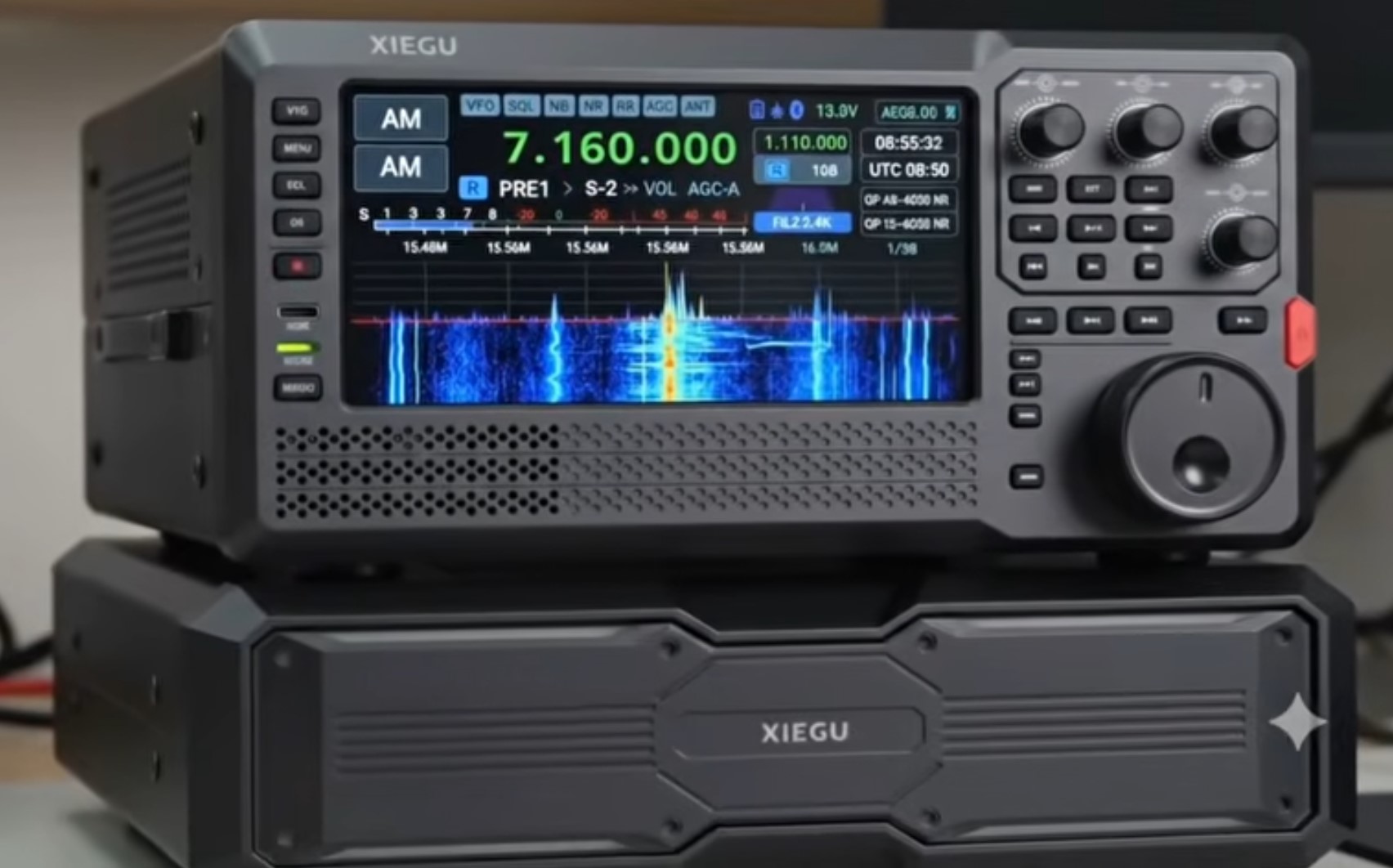
Spoločnosť Xiegu pripravuje uvedenie nového stolového KV/50 MHz SDR transceivera G7250. Ide o prvý model výrobcu, ktorý kombinuje výkon 100 W, architektúru Direct RF Sampling, a separate control unit and a high level of digital signal processing. The first published technical information indicates that this is not just a successor to the successful G90 or X6200 models, but a completely new design platform designed for both home and remote operation.
Na rozdiel od predchádzajúcich zariadení výrobcu je G7250 navrhnutý ako dvojdielny systém pozostávajúci z hlavnej RF jednotky a samostatného ovládacieho panela s dotykovým displejom. Takéto riešenie umožňuje flexibilnejšie usporiadanie pracoviska, jednoduchšiu montáž do vozidiel alebo vzdialené umiestnenie výkonovej jednotky v blízkosti anténneho systému. Podľa zverejnených informácií je možné obe časti prepojiť prostredníctvom ethernetového rozhrania až na vzdialenosť približne 100 metrov.
The manufacturer has not only switched to a more powerful power amplifier, but has also completely changed the architecture of both the receiver and transmitter. The entire device is built on the principle of direct RF Sampling (SDR), a concept also used in several modern professional SDR transceivers.
In the article you will read
Hlavné vlastnosti Xiegu G7250
Zo zverejnených materiálov vyplýva, že Xiegu G7250 pokrýva amatérske pásma od 160 m po 6 m. Frequency range prijímača je 0,5 až 30 MHz a 50 až 54 MHz. Podporované sú prevádzkové režimy SSB, CW, AM, NFM a digitálne módy. Maximálny vysielací výkon je udávaný ako 100 W na KV pásmach a 90 W na pásme 50 MHz pri napájaní jednosmerným napätím 9 až 15 V.
The most important innovations include a completely new architecture based on direct sampling of the high-frequency signal. The receiver uses multi-stage input bandpass filters together with high-quality inductors with a high quality factor (High-Q) and a two-stage low-noise preamplifier with a wide dynamic range. The aim of this concept is to minimize input losses, improve selectivity and at the same time increase immunity to strong out-of-band signals. The manufacturer states a sensitivity of 0.2 μV for SSB, CW and FM modes and a minimum detectable signal level (MDS) of −138 dBm.
Riadiaca jednotka je vybavená 7-palcovým kapacitným dotykovým displejom s vysokým rozlíšením. Ovládanie však nestojí výlučne na dotykovom rozhraní. Panel obsahuje kompletnú sadu fyzických tlačidiel, otočných ovládačov a hlavný ladiaci gombík, takže používateľ môže kombinovať klasické ovládanie s dotykovým rozhraním podľa aktuálneho spôsobu práce. Spektrálny analyzátor spolu s waterfall zobrazením umožňujú priebežné sledovanie obsadenosti pásma a rýchlu identifikáciu slabých signálov.
Digital signal processing includes adjustable digital filters, digital noise reduction (NR), noise blanker (NB) and noise threshold. Also included is a voice recorder with playback and memory for pre-programmed CW messages, which will be especially appreciated by contest operators or stations that regularly call CQ.
The manufacturer also lists support for network transmission of baseband signals. This is an interesting feature that allows you to transmit baseband data over a computer network and then process it with compatible SDR software. The HDSDR program is given as an example. This feature can be used for remote station operation, experimenting with digital modes, or for processing the received signal yourself.
Direct RF Sampling Architecture
Najväčšou konštrukčnou zmenou oproti starším zariadeniam Xiegu je použitie architektúry Direct RF Sampling. Na rozdiel od klasického superheterodynného prijímača alebo SDR s medzifrekvenčným vzorkovaním je vysokofrekvenčný signál po prechode vstupnými pásmovými filtrami digitalizovaný priamo vysokorýchlostným A/D prevodníkom. Tým odpadá potreba analógových zmiešavačov, lokálnych oscilátorov a medzifrekvenčných filtrov, ktoré boli po desaťročia základom väčšiny KV transceiverov.
The digitized signal is then processed by a field-programmable gate array (FPGA). Its task is to perform time-critical operations with high data throughput before the actual digital signal processing. The FPGA provides data transfer between the A/D converter and the DSP processor, performs digital decimation, data flow management and other operations requiring parallel processing of a large volume of samples.
The FPGA is followed by the DSP, a digital signal processor that performs demodulation of individual operating modes, digital filters, noise reduction, AGC, audio signal shaping, and other functions. The advantage of such a division of tasks is a more efficient use of hardware resources. The FPGA performs high-speed operations directly at the sample level, while the DSP solves algorithms operating at a significantly lower data rate.
Podobná architektúra sa v posledných rokoch objavuje vo viacerých moderných SDR transceiveroch vyššej triedy. Xiegu sa týmto modelom zaraďuje medzi výrobcov, ktorí využívajú plne digitálnu cestu spracovania vysokofrekvenčného signálu namiesto tradičného superheterodynného riešenia.
Receiver and transmitter architecture
One of the most interesting technical aspects of the G7250 is its internal architecture. The manufacturer has published a block diagram from which the design philosophy of the entire transceiver can be derived quite accurately. At first glance, it is clear that this is not a classic superheterodyne, but a modern SDR concept based on direct sampling of the high-frequency signal (Direct RF Sampling). The analog part remains only where it is necessary for processing RF power or protecting the receiver input, while most of the processing takes place in the digital domain.
Admission path
The receiver starts with an input bandpass filter (BPF). Its task is to limit the width of the received spectrum before digitization. In Direct RF Sampling systems, this part is much more important than in classic superheterodynes. The A/D converter samples the high-frequency signal directly, and any strong signal outside the desired band could reduce the effective dynamic range of the converter or create unwanted digitization products.
The manufacturer also mentions the use of multi-stage input filters, high-quality inductors with a high quality factor (High-Q) and a two-stage low-noise preamplifier with a large dynamic range. Such a solution should contribute to better receiver selectivity and higher immunity to strong neighboring signals. It is precisely the high-quality analog input that is one of the decisive elements of every modern SDR receiver.
The input filter is followed by a high-speed A/D converter. This is where the biggest change compared to classic HF transceivers occurs. Instead of an analog mixer and intermediate frequency filters, the high-frequency signal is digitized directly. From this point on, the entire received signal is represented by digital samples.
The digitized data then enters the FPGA field-programmable logic array. In the block diagram, the FPGA is placed between the A/D converter and the DSP processor, which corresponds to the architecture used in many professional SDR devices. The FPGA provides time-critical operations with high data throughput, such as data flow management, decimation, digital frequency shifts or other operations performed before the demodulation itself.
The FPGA is followed by the DSP digital signal processor. This part implements the actual demodulation of individual operating modes, digital filters, automatic gain control (AGC), noise reduction, Noise Blanker, Noise Threshold and other digital processing algorithms. The output of the DSP is no longer a high-frequency signal, but a digital audio signal ready for conversion to analog form.
The last stage of the receiver is the D/A converter, which creates an analog audio signal for the power audio amplifier and speaker. At the same time, the block diagram shows a separate branch going from the FPGA to the display unit. This indicates that the spectrum analyzer and waterfall use data processed before demodulation itself, which allows for smooth spectrum display without loading the main DSP processor.
Broadcast path
The transmitter is also designed as a predominantly digital system. The audio signal from the microphone is first digitized by an A/D converter. The DSP then performs all operations associated with modulation, signal shaping, equalization, compression, and generation of individual operating modes.
Výsledný digitálny signál prechádza opäť cez FPGA, ktoré zabezpečuje vysokorýchlostné spracovanie a prípravu dát pre D/A prevodník. Ten vytvára analógový vysokofrekvenčný signál určený pre ďalšie analógové stupne vysielača.
Next is the bandpass filter BPF, which suppresses unwanted products resulting from digital-to-analog conversion. After it, there is an ALC (Automatic Level Control) circuit, which controls the excitation level of the power amplifier and ensures stable transmission power without excessive distortion.
The PA power amplifier amplifies the signal to a nominal power of 100 W in the HF bands and 90 W in the 50 MHz band. At its output there is a low-pass filter (LPF), the task of which is to suppress higher harmonic components so that the transmitted signal meets the requirements for spectral purity. The manufacturer states a suppression of unwanted products of at least 55 dB, a suppression of the carrier of at least 40 dB and a suppression of the opposite sideband of at least 50 dB.
The last block of the transmitter is the integrated automatic antenna tuner (ATU). It is located after the power amplifier, so it operates at full transmission power. According to the manufacturer, it can match impedances in the range of 20 to 150 Ω, with the first tuning taking no more than ten seconds and retuning from memory less than 0.1 seconds. The tuner remembers the settings for individual bands, so when returning to a previously tuned frequency, the adjustment takes place almost immediately.
What does the block diagram reveal about the design?
Although the manufacturer has not yet disclosed the integrated circuits used or the specific types of A/D converters or FPGAs, the block diagram itself reveals that the G7250 belongs to the next generation of SDR transceivers. The analog part is limited to the input and output high-frequency circuits, while the crucial part of the processing takes place in the digital area. Such a solution makes it easier to implement new DSP algorithms through firmware updates, improve filters or add new functions without interfering with the hardware.

Another interesting detail is the separate processing of data for the display unit directly from the FPGA. This suggests that the spectrum analyzer will not be dependent on the performance of the DSP processor and can operate at a high refresh rate while simultaneously utilizing advanced DSP functions.
Celkovo bloková schéma naznačuje, že konštruktéri sa snažili oddeliť časovo kritické operácie spracovania RF signálu od algoritmov digitálneho spracovania audia. Ide o riešenie, ktoré sa dnes používa vo výkonnejších SDR platformách a predstavuje výrazný technologický krok oproti predchádzajúcim generáciám transceiverov Xiegu.
Technical parameters
| Parameters | Value |
| Architecture | Direct RF Sampling SDR |
| Frequency range | 0.5-30MHz, 50-54MHz |
| Bands | HF + 50 MHz |
| Operating modes | SSB, CW, AM, NFM, DIG |
| Minimum tuning step | 1Hz |
| Power supply | 9.0 - 15.0 V DC |
| Output power | 100W (HF), 90W (50MHz) |
| Receiver sensitivity | 0.2 μV (SSB/CW/FM), 2 μV (AM) |
| MDS | -138 dBm |
| Digital filters | adjustable DSP filters |
| Noise reduction | NR, NB, Noise Threshold |
| Spectrum and waterfall | yes |
| Touch screen | 7″ capacitive |
| Separate control unit | yes |
| Automatic antenna tuner | 20 – 150 Ω |
| First ATU tuning | ≤10s |
| Tuning from memory | ≤0.1s |
| Voice recorder | yes |
| CW Message Memory | yes |
| Network baseband streaming | yes |
| Recommended external speaker | Xiegu GY-10 |
The technical parameters are based on data published by the manufacturer and distributors at the time of the new model's announcement. The manufacturer also warns that these are pre-production parameters and may change before launch.
YouTube videos
The first videos show a pre-production prototype during testing, clearly showing the new user interface, waterfall display speed, touch response, and separate control unit.
https://www.youtube.com/watch?v=H2O4k-ZAb68
https://www.youtube.com/watch?v=gy5XcLu_Occ
The videos do not yet present more detailed laboratory measurements of the receiver or transmitter. Most of the demonstrations are focused on operating the device and introducing its main functions.
Evaluation from a radio amateur's perspective
Model G7250 predstavuje pre spoločnosť Xiegu významný technologický posun. Kým modely G90 alebo X6100 were primarily focused on compactness, low power consumption and portable operation, the G7250 is designed from the beginning as a full-fledged desktop transceiver with a power of 100 W.
The biggest change is not the transmitter performance itself, but the transition to Direct RF Sampling architecture. This concept dominates the higher class of SDR transceivers today and allows most functions to be implemented digitally. The result is a simpler signal path, fewer analog stages and more room for further development through firmware updates.
The use of an FPGA between the A/D converter and the DSP processor is also very interesting. Such a division of tasks allows parallel processing of high-speed data streams without burdening the main DSP processor. This is a solution that is commonly found in more powerful SDR platforms.
The separate control unit also deserves attention. The separation of the control panel from the RF part allows you to place the power unit near the antenna switches or power amplifiers, while the operator himself can work in another place. In addition, the manufacturer states the possibility of connecting both parts using an Ethernet interface at a distance of up to approximately 100 meters. Such a solution may be interesting for contest workplaces, remote stations and mobile installations.
The integrated automatic antenna tuner with tuning memory does not offer an extremely wide range of adjustment, but it corresponds to the concept of a transceiver intended primarily for operation with resonant amateur antennas. A big advantage is the very short re-tuning time from memory.
Support for network baseband signal transmission can also be considered interesting. If this feature is implemented to the extent indicated by the manufacturer, it can significantly simplify remote operation and integration with third-party SDR software.
It is still too early to make a definitive assessment of the reception parameters. Although the manufacturer provides receiver sensitivity, MDS, and basic data on the input chain, detailed laboratory measurements such as RMDR, BDR, IMD DR, reciprocal phase noise mixing, or measurements according to the Sherwood Engineering methodology are missing. It is these data that will show how the new transceiver will cope in heavily occupied contest bands.
Napriek tomu už dnes možno povedať, že G7250 predstavuje doteraz najambicióznejší amatérsky transceiver spoločnosti Xiegu. Ak sa výrobcovi podarí zachovať deklarované parametre aj vo finálnej sériovej verzii, pôjde o zariadenie, ktoré môže výrazne rozšíriť ponuku 100 W SDR transceiverov strednej triedy.
Conclusion
Xiegu G7250 prináša kombináciu modernej SDR architektúry, oddelenej riadiacej jednotky, výkonu 100 W a pokročilého digitálneho spracovania signálu. Zverejnená bloková schéma ukazuje premyslené rozdelenie úloh medzi analógovou a digitálnou časťou, pričom využitie FPGA naznačuje architektúru porovnateľnú s výrazne drahšími SDR transceivermi.
At the time of writing, this is still a pre-production model and the manufacturer warns that some parameters may still change. Therefore, a definitive assessment will only be made after the first independent measurements and the experience of radio amateurs in real operation.
Pekne popisane Vilko,
Jedinu poznamku si zasluzi len vyzdvihovanie unikatnosti a inovativnosti Xiegu G7250. Tato hardwerova koncepcia je uplne standardna vo vsetkych SDR transceiveroch od IC7300, posledne Yaesu, SUN SDR, Annan az Flexradio aj K4 od Elecraftu. Bude len zaujimave, ako sa to cele podari harverovo a softverovo odladit. Uz sa tesim na uspesneho konkurenta popularneho IC7300. Ked to dostane aj HDMI alebo DP, bude to aj pre nas slabsie vidiacich. Ale to by sa dalo riesit ja HD SDR softverom. Snad uz aj toto prispeje k modernizacii nasich hamshackov.
TNX Tibor! Xiegu od modelu X1M, ktorý prišiel v roku 2014, prefrčal X6100 a cez clopásmový HF + 6 m QRP transceiver s farebným displejom X5105 až k nedávnemu X6200 veľmi rýchlo. Rozdiely voči klasickým „hráčom“ ako IC-7300 určite budú.
Pozornosť by som upriamil na ovládateľnosť, ergonómiu a konektivitu. Takých 25 rokov dozadu sa nám o odolnosti, ktorú ponúkajú dnešné prijímače, len snívalo. Ale niekedy výrobca neodhadne, že dôležitý je pocit z ladiaceho gombíka. Alebo pripojenie spínania koncového stupňa (snáď 99% TCVR má CINH, len TS-2000, ktorú mám, je unikát). Pamätám aj na dobu CAT cez sériové COM porty a dnes už viaceré majú USB vrátane zabudovaného zvukového rozhrania….
Samozrejme je aj otázka softwarového odladenia. Napríklad je známe, že FT-991 má slabší panadaptér. Prekvapujú aj niektoré nastavenia modulácií, ktoré sú dosť zložité.
Životnosť a servis sú tiež body, ktoré pri výbere zavážia. Také xiegu.eu na stránke výslovne uvádzajú, že podporu poskytujú len zákazníkom, ktorí nakúpili u nich alebo u ich partnerských predajcov.
A potom je tu tradícia. Poznám veľa rádioamatérov, ktorí si navykli na produkty niektorej značky.
Xiegu je ale nový vietor a stojí za všimnutie.