
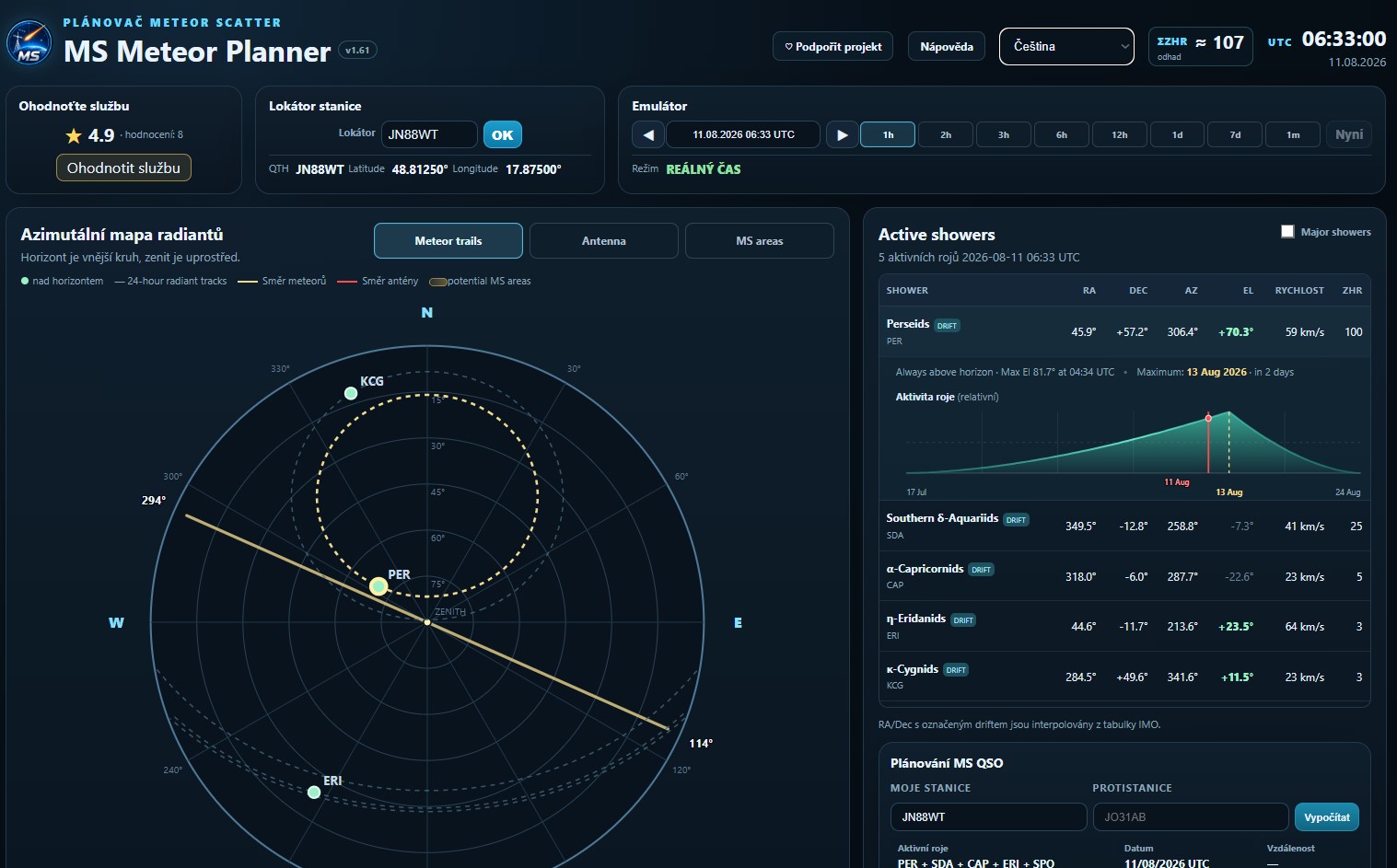
MS Meteor Planner od Nicka, US8AR, je bezplatný webový nástroj určený na plánovanie spojení prostredníctvom odrazu od meteorických stôp (meteor scatter, MS). The application runs directly in the browser at QSL.net/us8ar/ms as of the date of writing this article, it is in version 1.61. The interface is translated into twelve languages, including Czech, which makes it an accessible tool even for operators who do not know the English terms in the original MS tools by heart.
US8AR is also the author of the well-known KST Chat program, which extends the functionality of the ON4KST chat server for negotiating skeds on VHF bands. MS Planner follows the same community - the goal is to make it easier for the operator to estimate when and where to point the antenna when attempting an MS connection.
In the article you will read
How to get started quickly and easily in less than 30 seconds?
The basic work with the tool consists of three steps: entering the station's own locator, entering the locator or call sign of the opposing station, and reading the result from the output table. The interface displays a pair of locators directly in the header (for example, in the format KO60RR ↔ JO31AB), making it immediately clear between which two points the route geometry is calculated. After entering both locators, the tool automatically calculates the recommended azimuths, time windows, and intensity of expected meteor activity, without the need for further settings.
Interface
The top bar of the interface contains a language selection (twelve language mutations including Czech) and a time slider in UTC with step buttons ◀ 1h, 2h, 3h ▶, which allows you to quickly move the displayed time forward or backward without having to manually rewrite the date and time. Below the main panel is a table of radiants of active meteor showers and then an area with the locators of your own and target stations, from which the output planning table is generated.
Station locator
The position entry is done in the form of a Maidenhead locator (QTH locator) used in amateur radio practice all over the world. The tool works with a pair of locators simultaneously – the own station and the target station – which is visible directly in the header of the output section in the format of two locators separated by a two-way arrow symbol. This pair of locators is the input for all subsequent calculations of route geometry, azimuths and time recommendations.
Meteor shower table

Tabuľka radiantov zobrazuje aktívne meteorické roje označené skratkami ich medzinárodných kódov, napríklad PER (Perzeidy), GEM (Geminidy), QUA (Kvadrantidy) a LYR (Lyridy). Ku každému roju tabuľka priraďuje Azimut (Az) and elevation angle (El) of the radiant, as well as the ZHR value (Zenithal Hourly Rate - the statistically expected number of meteors per hour under ideal conditions) and information about the peak of the shower activity (Peak). These four generally known meteor showers have long been among the strongest and most reliable for MS operation - the Quadrantids in early January, the Lyrids in April, Perseids in August and the Geminids in December, with the exact peak dates varying slightly from year to year and the tool likely recalculating them dynamically based on the current date.
Azimuthal map

The planner also includes an azimuth display that visually shows the operator the direction in which the antenna should be pointed relative to the radiant and target station. Such a display is common in MS instruments precisely because the success of the reflection depends on the geometric relationship between the antenna, meteor trail and counterstation - the antenna does not have to be pointed directly at the radiant, but to the area where the probability of a useful reflection is highest.
Directions and MS zones
Pri meteor scatter prevádzke sa okolie trasy medzi dvomi stanicami zvykne deliť na takzvané zóny alebo koridory optimálneho nasmerovania antény, keďže odraz nevzniká priamo na spojnici dvoch bodov, ale v oblasti meteorickej stopy medzi nimi. MS Planner US8AR pracuje s konceptom smerov a zón v kontexte odporúčaného azimutu pre danú dvojicu staníc a daný čas, čo operátorovi šetrí manuálny výpočet, ktorý by inak vyžadoval samostatnú prácu s mapou veľkého kruhu a polohou radiantu.
Time emulator
The time emulator allows you to move the displayed UTC time forward or backward using buttons in steps of 1, 2 or 3 hours. Thanks to this, the operator can simulate in advance how the recommended azimuths, radiant elevations and meteor activity intensity will change throughout the day, and thus plan a sked for a specific hour without having to have the application open at the exact time.
MS QSO Planner

The output of the whole process is a planning table, which for a given pair of locators displays the summary value of ΣZHR (the sum of expected meteor activity from all relevant showers), the time period (Period), the specific time (Time), as well as the recommended azimuth (Az) and elevation (El) for the given combination of stations. This table is the core of the tool - it allows the operator to compare multiple time windows and choose the one with the highest probability of a successful connection.
Model limitations and how to understand recommendations
As with any radio propagation prediction model, MS Planner outputs should be understood as a statistical estimate, not a guarantee of a connection. Meteor activity is a random phenomenon and the actual number and intensity of reflections in a given hour may differ significantly from the model average. The recommended azimuth is based on the radiant geometry and the position of both stations, but the actual success of the connection also depends on the power, antenna type, noise background on the given band and the current ionospheric situation, which the tool does not directly model. The recommendations therefore serve as a guideline for planning a sked, not as an accurate prediction of a specific connection.
Frequently asked questions
Operators who are new to the tool most often ask about the correct format for entering the locator (six-digit Maidenhead locator for more accurate results), the meaning of meteor shower abbreviations in the radiant table, and how to interpret the recommended azimuth relative to the direction the station's antenna is actually pointed. A detailed explanation of individual interface elements is available directly in the tool's help section on the website. qsl.net/us8ar/ms/help, where it is also possible to switch to the Czech language interface.
Conclusion
MS Meteor Planner US8AR je praktický, voľne dostupný pomocník pre každého, kto sa venuje meteor scatter prevádzke na VHF pásmach. Kombinácia tabuľky aktívnych meteorických rojov, lokátorového vstupu, azimutálneho zobrazenia a časového emulátora umožňuje rýchlo naplánovať sked bez nutnosti manuálne počítať geometriu trasy. Nástroj je dostupný priamo v prehliadači na qsl.net/us8ar/ms, vrátane slovenskej jazykovej mutácie.