
Metropwr SAS is an Italian company based in Grumo Appula near Bari in Apulia and is run by radio amateur Antonio Ferrulli, IZ7LDG. The Metropwr portfolio has expanded over the years from stand-alone SWR/wattmeters to a complete system including RF power measurement and matching, antenna switch control, rotator control and remote management of linear amplifiers - all connected via a common bus, USB and LAN.
You will read in the article
Separate sensors and consoles
The key architectural principle of Metropwr devices is the physical separation of the measurement sensor (directional coupling member) from the display console. The sensor is installed directly in the coaxial path between the transmitter and the antenna, while the console can be placed on the operator's desk up to 5 m from the sensor. This approach minimizes the length of the RF line between the transmitter and the antenna, while eliminating the effect of the RF field on the display and control electronics.
The current offer includes two sensors for KV and 6 m: Z3 with permanent load up to 3 kW PEP (€249) and Z5 for 5 kW (€269). Both are equipped with SO-239 connectors on the RF route and an SMA connector for the measurement output. Directional selectivity (directivity) is given as 30 dB, which is a value sufficient for most PSV measurements in normal operation, but at a very low PSV (below 1.2) it can already cause a deviation. The sensors are backward compatible with the older FX775 and FX773 consoles, but also with the new FX778. Two sensors can be connected to one console simultaneously and switched between them - practical in stations with multiple output branches (for example HF and 6m).
FX778 and FX774 – current models
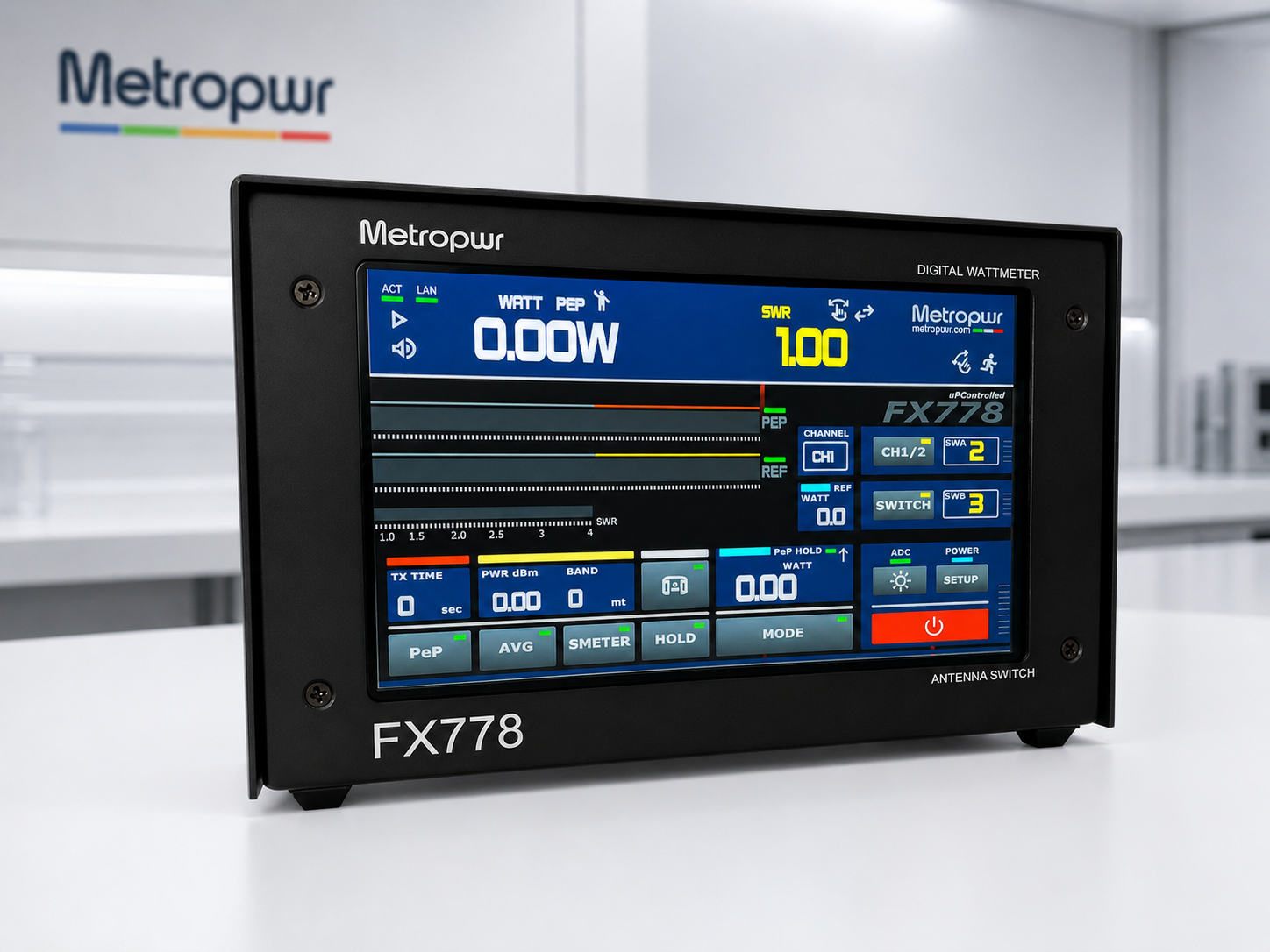
The flagship products of the line are currently the consoles FX778 (7-inch touchscreen) a FX774 (5-palcový displej). Firmvér oboch modelov je identický, rozdiel je iba vo veľkosti obrazovky. Frekvenčný rozsah pokrýva 1,8 až 60 MHz s integrovaným čítačom frekvencie. Výkon sa zobrazuje v režimoch AVG (priemerný), PEP (peak), reflected and in dBm with autoranging up to 5.5 kW. The accuracy of power measurement is stated at the level of 5%, PSV error below 5%.
The console is built on a 32-bit processor with a 16-bit ADC and provides 11-band calibration for each of the two RF channels (CH1/CH2). There are high PSV alarms (2.0 / 3.0 / 5.0 thresholds), SWA/SWB antenna switch status display and analog VU power display for operators who prefer a classic visual style.
Important change compared to older models: the current FX778 firmware does not support vector impedance measurement (R, Z, X). This feature was present in the FX775 and FX773 (now discontinued) but has been removed in the new line. The FX778 thus measures exclusively the power and PSV from the directional coupler. For operators who need impedance measurements on a coax path at full power, this can be a deciding factor in their choice.
FX778 comes in two versions: basic with USB connection (€649 with Z3 sensor) and FX778N version with integrated LAN interface (€699 with Z3). For the basic model, LAN is available as an additional ZLan card, which can be installed internally. The supply voltage is 9-13.8 V DC.
Discontinued models
Metropwr gradually phased out the FX775 (7″ display), FX773 (5″ display), FX771, FX1, FXMASTER and FX743 models. From the point of view of functionality, the most significant change is the loss of vector measurement - FX775 and FX773 provided R, Z and |X| (absolute value of reactance, without distinguishing capacitive and inductive components) directly at full transmission power up to 3 or 5 kW. Distributor PileupDX lists the FX775 as having a power measurement accuracy of 5% and PSV below 5%, a frequency range of 1.8-54MHz, a weight of 500g and dimensions of 205x110x105mm. Some distributors (for example Wimo) still offer the FX775 MKII with an added LAN interface for €729.
A separate branch was the MetroVNA product line – a pocket-sized vector network analyzer with a range of up to 250 MHz, intended primarily for measuring antennas and filters at low powers. MetroVNA is not directly related to the FX series wattmeters, although it is a product of the same company.
RT1 – rotator touch controller

The RT1 (€499) is a stand-alone console with a 7-inch touchscreen, designed to control the Yaesu G800DXA, G1000DXA and G2800DXA DC rotators. A map with the current azimuth is displayed on the screen in real time. the operator can set the target direction by touching the map, use the CW/CCW buttons, the rotary encoder or the PARK function to automatically return to the default position. The start of the motor is controlled by a ramp, which reduces mechanical stress during rotation.
RT1 podporuje ukladanie obľúbených smerov a je pripojiteľný cez LAN a USB-C. Up to four clients can connect simultaneously - the operator on the touch console and remote users via PC software or iOS application. Integration with PSTrotator expands the possibilities of automatic tracking. A key added value of the RT1 is that it can also control two ZX7 antenna switches (1×4), thus centralizing both routing and antenna selection control in one place.
SP1 and RT2 - remote management of the amplifier and rotator
SP1 is a compact board (PCBA) designed for remote control of SPE Expert 1.5K, 1.3K and 2K linear amplifiers via LAN or Internet. It allows you to remotely turn the amplifier on and off, view its display on a PC and manage two ZX7 switches. The Windows application has been rewritten for compatibility with Windows 11. In combination with SP1, the Remote Expert package costs €299. For a station with an unattended amplifier at a remote site, the SP1 is a practical solution - the amplifier can be monitored and controlled from anywhere.
The RT2 (€299 in the Remote Rotor package) is a simplified version of the RT1 without its own display – it's a PCBA with a LAN and USB-C port that connects to the rotator controller via a mini-DIN connector. It supports the same Yaesu rotators and GS-232B protocol. It allows the connection of two ZX7 switches and four simultaneous clients. RT2 is suitable for operators who prefer to control exclusively from a PC without the need for a separate console.
Software and connectivity
All current Metropwr devices support connection via USB, most also via LAN. Wi-Fi is not offered - connection is handled exclusively by cable (Ethernet or USB). Metropwr software for Windows and macOS displays the measured values on the computer screen and enables device configuration. The firmware is updated via USB directly from the computer. In addition, RT1 works with PSTrotator and SDR applications, allowing integration into automated stations.
All devices share a common EXP bus, through which Z3/Z5 sensors, ZX7 antenna switches and other accessories are connected to a single console. The maximum length of the line is 5 m - for most installations in a shack, this is sufficient, but for remote sites with a separate antenna field, it is necessary to solve the extension via a LAN connection.
Reviews in the professional press
On the Metropwr website, they are in the section Reviews k dispozícii recenzie z renomovaných časopisov Funkamateur (Nemecko), CQ-DL (Nemecko), RadCom (Veľká Británia), Świat Radio (Poľsko) a QTC (Sweden). However, these reviews are for the MetroVNA pocket vector analyzer only, not the FX series wattmeters or the RT1 or SP1 control units.
Reviewer DM2CMB at Funkamateur called the MetroVNA a "Swiss Army Knife for the RF technician" with accurate KV level measurement and only 1dB deviation at 145MHz. RadCom praised the display's refresh rate (ten frames per second) and the versatility of the ten measurement modes, but criticized the incomplete English documentation and the lack of reactance sign resolution. Świat Radio compared the MetroVNA measurement results with the professional Anritsu Site Master analyzer and found that the results were "not significantly different" - with an accuracy of ±1 dB and a fraction of the cost of a professional instrument. QTC Sweden highlighted the compact metal case and Bluetooth connectivity with Android.
Independent measured reviews of the FX778, FX774 wattmeters or the RT1 and SP1 control units are missing from the available sources. For the potential buyer, this means that verified data on the accuracy of the FX778 + Z3/Z5 measurement chain at different powers and frequencies is not yet publicly available from a third party.
Practical deployment and integration
The Metropwr system is designed in a modular way. The simplest setup for a regular station is the FX778 console with a Z3 sensor – a compact Wattmeter with a large touch screen for €649. For a contest station with multiple antennas and a rotator, an extension with a ZX7 switch (€249) and an RT1 (€499) is offered, creating a centralized workplace with routing control, antenna selection and performance monitoring from one place. For the remote station, SP1 is added to control the amplifier and RT2 to control the rotator via LAN.
The total cost of a fully equipped set (FX778N + Z3 + RT1 + ZX7 + SP1) exceeds €1,700, which is comparable to alternatives (for example, a combination of LP-100A or Station Genius for power measurement, Green Heron RT-21 for rotator control and a separate antenna switch), but the advantage of Metropwr is a unified ecosystem with a single software environment. The trade-off is that the system is tied to proprietary sensors and switches—the ZX7 is a four-position switch, requiring two units to be cascaded for a station with more than four antennas.
It is also worth paying attention to what the system does not offer: lack of Wi-Fi connectivity (only cable), vector impedance measurement in current models and support for rotators from manufacturers other than Yaesu. The planned UB1 module for controlling Ultrabeam antennas via Raspberry Pi is still in "Coming soon" status. For operators with Hy-Gain, Prosistel or Create rotators, the RT1 is therefore unusable without modifications or a converter to the Yaesu protocol.