
Why MMANA-GAL Basic in 2025?For radio amateurs who deal with antennas, this is an excellent free tool for modeling antennas. It is characterized by sufficient accuracy for amateur radio purposes and very good clarity, including possible translations. Lower accuracy is not a complication because we still make the antenna in a real environment. We do not know the exact conductivity of the ground or see the inhomogeneity of the electromagnetic field. Simulating antennas with a program like MMANA-GAL Basic is therefore a tool - but a very useful one. And that's why we return to it todayreturn.
The basic version was developed by DL1PBD and DL2KQ, with the computational core itself based on the modified MININEC-3 mutation by Alexandre Schewelew.
Compared to the PRO version (commercial), Basic has limitations on the number of wires, segments, and other parameters. The core is written in C++ and optimized to allow relatively accurate calculations, even though it is a stripped-down, simpler version compared to PRO.
You can read in the article
Basic limitations and parameters of MMANA-GAL Basic
Vo verzii Basic these parameters are limited:
- maximum number of segments: 8192
- maximum number of wires: 512
Tieto limity sú výrazne nižšie než v PRO verzii, ktorá podporuje tisícky drôtov a segmentov, ale pre bežné antény (yagi, dipóly, Multiband) sú postačujúce.
User interface and control

The program offers graphical and tabular user interface. The definition of the antenna, editing of wires, sources, and loads is done directly in tabular form, resembling working in Excel - the user enters values into cells and presses Enter.
The current antenna view is possible in a 3D view: by rotating the model with the mouse along the axes, you can visualize the geometry from different angles, zoom in, or select a specific wire.
Calculations and antenna analysis

After defining the antenna, the program allows the initiation of calculations, which include calculating the impedance at the feed point, SWR, gains, F/B ratio, and other characteristics. The results can be displayed through various graphs: impedance curves, SWR, gain vs. direction, F/B ratio.
The program also provides the option to optimize antenna parameters. Users can define variables (e.g., wire lengths, distances between elements) and let the program search for optimal values that minimize SWR or maximize gain.
Wire and Element Editor
Vo verzii Basic je k dispozícii Wire Editor, where the geometry of the antenna can be modified - add new wires, change their parameters (length, position, radius), define segmentation. In addition, it is available Element Editor, ktorý umožňuje detailne nastaviť zdroje (napr. napájací bod), záťaže (napr. kondenzátory, cievky) či pulzy.
This editor allows simulation modeling of various passive or active components; the program includes tools for LC matching, Q-match, and other commonly used techniques.
Antenna radiation and far-field analysis
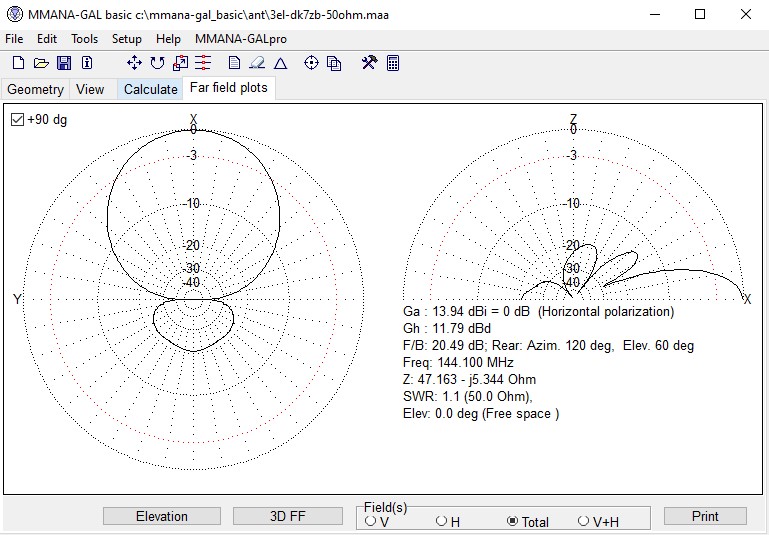
Basic verzia umožňuje generovať grafy vzdialeného poľa (far-field) antény, display gain characteristics in 2D (e.g. in elevation or azimuth plane) and calculate basic parameters such as front-back (F/B).
Treba poznamenať, že v Basic verzii sú kroky pre 3D výpočty zafixované na 5°, which limits the display resolution compared to the PRO version, which allows finer steps.

Additional tools and useful functions
MMANA-GAL Basic poskytuje aj nástroje pre vysokofrekvenčné komponenty - after calculation, it is possible to add coils, capacitors, or linear components such as transmission lines, and simulate their impact on antenna impedance and tuning.
Program tiež podporuje zápis prúdového rozloženia to CSV files, so users can analyze currents on wires and export them for further analysis or visualization.
Files and project management
Modely antén sú ukladané vo formáte .maa – common for MMANA-GAL. The Basic version can open files created in the PRO version, but only if they use wires and segments within the limits of the Basic version.
For ease of use, geometric data, heights above ground level (ASL), or source and load parameters can be edited directly in the application.
Installation and localization
The program installation is relatively simple: after downloading the ZIP file from the official GAL-ANA Basic version, the installer can be run. Some accompanying materials recommend running the installation with administrator rights to properly set language files and configurations.
MMANA-GAL Basic supports multiple languages - including English, German, and Czech. The language can be changed in the settings by editing the file mmnlanguage.txt, which is located in the 'Language' tab of the installation folder.

Advantages and limitations of MMANA-GAL Basic
Advantages
- Free for non-commercial and amateur use; ideal for radio amateurs, students, and experimenters.
- Powerful enough for common antennas (dipoles, Yagis, multi-element antennas).
- Intuitive user interface with 3D visualization and detailed editing capabilities.
- Support for complex components and simulation of tuning and matching elements (LC, Q-match, feedlines).
Limitations
- Limited number of segments and wires (8192 segments, 512 wires) compared to the PRO version.
- Fixed step of 5° for 3D calculations reduces the accuracy of radiation visualization.
- Inability to merge multiple models (as allowed by the PRO version).
- Compared to the PRO version, the function of unlimited undo/redo and advanced error checking in the model is missing.
Updates and development of MMANA-GAL
Vývojári pravidelne vydávajú aktualizácie; v verzii 3.0.0.31 for example, file formats were unified between Basic and PRO versions, accelerated writing of current data in CSV format, and improved remote field printing options.
It is recommended to regularly check the official GAL-ANA website for a new version, as errors may be fixed or minor features added to improve usability and simulation accuracy. The current version is 3.5.3.82.
Conclusion
MMANA-GAL Basic represents a robust, reliable, and affordable tool for modeling antennas using the moment method. For radio amateurs, students, and experimenters, it is an ideal gateway to the world of antenna design without the need to invest in expensive professional tools. Despite limitations, the Basic version covers all key needs of wire antenna simulation and offers extensive analysis, optimization, and visualization options - making it an indispensable tool in many projects or research activities.