
Momobeam je taliansky výrobca antén so sídlom v meste Marsala na Sicílii, ktorého v roku 2011 založil rádioamatér Giuseppe Spanò, IT9HBT. The idea for the company was based on the founder's practical experience - the windy Mediterranean coast, high humidity and salty air represent extremely challenging conditions for long-term operation of antennas. Therefore, the structures had to be not only electrically efficient, but above all mechanically reliable and resistant to corrosion. It was this approach that became the basis of the Momobeam brand philosophy.
Today, the manufacturer's portfolio includes more than 80 products divided into several categories - monoband yagi, multiband yagi, wire antennas, antennas for WARC bands, antennas for 50 MHz and higher frequencies, RF chokes (Common mode) and baluns. The products are available through direct sales on the Momobeam website, but also through major amateur radio dealers, including DX Engineering (USA), WiMo (Germany), Martin Lynch & Sons (UK), as well as distributors in Italy, Austria, Spain and China.
In the article you will read
Why Momobeam antennas?

Momobeam's design philosophy is based on maximum simplicity and reliability. The manufacturer tries to avoid traps, switching relays and other moving mechanical parts wherever technically possible. Most models use full-size elements without shortening coils. Only where the antenna dimensions require a compromise - for example, in the MONO2 40T model - are capacitive hats used to shorten the elements.
This approach provides low electrical losses, high efficiency, a wide operating bandwidth with favorable SWR values, and very good long-term reliability. Each antenna uses a Current Balun located directly at the feed point, which effectively suppresses common mode currents on the coaxial cable sheath.
The antenna construction uses aluminum tubes, UV stabilized insulators made of POM-C material, high-quality plastic elements made of polypropylene and robust fasteners. Each antenna is supplied with complete mounting material, spare parts and clearly marked bags with individual components, which greatly facilitates assembly even for less experienced users.
A significant recognition of the manufacturer's technical level is the cooperation with the ARRL organization. Within its framework, the antenna was created ARRL Dual-band Momobeam 6/10, which the ARRL offers through its ARRL Store. The product's inclusion in the offering of the largest amateur radio organization in the world represents significant international recognition of the quality of Momobeam's design.
What makes Momobeam different from the competition?
There are several reputable manufacturers operating on the amateur radio antenna market, with a significant portion of multiband designs using traps, switching relays or other active elements enabling switching of individual bands. Momobeam has chosen a different philosophy. Most of its antennas use full-size elements without traps and without switching relays, with individual bands being addressed by a suitable combination of mutually cooperating radiators and directors.
The result is a simpler electrical and mechanical design, lower losses, high reliability and minimal maintenance requirements over many years of operation. Fewer parts also mean fewer potential failures, which will be especially appreciated by radio amateurs operating antennas on high masts or in locations with challenging climatic conditions.
Another characteristic feature of Momobeam antennas is a favorable ratio between mechanical dimensions, weight and achieved electrical parameters. Thanks to this, they are suitable not only for large contest stations, but also for radio amateurs using smaller masts or lighter rotators. Several models are also available in versions with separate feeders (Separate Feed or Dual Feed), which are intended primarily for demanding contest operation of the SO2R type.
Monoband antennas
Monoband antennas represent one of the most extensive parts of the Momobeam production program. The basis is the MONO series, where the number in the name indicates the number of antenna elements. The range includes models MONO2, MONO3, MONO4, MONO5, MONO6 and MONO7 for various rádioamatérske pásma.
The manufacturer offers monoband yagis for the 10 m, 15 m, 17 m, 20 m, 30 m and 40 m bands. The largest model is the MONO6 20 – a six-element full-size yagi for the 20 meter band. At the opposite end of the range is the MONO3 40 FS – a three-element full-size antenna for the 40 m band, which is among the most mechanically demanding designs in the entire range.
A significant part of the portfolio consists of antennas for the 50 MHz band. The models available are MONO3 6 portable, MONO4 6, MONO5 6, MONO5 6HD, MONO6 6, MONO6 6HD and MONO7 6. The portable version of MONO3 6 Portable is intended primarily for POTA, SOTA and other field activities, while the HD (Heavy Duty) variants are designed for long-term operation in areas with higher mechanical loads due to wind or ice.
For the 40m band, the manufacturer also offers the MONO2 40T model – a two-element T-yagi using capacitive hats to shorten the reflector. This solution allows for a reduction in the physical dimensions of the antenna while maintaining favorable electrical properties.
The monoband range is complemented by vertical antennas and a separate category of dipoles, represented by the 2UB 5060 DIP model designed for multiple bands.
Momobeam antennas in practice – assembly overview
The following video from the Dayton exhibition Hamvention 2025 presents the complete range of Momobeam. An interview with a company representative introduces individual product lines, design solutions and the latest models included in the offer.
Multiband antennas

A significant part of the production program is made up of multiband antennas. Momobeam divides them into four basic categories according to the number of bands covered – Dual-band Yagi, Tri-band Yagi, Four-band Yagi and Five-band Yagi. The offer includes combinations covering the classic contest bands 10, 15 and 20 m, four-band sets supplemented by 40 m, and antennas covering WARC bands.
The basis of the two-band series is formed by DUO series. Models are available for 10/15 m, 15/20 m, 12/17 m, 6/10 m and 30/40 m band combinations. The number in the designation (for example DUO4, DUO7 or DUO12) indicates the total number of antenna elements. The DUO12 6/10 model is a twelve-element dual-band yagi for the 50 and 28 MHz bands.
It is designed for three bands series THREE, which covers the classic combination of 10, 15 and 20 m. The TRI7, TRI9, TRI12 and TRI15 models differ in the number of elements, the achieved gain and mechanical dimensions. They all use a single feeder (Single Feed).
Quad-band antennas represent TETRA series for the 10, 15, 20 and 40 m bands. The TETRA14 model is available in a Separate Feed variant, while the more powerful TETRA15 and TETRA18 models are offered in a Dual Feed version.

The highest category is represented by model PENTA10 10/12/15/17/20, which covers five amateur radio bands using a single antenna without the use of traps or switching relays. It is a full-size design designed primarily for DX operation and contesting.
| Model | Bands | Number of elements | Power supply |
|---|---|---|---|
| DUO7 6/10 | 6m, 10m | 7 | Single Feed |
| DUO12 6/10 | 6m, 10m | 12 | Single Feed |
| TUESDAY 10/15/20 | 10m, 15m, 20m | 7 | Single Feed |
| TUESDAY 10/15/20 | 10m, 15m, 20m | 9 | Single Feed |
| TUESDAY 12 10/15/20 | 10m, 15m, 20m | 12 | Single Feed |
| TETRA14 10/15/20/40 | 10m, 15m, 20m, 40m | 14 | Separate Feed |
| TETRA18 10/15/20/40 | 10m, 15m, 20m, 40m | 18 | Dual Feed |
| PENTA10 10/12/15/17/20 | 10m, 12m, 15m, 17m, 20m | 10 | Single Feed |
Antennas for 50 MHz and higher bands
The 50 MHz band is one of the areas that Momobeam pays special attention to. The range includes antennas from the portable MONO3 6 Portable model to the seven-element MONO7 6 antenna. The user can choose between lightweight antennas suitable for field activations POTA or SOTA and more robust models designed for permanent installation.
For more demanding climatic conditions, the manufacturer offers the MONO5 6HD and MONO6 6HD (Heavy Duty) models, which use a reinforced mechanical construction suitable for areas with higher wind or ice loads.
In the dual-band antenna category, there are the DUO7 6/10 and DUO12 6/10 models, which combine the 50 MHz and 28 MHz bands in one design. Thanks to the common power supply, they represent an interesting solution for radio amateurs who regularly use both bands.
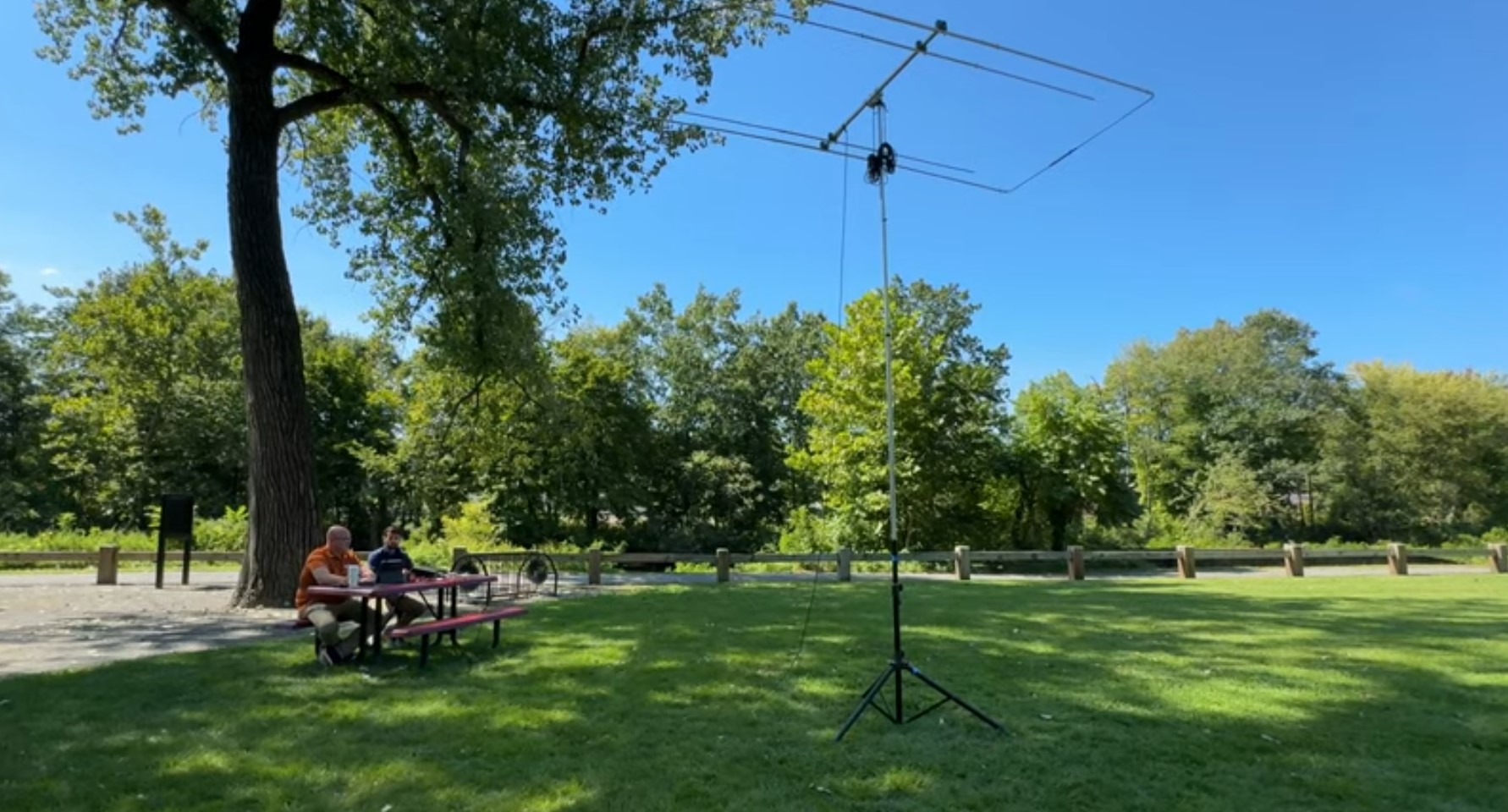
A special place in the offer is occupied by the ARRL Dual-band Momobeam 6/10 antenna, developed in cooperation with the ARRL organization. The design combines a Moxon rectangle for the 10 m band with a three-element Yagi for the 6 m band. A characteristic feature is the Open Sleeve power supply system, in which the 50 MHz band radiator is excited by electromagnetic coupling without direct galvanic connection to the 28 MHz section power supply. The antenna weighs approximately 4.5 kg and its turning radius is approximately two meters, which makes it suitable even for smaller masts or portable DX expeditions.
ARRL Momobeam 6/10 – demonstration of POTA assembly and operation
The following video captures the Parks on the Air (POTA) program activation, during which W1AW station operators demonstrate hands-on experience with the ARRL Dual-band Momobeam 6/10 antenna, including field installation and operation.
Antennas with separate feeders (Separate Feed and Dual Feed)
Momobeam uses three basic methods of antenna power supply. Single Feed models use one common power supply for all bands. Separate Feed (SF) variants have separate coaxial inputs for each band, while the manufacturer uses the designation Dual Feed (DF) for models that allow independent power supply of multiple band sections.
Separate power supplies significantly reduce the mutual influence of individual bands at the power supply point and at the same time allow the operation of two transceivers or two power amplifiers on one antenna. Such a solution is extremely interesting especially for contest stations using SO2R (Single Operator Two Radios) operation.
This category includes the models TRI7 10/15/20 SF, TRI9 10/15/20 SF, TRI12 10/15/20 SF, DUO8 15/20 SF, DUO11 10/15 SF, DUO5 30/40T SF, TETRA14 10/15/20/40 SF, TETRA15 10/15/20/40 DF and TETRA18 10/15/20/40 DF. An especially interesting solution is the DUO5 30/40T SF, which combines the 30 and 40 ms bands with separate power supply for both bands.
Antennas for WARC bands
WARC bands – 30m (10.1MHz), 17m (18.068MHz) and 12m (24.89MHz) – form a significant part of Momobeam’s portfolio. The manufacturer offers both stand-alone monoband antennas and multiband solutions designed specifically for these frequencies.
The 17m band is covered by the MONO3 17 and MONO4 17 models. The 30m band is covered by the two-element full-size antenna MONO2 30 FS. The combination of the 12 and 17m bands is represented by the DUO4 12/17, DUO7 12/17 and DUO9 12/17 models with different numbers of elements depending on the desired gain.
For radio amateurs requiring coverage of all three WARC bands, the TRI9 12/17/30 antenna is designed. The DUO5 30/40T SF model also combines the 30 m band with the 40 m band and is an antenna with separate power supplies.
The range is also complemented by wire antennas from the Endfed 12–30 series, available in power options of 100 W, 300 W and 1 kW.
RF Choke, baluns and other products
In addition to antennas, Momobeam also offers a wide range of RF Choke – common mode chokes – and baluns designed for both power and common amateur applications.
The manufacturer distinguishes two basic groups. Classic RF Chokes are designed to be mounted directly at the antenna feed point, while the RF Choke Line Isolator is installed on the coaxial line route or near the transceiver. Power versions cover the range from 1 kW to 10 kW PEP in the band of approximately 3 to 50 MHz or 7 to 50 MHz depending on the specific model.
Up to approximately 6 kW, SO-239 connectors are used, the most powerful models use professional 7/16 DIN connectors. For mounting RF chokes on the antenna beam (boom), RFC-SUP mounting kits are available for round and square booms of various sizes.
A separate product category is wire antennas. The range includes approximately twelve EndFed models for the 10–40 m and 10–80 m bands. Variants marked with the letter C extend the basic range to include the 12 m and 17 m bands. The latest EndFed 12–30 models designed for the WARC bands were added to the manufacturer's offer in 2026.
Practical tip when choosing a Momobeam antenna
When ordering an antenna, it is advisable to pay attention to the designation of a specific version. Momobeam uses the suffixes 1Bal, 2Bal or the designations of the versions Separate Feed and Dual Feed according to the power supply method and the number of integrated current baluns.
Before ordering, it is worth checking whether the delivery includes an integrated RF Choke, or which power variant is most suitable for the planned operation. At outputs of several kilowatts, a properly sized common mode choke can significantly limit unwanted RF currents on the coaxial line, reduce the risk of interference with electronics in the shack, and at the same time maintain the optimal radiation pattern of the antenna.
Summary
Momobeam is among the manufacturers that have embarked on their own design path. Instead of complex switching systems and traps, they rely primarily on full-size elements, simple mechanics, current baluns, and a robust construction designed for long-term operation in harsh climatic conditions.
The portfolio of more than 80 products covers practically the entire spectrum of amateur radio needs - from simple monoband antennas to multiband contest Yagis to specialized antennas for WARC bands, 50 MHz or SO2R operation. The offer is complemented by high-quality RF common mode chokes, baluns and wire antennas suitable for radio amateurs with limited space.
Thanks to the emphasis on simple construction, low electrical losses, high reliability and a favorable ratio between weight and achieved parameters, Momobeam antennas represent an interesting choice not only for DX expeditions and contest stations, but also for everyday amateur radio operations. The products can be ordered directly from the manufacturer or through authorized dealers, including DX Engineering in the USA or WiMo in Germany.