
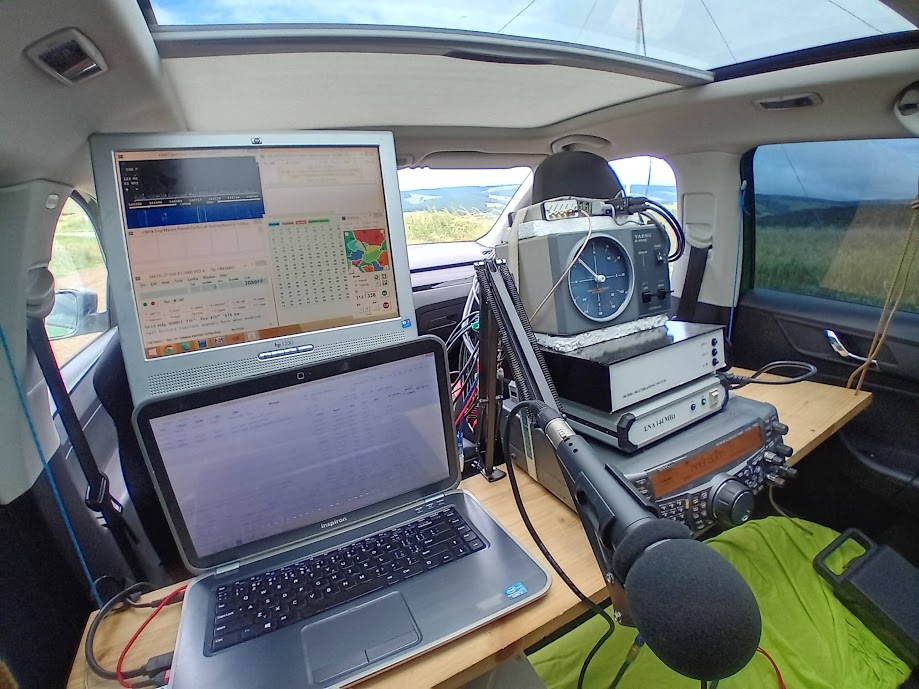
A modern contest station is no longer just a transmitter, antenna and power stage. Automatic switching of antennas, transverters, filters or routing is increasingly being used. PTT signálov. Jedným z najjednoduchších spôsobov, ako takúto automatizáciu realizovať, je využitie protokolu OTRSP and the K7MDL decoder.
Project OTRSP Band Decoder by K7MDL allows you to use a cheap Arduino module to decode AUX messages from contest programs such as N1MM+ alebo Logger32, a prevádzať ich na logické výstupy vhodné na ovládanie externých zariadení.
In the article you will read
What is OTRSP?
OTRSP (Open Two Radio Switching Protocol) is a serial communication protocol designed to control contest devices. It was originally created for SO2R systémy, no jeho využitie je podstatne širšie.
The contest program sends information about the current band, PTT status, or other operating parameters via the serial port. The decoder then converts the received data into logic outputs that can control relays, switches, or other devices.
What can the OTRSP decoder K7MDL be used for?

There are a large number of possible uses. The most common is the automation of tasks that the operator would otherwise have to perform manually.
Switching transverters is very practical. If the operator changes the band, for example, from 432 MHz to 1296 MHz, the OTRSP decoder automatically activates the correct transverter including power supply, PTT line and the corresponding RF path.
Another use is a band decoder for the output stage. When changing the band, the decoder can switch low-pass filters or other power amplifier circuits. Not every device has a band output (such as a BCD) that would be usable in this way.

Antenna switching is also very interesting. N1MM+ allows you to define tables that can automatically switch to the correct antenna for a specific band. The program can even switch antennas based on the azimuth of the opposing station or the contest configuration.
Operating principle

The K7MDL program receives AUX messages from the contest software via the USB serial interface. These messages contain a BCD value representing the selected state or band.
The Arduino then decodes the received message and sets the appropriate digital outputs. In its basic configuration, it uses four output bits, which allows for up to 16 different states. The outputs can be used directly or via an external decoder to control multiple relays.
In practice, this is a very simple solution. All the intelligence remains in the contest program and the Arduino only acts as a converter between the OTRSP protocol and the hardware outputs.
Decoder construction

To implement the decoder, I used an Arduino Nano and a four-relay module purchased from Techfun.sk. Since I only needed three switching states, four relays were more than enough.
Arduino is an open hardware platform based on a microcontroller, which is used in amateur radio practice to control various devices, decoders and automation systems. Thanks to its simple programming support, it is also suitable for less experienced designers.
The cost of construction is minimal. Apart from the Arduino Nano, a relay module and a few wires, virtually no other components are required.
After uploading OTRSP Band Decoder sketch to Arduino The decoder was immediately ready for operation. In N1MM+, it was enough to define a state switching table and the system started working without any further modifications.
Solution advantages

The biggest advantage of the K7MDL OTRSP decoder is its simplicity. There is no need to analyze the CAT communication of individual devices or program your own frequency decoding.
Another advantage is versatility. The same decoder can be used to switch transverters, filters, antenna switches or other auxiliary devices. All logic remains defined in the contest program and its change does not require any intervention in the hardware.

For contest stations, OTRSP represents a very simple way to increase the level of automation and reduce the risk of errors when switching bands.
Conclusion
The OTRSP decoder K7MDL is an interesting project for any radio amateur who wants to automate their station without complex hardware solutions. In combination with an Arduino Nano and a simple relay module, a universal band decoder capable of controlling a wide range of devices is created.
Thanks to its open source code, minimal cost, and simple configuration, it is one of the projects that can be built by virtually any radio amateur with basic experience with Arduino.