
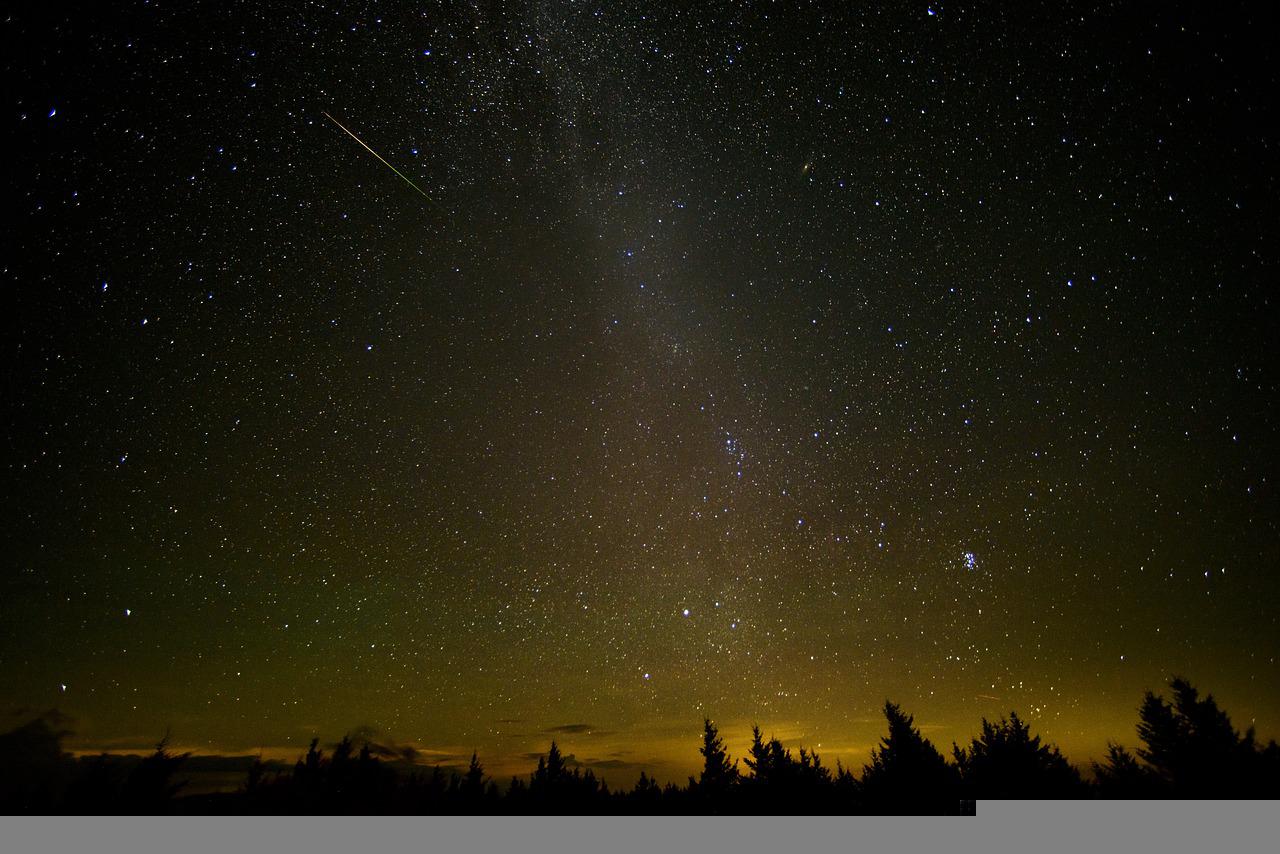
The Perseid meteor shower is one of the most reliable August phenomena in the night sky. However, it has a special dimension for radio amateurs: each maximum brings an increased density of ionized tracks in the atmosphere, and therefore improved conditions for meteor scatter (MS) spojenia na VHF In 2026, exceptionally favorable astronomical conditions will be added - the Moon will be at its maximum in the new moon phase and will not disturb the night sky.
In the article you will read
When will the Perseids peak in 2026?
The Perseid shower is active from July 17 to August 24. The expected maximum activity will occur on the night of August 12-13, 2026. According to data from the In-The-Sky.org portal, the highest hourly activity falls on August 13, 2026. The International Meteor Organization (IMO) reports a zenith hourly frequency (ZHR) of up to 150 meteors per hour under ideal observing conditions.
Astronomical conditions in 2026 are exceptionally favorable. The new moon will occur on August 12, 2026, which means that during the night of maximum there will be only a 1-day crescent moon in the sky with no practical impact on observations. Dark skies without lunar interference are optimal for both visual observation and MS operation.
| Parameters | Value |
|---|---|
| Active swarm period | July 17 – August 24 |
| Maximum activity | August 12/13, 2026 |
| New Moon | August 12, 2026 |
| ZHR (zenithal clock frequency) | up to 150 meteors/hour (ideal conditions) |
| Meteoroid burning height | 80 – 120 km |
| Parent comet | 109P/Swift-Tuttle |
| Radiant swarm | constellation Perseus (right ascension 03h10m, declination 57° S) |
Origin and characteristics of the Perseids
The Perseids originate from dust and small fragments left behind by the comet 109P/Swift-Tuttle as it orbits the Sun. These meteorites gradually disintegrated along the entire path of the comet. The Earth passes through this region every year at the same time - from the second decade of July to the end of August. When entering the atmosphere, the meteorites move at an entry speed of about 59 km/s and burn up at altitudes of 80 to 120 km, where they leave behind ionized trails that are visible even by radio.
The name of the shower comes from the position of its radiant – the apparent point from which the meteors fly. The Perseid radiant is located in the constellation Perseus, which rises above the northeastern horizon before midnight. The higher the radiant is above the horizon, the greater the number of meteors that can be observed. The Perseids are characterized by relatively fast meteors with bright trails; bolides – extremely bright meteors leaving long-lasting luminous trails – are not uncommon.
Perseids from a radio amateur's perspective – video
When to observe the Perseids in 2026?
The ideal time for observation is between midnight and dawn. It is during these hours that the radiant is highest above the horizon and the number of visible meteors is highest. However, activity can also be registered throughout the late evening, only with a lower frequency. The Science at Reach portal recommends starting observation as early as August 1, 2026 and watching the shower every night in the early morning hours - hourly activity will increase towards a maximum on August 12/13.
For successful visual observation, the same principles apply as for sky observation in general: a sufficiently dark place away from light pollution, adaptation of the eyes for at least 15 minutes without artificial light, and a comfortable position - preferably lying on your back. Special optics are not required, meteors are visible to the naked eye.
For MS operations, the increased density of meteor trails before and after the maximum allows for active operation throughout the entire interval of the shower activity – i.e. from the beginning of August. The maximum on August 12/13 will be the most productive period for MS skeds from a statistical point of view.
Princíp meteor scatter spojení
Meteor scatter (MS) je technika VHF spojenia využívajúca ionizované stopy zanechané meteoritmi pri vstupe do atmosféry ako reflexné médium pre rádiové signály. Keď meteorit vstúpi do atmosféry vo výške 80 až 120 km, pri spaľovaní ionizuje okolitý vzduch. Vzniknutá ionizovaná plazmová stopa je krátkodobo vodivá a môže odraziť rádiový signál na vzdialenú stanicu – podobne ako zrkadlo. Dĺžka trvania stopy závisí od veľkosti meteoritu a pohybuje sa typicky od zlomku sekundy do niekoľkých sekúnd; pre väčšie meteority (bolidy) môže stopa pretrvávať aj desiatky sekúnd.
Táto technika umožňuje premostiť vzdialenosti 800 až 2 200 km na pásmach, kde by za normálnych troposférických podmienok nebolo spojenie možné. MS je teda výhradne DX technika – pre spojenia kratšie ako cca 500 km sa ionizovaná stopa nachádza pod obzorom oboch staníc súčasne a spojenie nie je uskutočniteľné.
The most commonly used bands for MS are 50 MHz (6 m), 144 MHz (2 m) and to a lesser extent 70 MHz (4 m) or 432 MHz (70 cm). The digital mode MSK144 from the WSJT-X set is today the standard for MS operation due to its resistance to short reflections (so-called pings). The older mode FSK441 is still in operation. For experienced operators, MS connection is also possible in SSB or CW on longer tracks.
The MS connection procedure is based on skeds agreed in advance – most often via ON4KST chat or similar tools. The stations transmit in alternating periods. In the first period of each minute, the station transmits to the west and north, in the second to the east and south. The message is gradually built up from successfully received fragments with each new reflection; after confirmation of the complete report, the connection is valid and recorded in the log.
MS operation during the Perseids – QSO demonstration
Perseids 2026 – a call to all VHF operators
The Perseids 2026 offer a combination that is repeated only exceptionally: a strong shower with a ZHR of up to 150, a new Moon exactly at the time of maximum and therefore a dark sky without interference. For MS operators, this is an ideal opportunity to establish connections on the 2 m and 6 m bands to distances that are normally inaccessible. If you have not tried MS yet, the Perseids 2026 are the right opportunity - all you need is a basic VHF station, WSJT-X with MSK144 and a desire to experiment. Arrange your skeds via ON4KST, set the frequency and let the atmosphere work for you.
Dates and astronomical parameters are taken from the portals Veda na Dosah (CVTI SR), In-The-Sky.org (author Dominic Ford) and TimeAndDate.com. Data on the ZHR are based on the list of meteor showers of the International Meteor Organization (IMO).