
Sporadická E vrstva, ktorá umožňuje robiť DX spojenia v pásmach 6 a 2 metrov. It occurs in two seasons. The main one is roughly from May to August, but new research also points to a secondary one - from mid-December to January. Even with relatively small equipment, it is possible to make a connection of around 2000 km, while the signal strength ranges from minimum to extreme S9. Výskyt Es vrstvy však nie je možné predpovedať, čo kladie zvýšené nároky na neustále sledovanie pásma. Jej výška nad zemským povrchom sa pohybuje približne od 90 po 120 km.
You will read in the article
Game changer: SE-Prop
While Es is not that rare on the 6-meter band, the 2-meter band can count sporadically on the fingers. The first symptom of Es is usually the presence of distant FM radio stations in the 88-108 MHz band. Those working on 28 MHz (or CB) can also register it by having stations on the band from a distance of 200 to 400 km, which are otherwise unreachable. He is a perfect helper DX cluster. Väčšina spotov však pochádza od staníc zo západnej a južnej Európy, z OM len minimum. Vďaka programu SE-Prop od Jamesa K9SE to nemusí byť na škodu. Čo teda SE-Prop robí?

A practical example of using SE-Prop
V clustri sa objaví spot of the Italian station from JN65, which worked with the English station from square JO01 in the band that interests us. From this data, SE-Prop calculates the location of the reflection point. From its position and its own square, it is possible to calculate the position of the counter station with which this Es can work.
Budeme potrebovať: pripojenie do DX clustra (Packet alebo I-net), počítač s W95+ a samozrejme program SE-Prop. It is freely redistributable as public domain without the support of the author. After installation, the disk will lose a few hundred kilobytes.
Program control
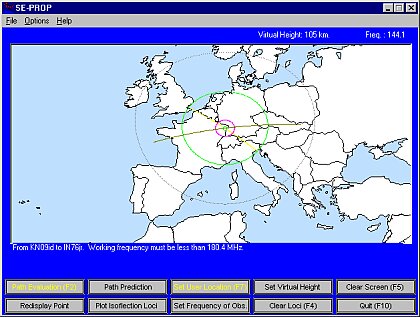
Program sa ovláda myšou alebo klávesnicou. Nie je to však úplne totožné, pretože po stlačení tlačidla myšou sa QTH zadávajú myšou, po stlačení klávesu očakáva program textový vstup. Prednastavená je frekvencia 50,1 MHz, virtuálna výška Es 105 km a mapa USA. The map can be changed via the top menu "OPTIONS", the height can be changed by clicking on the button "SET VIRTUAL HEIGHT" and the frequency by clicking on the button "SET FREQUENCY OF OBS. „.
Ďalej zadáme vlastné QTH „SET USER LOCATION„. Do mapy pribudne červený bod. Teraz zadajte údaje z clustra „PATH EVALUATION". After entering both squares, the location of the reflex point will be automatically displayed.
Zelený ovál označuje MUF. If we are inside, it is lower than the chosen one and this reflective point has no meaning for us. The dotted oval bounds the largest distance between stations for this reflection point. For long connections, it may happen that the program marks the connection probably not reached by the reflection from Es. In that case, try changing the virtual height.
Now we are going to calculate whether this point is also suitable for us. We click on „PATH PREDICTION“ a označíme reflexný bod a vlastné QTH. SE-Prop okamžite vyráta miesto kam by sme sa mohli dovolať.

In the example of the connection JN65 – JO01, after entering the reflection point and own QTH, the location of the prostanice in the Atlantic comes out and it is not worth calling. However, if it comes out on land, we don't hesitate to call!

The sporadic layer often moves, so the more data we enter, the more accurate the results will be. However, it is not possible to calculate multi-hop Es (multiple bounces from Es).
Evaluation
It all probably sounds complicated. Those who have a non-stop connection to the Internet can only smile, because there is a page where these calculations can be carried out without effort. But for the common man VHF DX-mana can be an asset to SE-Prop. Try it out!
You can download the SE-Prop program at CQ.sk.