
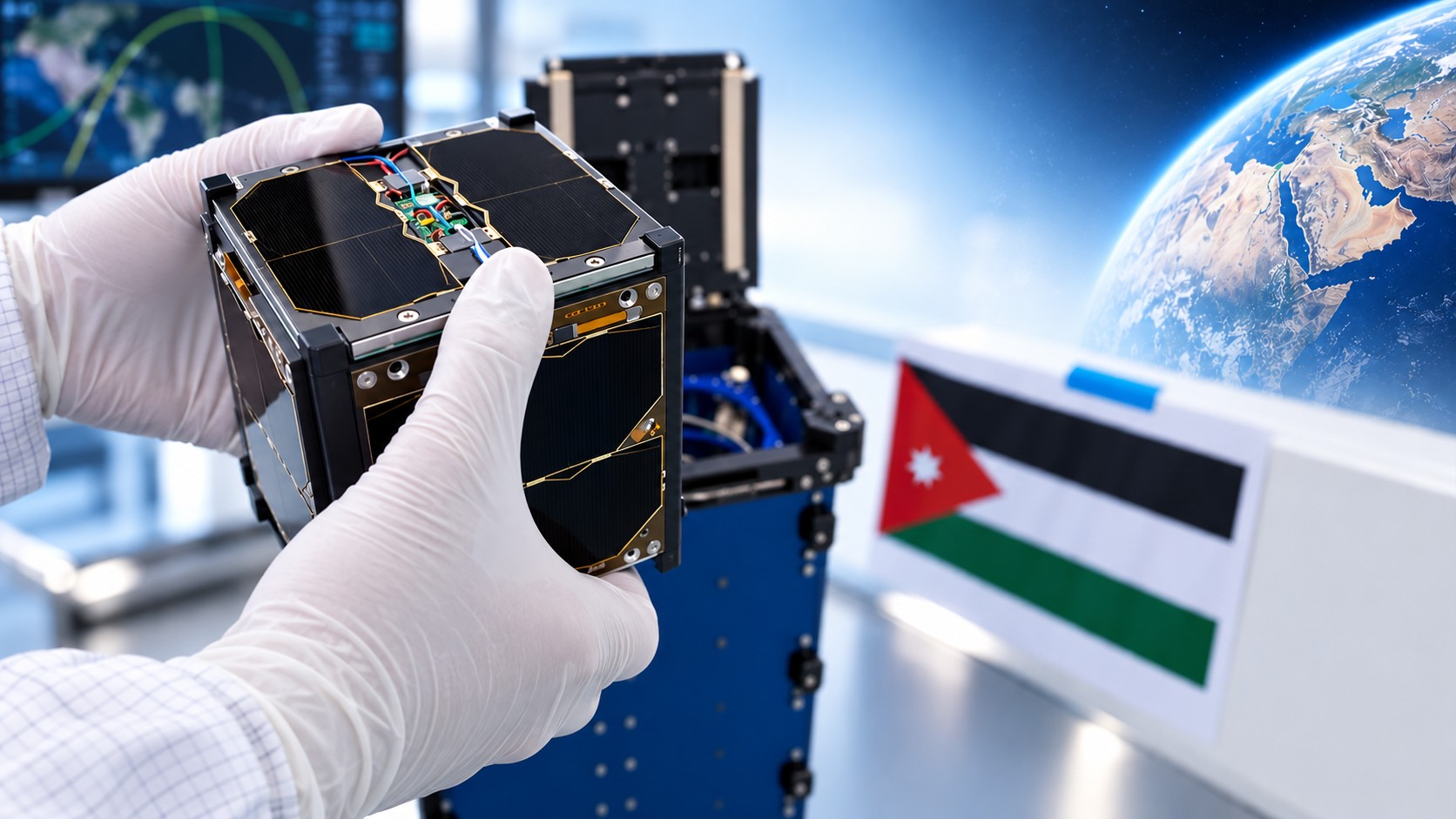
JY1Sat, later designated as Jordan-OSCAR 97 or JO-97, is the first Jordanian satellite. It is a 1U CubeSat developed as part of the Masar initiative at the Jordan University of Science and Technology under the auspices of the Crown Prince Foundation. The name JY1Sat refers to the amateur radio call sign JY1 used by the late Jordanian King Hussein. After successful launch and receiving telemetry, it was assigned the designation OSCAR 97.
The project had an educational and technological goal in addition to the amateur radio part. Jordanian students and academic staff participated in the development. The amateur radio part of the project includes a linear transponder for SSB and CW, telemetry in the format used by FUNcube, and an SSDV system designed to transmit stored image data. The mission also included a recorded audio message from the Jordanian Crown Prince.
In the article you will read
Launch of JO-97
JY1Sat was launched on December 3, 2018, from Vandenberg Air Force Base in California as part of the SpaceX SSO-A: SmallSat Express mission. N2YO lists NORAD ID 43803 and international designation 2018-099AX for the object. The German Wikipedia states the launch time as 13:34 UTC, launch complex Vandenberg SLC-4E, and the launch vehicle Falcon 9 v1.2 Block 5.
After the launch, the amateur radio system was activated and the first telemetry frames were received from Earth. It was after successfully establishing amateur radio operations that the satellite was designated JO-97.
Beacon, uplink and downlink JO-97
JO-97 uses two main amateur radio functions. Telemetry is transmitted on 145.840 MHz using 1k2 BPSK modulation. It is a data transmission compatible with the FUNcube telemetry system. AMSAT lists the beacon speed as 1200 bit/s.
| Function | Frequency | Mode |
|---|---|---|
| Telemetry / beacon | 145.840 MHz | 1200 bps BPSK |
| Uplink transponder | 435.100 – 435.120 MHz | LSB / CW |
| Downlink transponder | 145.855 – 145.875 MHz | USB / CW |

The transponder operates in U/V mode, being an inverting linear transponder. Therefore, LSB is used on the uplink and USB on the downlink. The transponder's range is 20 kHz and its task is to transmit SSB and CW operations between 70 cm and 2 m. When working through the satellite, it is, of course, necessary to account for Doppler shift and continuously adjust both the receiving and transmitting frequency during the pass.
The telemetry system has another interesting feature. JO-97 can transmit stored images in SSDV format. This is not classic SSTV, but a digital format designed for transmitting image data in data frames. AMSAT states that image data and stored audio messages can be decoded using FUNcube Dashboard.
Video: receiving telemetry and SSDV
A practical demonstration of receiving data from JY1Sat is captured in a video dedicated to receiving SSDV telemetry and images from the satellite. The recording documents amateur radio reception of the data signal and subsequent processing of the received data. It is a useful demonstration that JO-97 was not only interesting as a voice linear transponder but also as a source of digital data.
Another interesting example is the demonstration of receiving image signals from JY-97 and decoding using FUNcube Dashboard:
JO-97 operation M0YKS:
Summary
JO-97 or JY1Sat represents a significant milestone for the Jordanian space program and amateur satellite operations. As the first Jordanian satellite, it combined an educational CubeSat project with amateur communication, a linear transponder, FUNcube telemetry, and digital transmission of image data SSDV. After its launch on December 3, 2018, it became NORAD object 43803 and after the successful implementation of the amateur system, it was designated JO-97.
From a technical perspective, JO-97 is interesting mainly due to the combination of an analog U/V transponder and a digital telemetry system. For the experimenter, it represents a good example of how a small CubeSat can combine classic amateur operations with telemetry and the transmission of digital image data. However, when monitoring the satellite today, the current availability of individual functions should be verified according to live status reports, as available databases may differ in their assessment of operational status.