
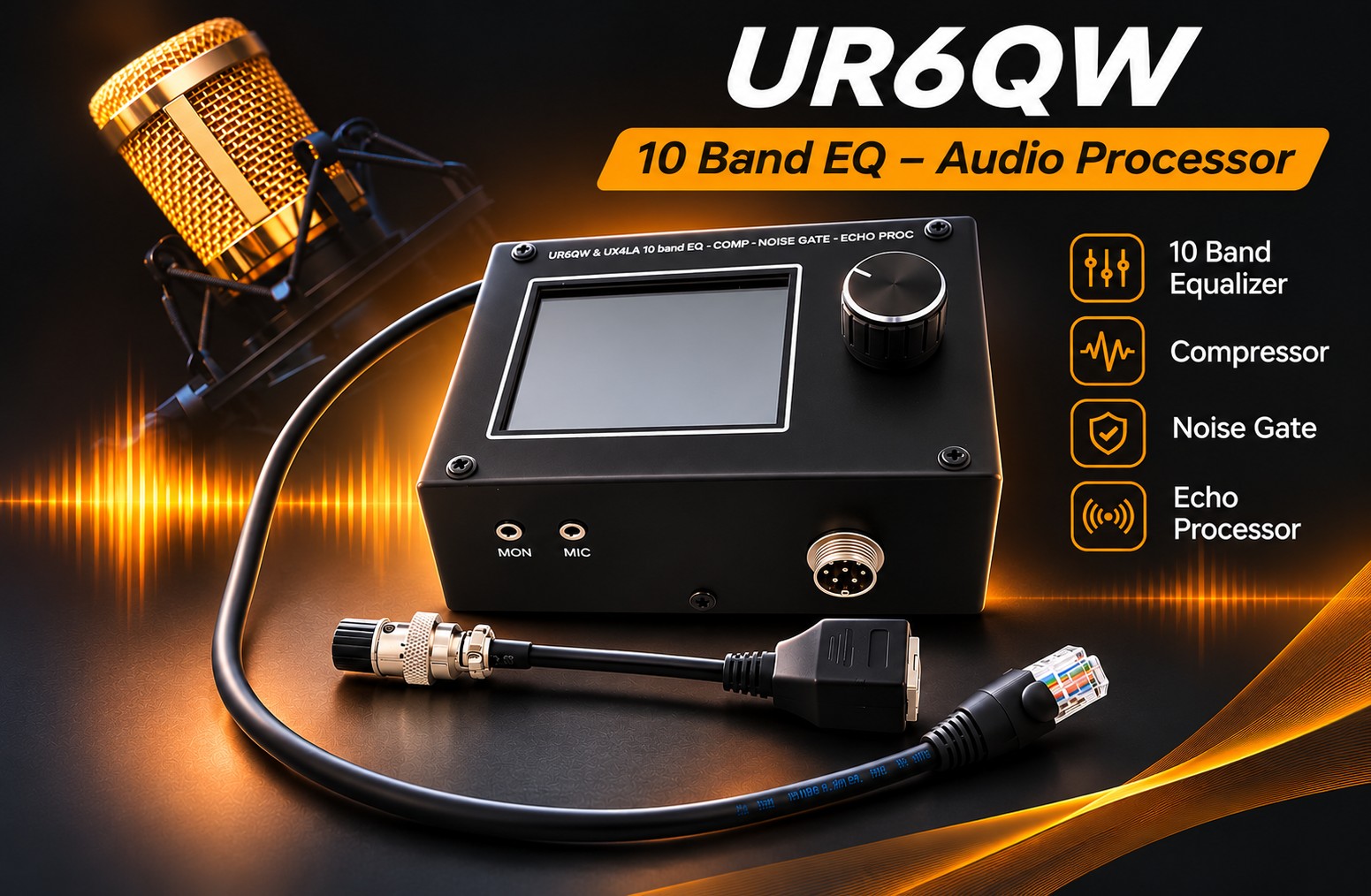
Kvalitná modulácia nie je len vecou drahého mikrofónu. Rozhoduje aj to, čo sa so zvukom deje predtým, ako dorazí do transceivera. Vstavané DSP modern radios offer a basic equalizer and a compressor, but those who really want to have sound under control reach for an external processor. One of the most affordable options is 10-band equalizer UR6QW EQ V.7. A small box with a touch screen, a compressor and an optional 48 V phantom power supply promises studio quality sound at a fraction of the price of studio equipment.
UR6QW devices are not new to the market. The older 5- and 8-band versions were already discussed on the WorldwideDX forum in 2017, especially compared to the significantly more expensive W2IHY processors. Version V.7 is currently available between 8-band and 12-band models.
You will read in the article
Two microphone inputs

At the heart of the EQ V.7 are two independent low-noise mic preamps with their own inputs. The gain of each of them is adjustable from 0 to 40 dB.
- Front MIC input - unbalanced 3.5 mm jack for electret or dynamic microphones. The electret power supply (Bias +3 V) can be turned off in the menu.
- Rear XLR Mic input – balanced XLR connector for quality studio microphones, dynamic and condenser.
Depending on the version, the equalizer is connected to the transceiver via an 8-pin round connector or RJ-45. AD0AR on eHam describes that the EQ also doubles as a switch between three mics: an XLR mic, the original radio mic, and an electret computer mic, all of which he toggles via the touch screen.
Video: EQ V.7 in brief
A video directly from the manufacturer shows what EQ V.7 looks like and what it can do.
48 V phantom power

Anyone who wants to use a condenser studio microphone on the air needs phantom power. The UR6QW solves it with an optional board with a voltage of +35 to +48 V, which the user installs himself. The manufacturer draws attention to the correct procedure: turn off the device, set the switch to the Bias position, connect the microphone and only then turn on the power.
SA0KEF on eHam recommends just the combination with a 48 V condenser microphone with a large diaphragm. According to him, such microphones are cheap today thanks to YouTubers, and a simple rule applies: the better sound you put into the processor, the better you get from it.
Equalizer, compressor, limiter and gate

The main function is a 10-band equalizer with a range of ±12 dB in each band. The distribution of bands depends on the firmware:
- KV firmware: 90, 150, 220, 350, 500, 800, 1300, 2000, 2900 and 4500 Hz, audio bandwidth 5 kHz,
- CB firmware: 100, 150, 250, 400, 650, 1000, 1700, 2700, 4400 and 7800 Hz, 8 kHz audio bandwidth.
The compressor offers a ratio of up to 10:1, a threshold of 0 to 40 dB, an onset of 1 ms, a hold of 5 ms and a release of 50 ms. It is complemented by a software-controlled limiter. Processing is provided by 24-bit A/D and D/A converters, and the suppression of 50 and 60 Hz hum is more than 30 dB.
The noise gate function is described precisely by SA0KEF: it is not a classic gate, but an expander for low levels. However, it is excellent for suppressing ambient noise. He rates the compressor and gate as comparable to professional studio equipment.
Touch screen and control
All parameters are set on a color touch LCD display and a rotary encoder, which can also be pressed. Control is fast and without a computer. The display also shows an input level indicator in 3 dB steps. There is a monitoring output for headphones (2 × 30 mW into 32 Ω) and a built-in recorder.
eHam's KC9LFD has only two reservations. When the display is permanently on, the device heats up a bit and occasionally turns the knob unintentionally. He would therefore welcome the option to dim the display or lock the controls.
Video: EQ V.7 in practice
IT9ICG demonstrates EQ V.7 with a Yaesu M-100 microphone and Yaesu FT-2000D transceiver.
Powered by USB
The equalizer is powered by 5 V via USB (4.5 to 5.5 V, maximum 200 mA). All you need is a USB mobile phone charger, a power bank or a computer USB port. The KW4CQ powers it from the IC-7610's front USB port, so it turns on and off with the transceiver. However, the equalizer did not work from the rear USB ports of the IC-7610.
Normal, DX, echo and roger beep
For radio amateurs, the Pass/Normal button is practical. SA0KEF uses it to quickly switch between raw audio for normal QSOs and processed audio for DX calls. KW4CQ has set up NORM and DX profiles and reports favorably on both.
An echo effect with a level of 0 to 24 dB and a length of 20 to 140 ms is available for CB operation. Some users call it reverb, but SA0KEF points out that it's more of a repeated echo. On VHF/UKV, you will appreciate roger beep: a 600 Hz sine tone with a length of 50 ms at the end of the session. The device also offers bypass mode, phase rotator and PTT transmission including UP/DOWN buttons on some radios.
Compatibility with transceivers
The manufacturer supports the following models:
- icom: IC-7300, IC-7000, IC-7610, IC-9700, IC-706, IC-7100,
- Yaesu: FTDX10, FT-991A, FT-710, FT-DX101D, FT-891, FT-857, FT-817 (RJ-45), FT-990 (8-pin),
- Kenwood: TS-590, TS-2000, TS-990.

Users on eHam also run it with other radios, such as VA2RP with Anan 7000 DLE and FT-991A or KC9LFD with an older Icom IC-756. WE7BY uses two pieces, one for IC-7300 and the other for IC-9700.
Technical parameters
- Converters: 24-bit A/D and D/A
- Audio bandwidth: 5 kHz (KV firmware), 8 kHz (CB firmware)
- Microphone inputs: 2 x independent Preamplifier, gain 0-40 dB
- Phantom power: +35 to +48 V (optional board)
- Equalizer: 10 bands, ±12 dB
- Compressor: up to 10:1, threshold 0-40 dB
- Maximum output level: 200 mV
- Monitoring output: 2 × 30 mW / 32 Ω
- Power supply: 4.5 – 5.5 V, max. 200 mA
- Dimensions and weight: 127 × 85 × 80 mm, 0.63 kg
User reviews and experiences
On eHam, EQ V.7 has eleven reviews with an average rating of 4.6. Enthusiastic responses prevail. W4BUZ, who has been using W2IHY equipment for 18 years, calls it "the best value for money". KC9LFD even writes that after damaging his vocal cords, he regained his taste for phonic operation. JUNKMAN appreciates the extended control range: the "extra 6 dB" makes a huge difference, he says. By comparison, an owner of an older 7-band version complained on the WorldwideDX forum that the range was only ±6dB. The advice from WE7BY and KW4CQ is also repeated: turn off compression and audio frequency adjustment on the radio and leave everything on the equalizer.
However, there are also reservations. The CX3AT found that voice memory replay did not work with the equalizer attached to the IC-7610 and was disappointed with the manufacturer's support. On the WorldwideDX forum in 2017, one owner of an older 8-band version complained about manufacturing defects and poor response from the manufacturer. The discussion also sounded a warning against fakes. The manufacturer itself recommends buying only original devices.
AD0AR wrote in 2023 that he had already ordered four equalizers from Ukraine to the USA. He waited the longest for a month, the last one arrived in 16 days.
Get it right and you'll get compliments. – WE7BY, eHam
Another assortment of Hifi Electronics
The company stands behind the UR6QW brand Hifi Electronics s. r. o. (UR6QW / DB6QW / OM9AQW). V obchode ssbhifi.com you will find a whole range of equalizers: echo processor, 5-band module and v.3 version, 8-band v.4 and v.6 versions with XLR, 10-band PRO and the highest 12-band model with 5-inch LCD display.
The offer also includes adapters between 8-pin connector and RJ-45 for €28 excluding VAT and extension cables. They are also available measuring devices (analog S/P meter for Icom, digital S-meter and VU meter) a kits including laboratory power supply and headphone amplifier. A metal stand is also designed for the EQ V.7.
Price list for ssbhifi.com lists two amounts for each version of EQ V.7. The version with an 8-pin connector costs from €177 / €229, with phantom power from €192 / €248. The version with RJ-45 costs from €192 / €248, with phantom power from €205 / €264.
Summary
The UR6QW EQ V.7 offers at a reasonable price what several separate studio rigs would otherwise require. Two microphone inputs, optional 48 V phantom power, 10-band equalizer, compressor, limiter and expander handle virtually any microphone. USB power and small dimensions of 127 × 85 × 80 mm make it a practical companion in the hamshack and on trips. Reviews on eHam confirm that, with the correct settings, it brings significantly more intelligible and punchy modulation.