
Trinidad and Tobago is an island nation in the Caribbean Sea, located approximately 11 km north of the coast of Venezuela. It consists of two main islands of the same name and a series of smaller islets. Trinidad is mainly lowland, intersected in the north by a mountain ridge connected to the Venezuelan Coastal Cordillera; Tobago, on the other hand, is more mountainous, with the Main Ridge approximately 29 km long and up to 550 m above sea level. m. The climate is tropical, with humid forests and savannas.

The original inhabitants of the islands were the Arawak Indian tribes and later the Caribs. The islands were discovered by Christopher Columbus in 1498. Trinidad remained under Spanish rule until 1797, when it was occupied by the British; During the colonization, Tobago alternated between the Spanish, the French, the Dutch, and finally it also fell to the British. In 1889, both islands were administratively merged into one colony. Trinidad and Tobago gained independence from the United Kingdom in 1962, became a republic within the Commonwealth in 1976, and since 1987 Tobago has had its own internal self-government.
You will read in the article
Economy as a technical background
The country's economy is primarily based on the extraction and processing of oil and natural gas. The first oil well was dug in Trinidad as early as 1867, commercial extraction started at the beginning of the 20th century, natural gas has been used commercially since 1953. Trinidad is also the world's largest producer of natural asphalt. Alongside the oil and gas industry, there is a developed petrochemical and chemical industry, agriculture (sugar cane, cocoa, citrus) is only marginally important today. The country has a modern telecommunications infrastructure, including several submarine cable systems feeding into the US, the Caribbean and South America - an environment that creates a solid technical basis even for amateur radio activity with international call prefixes 9Y and 9Z.
Station profile 9Z4BM – Leon
Caller 9Z4BM is Leon Singh, QTH Vistabella near San Fernando, Trinidad, locator FK90GG, CQ Zone 9, ITU Zone 11, IOTA SA-011. He got into radio through the CB band at the age of 17, he got his amateur radio license in 1996. He brought his own experience with building antennas from the CB era and after switching to amateur bands, he continued with the help of antenna software and professional literature.
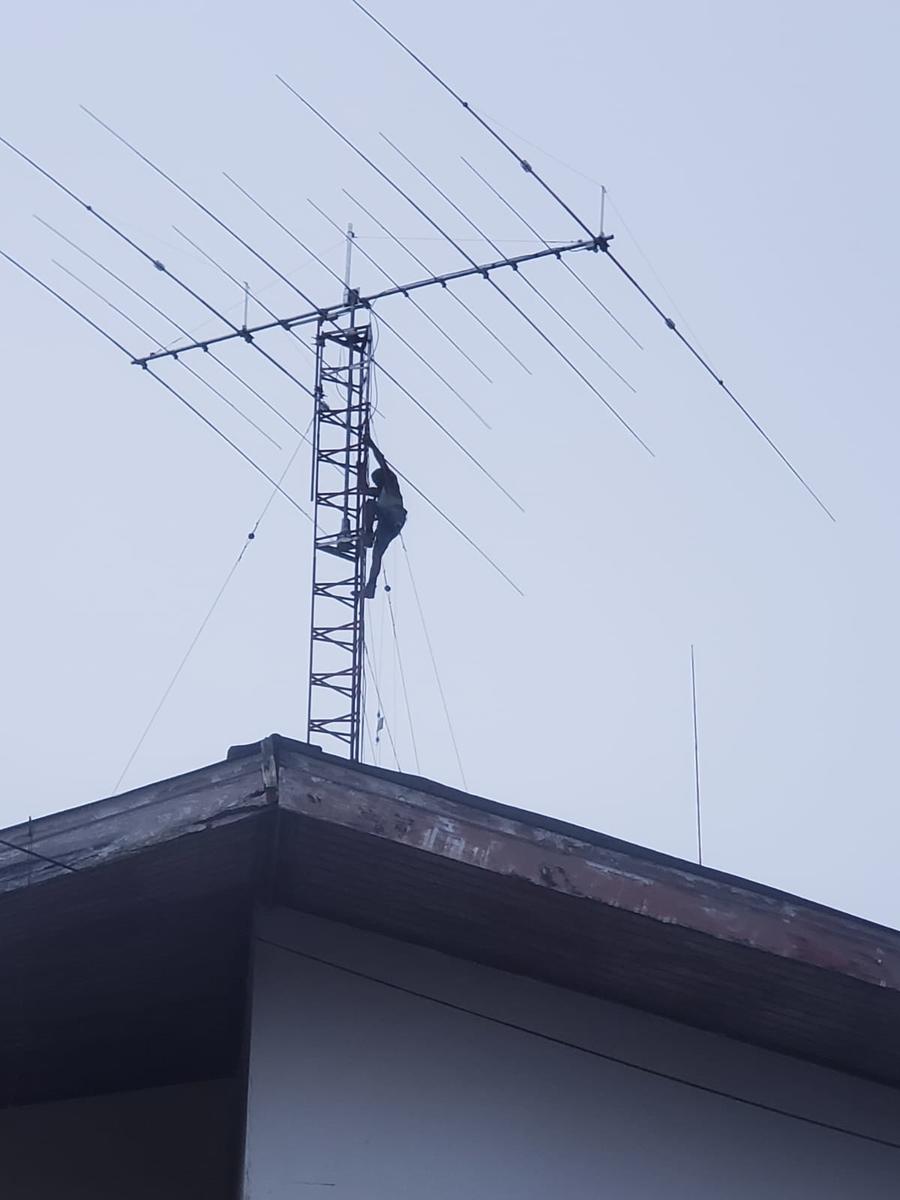
The station is built mainly on home-designed and constructed antennas: on 80 m inverted V, on 40 m a rotating dipole with traps, on the 20-10 m bands a home-built version of the Cushcraft X7 type yagi antenna, on 6 m a self-made 5-element Yagi with a boom length of about 24 feet, and on 2 m an 8-element Quagi antenna. For satellite operation, it uses a modified Gulf Alpha antenna system for VHF and UHF. Leon's philosophy of the station is clear - according to him, the quality of the signal depends primarily on the antenna system, and homebrewing also makes it possible to build a multi-band station without great costs.
Equipment and operation in the shack

Hlavným transceiverom je Icom IC-756, popri ňom stanicu dopĺňa Yaesu FT-920 pre KV pásma a 6 m a Yaesu FT-847 určený na satelitnú prevádzku. Pre prenosnú a núdzovú prevádzku slúžia Kenwood TS-50S a Alinco DX-70T, v zostave figuruje aj Yaesu FT-897D. The operation thus covers the range from classic KV bands over 6 m to VHF including satellites; Leon is also engaged in experimental operation towards meteor scatter a EME s využitím softvéru WSJT.
Participation in CQWW DX SSB 2026
In CQWW DX SSB 2026, 9Z4BM will be active from Trinidad and Tobago in CQ zone 09, in the Single Operator All Band (SOAB) category. For the DX community, this is a valuable opportunity to write in the DXCC log an entity that appears on the bands on strong race weekends to a more limited extent than the usual European or North American stations, and the presence of 9Z4BM thus usually causes an increased pileup, especially on the higher KV bands.
QSL 9Z4BM
Confirmation of the connection with station 9Z4BM is possible exclusively via QSL Direct - the station does not use an outgoing bureau, therefore connections cannot be confirmed via the national or international QSL bureau system. A Direct request is charged at , with older records showing a fee - so it's a good idea to check the current rate directly on QRZ.com before sending an envelope. International Response Coupons (IRC) are not accepted by Leon. According to the available data, the station does not use the logbook of The World or eQSL, so the classic QSL card remains the only verified method of confirmation.