
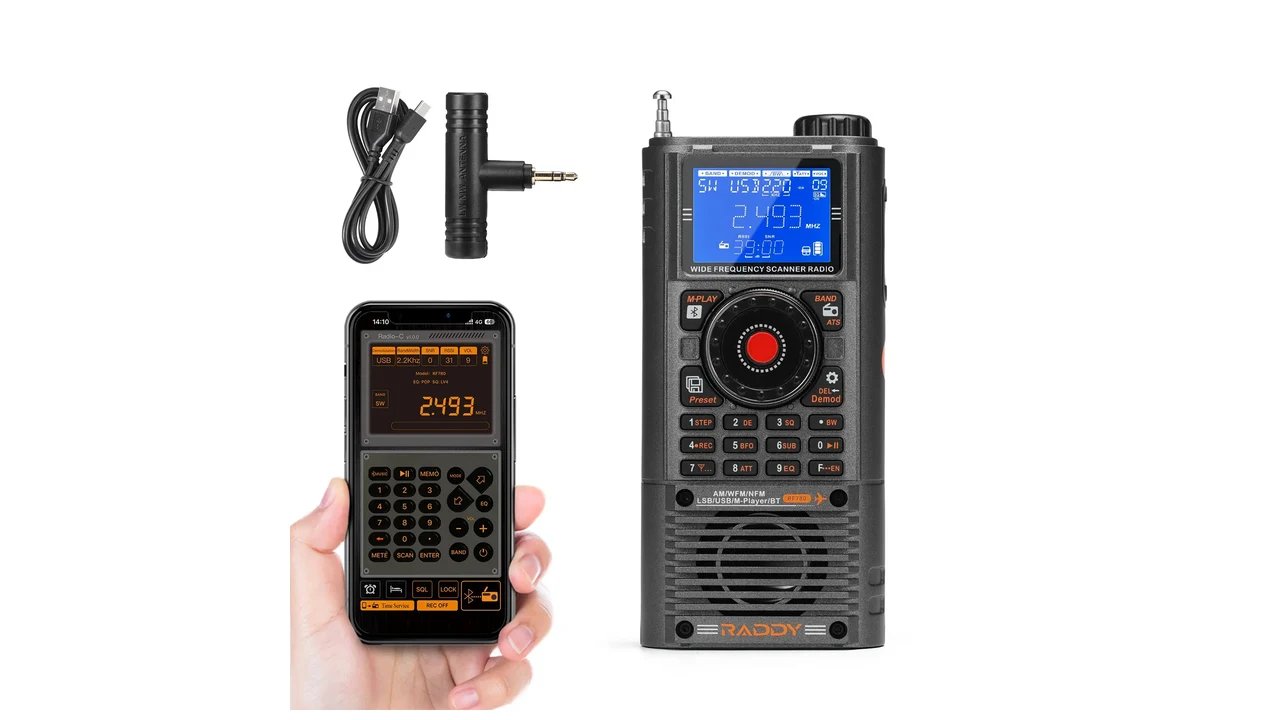
Pocket-sized receivers with "MW to UHF" range are no longer uncommon, but rarely do they also offer SSB, a numeric keypad, and in-body card recording that fits in a shirt pocket. The Raddy RF780 attempts such a combination. It is a purely receiving DSP device with dimensions of 60.46 × 35 × 136 mm and a weight of approximately 158 g including the battery, intended for travel, listening in the field and as a backup radio for emergency situations. But is it really possible to listen to amateur radio bands with it, or is it just another "Swiss pocket square" with a long list of functions?
According to available information, the RF780 is hardware related to the HanRongDa HRD-A330 receiver, which is also sold under the Zhiwhis brand as the ZWS-A330.
You will read in the article
Eight bands in one bag
The RF780 covers eight bands and has no broadcast capability. It receives medium wave (MW) in the range of 520 to 1710 kHz, with a setting from 522 kHz available for Europe. Shortwave (SW) covers the 2.30 to 30.00 MHz continuum with AM, USB and LSB modes. A separate CB band (25.00 to 28.00 MHz) offers AM and NFM.
On VHF je rozhlasové FM v rozsahu 64,0 až 108,0 MHz, letecké pásmo AIR (118,00 až 138,00 MHz) v AM a dve širokopásmové oblasti s NFM: VHF od 20,00 do 250,00 MHz a UHF od 250,00 až po 999,00 MHz. The eighth WB band (162.400 to 162.550 MHz) is used to receive NOAA meteorological broadcasts. However, this is intended for North America and you will not be able to use it in Europe.
What the RF780 does not receive is also important. Long waves (LW) are missing and the receiver does not support DMR, TETRA or DAB+ digital networks. So you listen to analog NFM on VHF and UHF, which is quite enough for amateur radio transmitters on 2 m and 70 cm.
The manufacturer states the sensitivity for each band separately, for example 2 dBµV for FM, −1 dBµV for the aviation band, −5 dBµV for VHF and 2 dBµV for UHF, with a signal-to-noise ratio of 45 to 50 dB. However, this is only catalog data.
SSB, BFO and bandwidths
For radio amateurs, the shortwave part is the most interesting. The RF780 allows you to switch to the SW independently AM, USB a LSB a SSB signal jemne doladiť pomocou BFO v rozsahu −100 až +100. Thanks to this, you can listen to amateur radio bands from 80 to 10 m, as well as utility stations on KV.
You choose the width of the intermediate frequency band according to the mode. Values of 0.5 are available in SSB; 1.0; 1.2; 2.2; 3.0 and 4.0 kHz. The reviewer recommends 0.5 kHz for CW and 2.2 to 3.0 kHz for SSB phone. For AM on SW and MW, for AIR and CB the range is 1.0 to 6.0 kHz, for NFM on VHF and UHF 1.7 to 4.5 kHz, and for radio FM 40 to 110 kHz.
Added is a 9-level squelch that works on SW, AIR, CB, VHF and UHF, and a Local/DX switch. The latter reduces the sensitivity of the input near strong transmitters, which is not an unnecessary luxury for a small broadband receiver.
Control, display and memories
You enter the frequency directly via a full-fledged numerical keyboard, which is also used to recall memories. A front rotary control (shuttle tuning) with an adjustable step is intended for smooth tuning. However, a review on hamradio.my points out that SSB fine tuning is slower on this small wheel than on the classic tuning knob of a larger receiver.
Backlit STN LCD display shows frequency, band, mode, bandwidth, RSSI, SNR, squelch level and battery status. The backlight can be in Auto mode (turns off after 10 seconds) or permanently on.
The memory is unusually large for a pocket receiver: 200 presets for each band, i.e. up to 1,600 positions in total. You can store stations manually or let the receiver scan the band and save the found stations automatically with the ATS (Auto Tuning Storage) function.
Bluetooth, app and recording
The RF780 has Bluetooth 5.2 with a range of up to 20 m. In addition to acting as a Bluetooth speaker for your phone, you can control it with the Radio-CT app (also listed as Radio-C). You can set the frequency, band, bandwidth, squelch and volume from your mobile phone, so the receiver can lie on the window near the antenna and you can tune it from your armchair.
The second feature that sets the RF780 apart from many competitors is the microSD (TF) card slot with a capacity of up to 256 GB. With one press, you record the received broadcast directly to the card, which is useful for DX listening, documenting reception or SWL reports. The receiver also plays music in MP3, WMA, WAV, APE and FLAC formats and offers six equalizer presets. When connected to a computer via USB-C, it works as a card reader and as a PC speaker. The card is not included in the package.
Antennas, power supply and practical functions
The basis is a built-in telescopic antenna. On the upper side there is a 3.5 mm connector for an external antenna, into which the included T-shaped ferrite antenna is connected for better reception of medium waves indoors. You can also use the same connector for a wire antenna.
Power is provided by a replaceable BL-5C lithium battery (3.7 V, 1000 mAh), which is charged via USB-C from a 5 V source. The advantage is that the BL-5C cell is common and you can get a replacement cheaply. The manufacturer and the reviewer do not state the durability in hours. However, Bluetooth, constant backlighting and high volume drain the battery noticeably faster than listening to headphones, so the reviewer recommends packing one or two spare batteries for multi-day trips.
Practical functions include a clock, dual alarm (tone or radio on), sleep timer and automatic NOAA notifications. In addition to the receiver and battery, the package also includes a ferrite MW antenna, a USB-C cable, a rear belt clip with screws and a screwdriver, a hand strap and instructions.
How the RF780 holds up in practice
The first video comes from Italian radio amateur IU7QCK (Luca Russo). It is already clear from the name what he was aiming for: a small DSP receiver that surprised him on short waves. The video is in Italian.
The second video from the Fred in the Shed channel presents a receiver called the HanRongDa HRD-A330. The very title of the video promises that the pocket radio will receive "almost everything".
Comparison with competitors and limits
Most often, the RF780 is compared to the Tecsun PL-330 and XHDATA D-808 receivers. Both have SSB with a step of 10 Hz and in addition long wave, D-808 and air band. But they are heavier: PL-330 weighs about 210 g, D-808 about 265 g. Neither offers app control, recording or VHF/UHF, and the PL-330 still charges via Micro-USB.
A comparison within one's own family is also interesting. The smaller Raddy RF75A weighs around 115g and is also app controlled, but has no SSB, numeric keypad or recording, just card playback. So if you want a pocket receiver for radio amateur bands as well, the RF780 is a more logical choice in Raddy's offer.
PL-330 and D-808 still have the upper hand in sound quality on KV and PL-330 even with serious DX reception on medium and short waves. The RF780 wins with UHF coverage, CB band, app and card recording, all in a body weighing around 158g.
Limits should be known in advance. Strong FM or radio transmitters nearby can overwhelm the receiver's input on both SW and VHF. The small speaker is not enough for weak signals, so for SSB and FM stereo it is more appropriate to use headphones via the 3.5 mm stereo connector. And as already mentioned, there is a lack of long waves and the 1,000 mAh battery does not last long with full use of functions.
Who is the RF780 for?
The RF780 is not a replacement for a desktop receiver or a SDR s poriadnou anténou. Jeho silou je, že ho máte stále pri sebe. Na výlete, pri SOTA alebo POTA activation of a friend, on vacation or in the event of a power outage, you can quickly get an overview of what is happening at KV, at the local carrier or in the airspace.
If you're looking for a first receiver to get into SSB and the ham bands, or to add to your backpacking station, the RF780 offers an unusually high amount of features for its price. However, if you are primarily interested in the quality of reception on medium and short waves, it is worth considering more classic designs.

The receiver offers, for example, Czech Yachtmeni e-shop za 2 599 Kč s DPH, including a Czech manual in PDF. You can find a detailed English review with a comparison table at hamradio.my.
Frequently asked questions
Can I listen to amateur radio bands in SSB with the Raddy RF780?
Yes. On shortwave from 2.30 to 30.00 MHz, it receives both USB and LSB with fine BFO tuning and a bandwidth of 0.5 to 4.0 kHz, so it can handle bands from 80 to 10 m.
Is it possible to broadcast with the RF780?
Nope. The RF780 is exclusively a receiver and has no transmission capability, not even on the CB and VHF bands.
Does the RF780 receive longwave or DAB+?
Nope. Coverage starts on medium waves from 520 kHz, and the receiver does not support DAB+, DMR or TETRA digital broadcasting.
How long does the battery last?
The manufacturer does not state the endurance in hours. The BL-5C battery with a capacity of 1,000 mAh discharges the fastest when Bluetooth is turned on, the backlight is always on and the volume is high, so a spare battery is worth it for longer trips.
Can I record the received broadcasts?
Yes. The RF780 records the received broadcasts directly to a microSD card with a capacity of up to 256 GB. The card must be purchased.