
In the article you will read
Protection of the antenna system against the effects of lightning impulses
Protection of an amateur radio station against the effects of atmospheric discharges is one of the basic requirements of any fixed installation. Although direct lightning strikes cannot be reliably eliminated with a single device, a properly designed surge protection can significantly reduce the risk of damage to transceivers, power amplifiers, antenna tuners and other devices connected to coaxial lines.
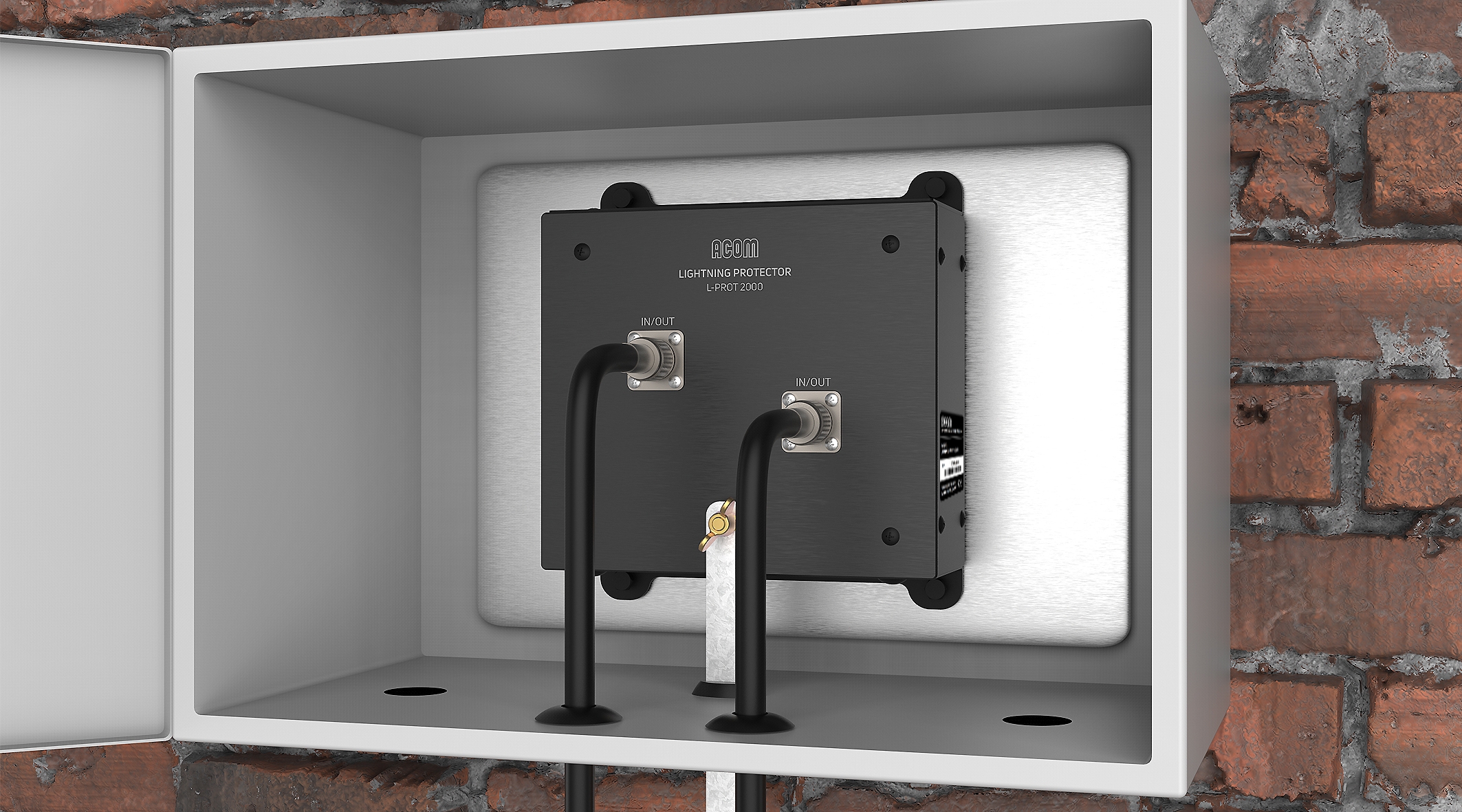
ACOM has launched a device L-PROT 2000, designed for protection of TX/RX systems in the 1.8 to 54 MHz band at power up to 2000 W. The design differs from conventional coaxial surge protectors using gas surge protectors (GDTs) and uses a combination of low-frequency pulse filtering and air spark gaps.
Features of ACOM L-PROT 2000
ACOM L-PROT 2000 is designed for coaxial lines without DC power transmission. The device works bidirectionally, so there is no need to distinguish between input and output. Both RF ports are identical and marked as IN/OUT.

The manufacturer states that the protection ensures the removal of static charge accumulated on the antenna, prevents the transfer of direct current between the ports, and at the same time suppresses the low-frequency components of the electromagnetic pulse arising from a lightning strike. A practical benefit may also be the reduction of receiver noise during wind, rain, or snowfall, when an electrostatic charge is created on antenna systems.
Unlike many compact surge protectors, the L-PROT 2000 uses massive hemispherical air spark gaps. These serve as voltage limiters during extreme impulses and, according to the manufacturer, withstand repeated surge events better than classic gas surge protectors.
How protection works

During an atmospheric discharge, electromagnetic pulses with a very wide frequency spectrum are induced in the vicinity of antenna systems. A significant part of the energy is in the very low frequency range below 100 kHz and is directed towards the DC component.
The principle of the L-PROT 2000 lies in the strong attenuation of these low-frequency components. The device creates high attenuation in the LW/VLF band, thereby significantly reducing the pulse energy penetrating the equipment in the radio room.
Two internal choke circuits create a DC short circuit to ground, thus preventing the accumulation of electrostatic charge on both sides of the line. In the event of an extremely close lightning strike, air spark gaps are activated to limit the resulting surge voltage.
It is important to emphasize that the device cannot be understood as absolute protection against direct lightning strikes. It is part of a comprehensive protection system that must include quality grounding, equipotential bonding, and proper routing of coaxial cables.
Technical specification
| Operating band | 1.8-54MHz |
| Impedance | 50 Ω |
| Maximum RF power | 2000W |
| Connectors | SO-239A (UHF, PTFE) |
| Attenuation in the working band | max. 0.03 dB |
| Maximum PSV | 1.1 : 1 |
| Return loss | −26.5 dB |
| Rated discharge impulse | 20 kA ( 8/20 µs) |
| DC resistance port – ground | max. 12 mΩ |
| Dimensions | 175 × 85 × 193mm |
| Weight | approximately 1.23 kg |
| Operating temperature | −40°C to +60°C |
The manufacturer also states a minimum attenuation of 50 dB at 100 kHz, 80 dB at 30 kHz and 100 dB at 10 kHz. In the VHF and UHF ranges, the device achieves an attenuation of at least 30 dB at 100 MHz and more than 50 dB above 300 MHz.
Assembly and installation
Proper installation is as important as the protection itself. ACOM recommends installing the L-PROT 2000 outside the amateur radio room, ideally in a distribution box or on a wall near the coaxial cable entry into the building.
The device should be located as low as possible at the building foundation and as close as possible to the lightning protection system or the main earthing point of the building. A short and low impedance connection to the earthing system is crucial for the correct function of the protection.
The grounding rod must be connected to a quality grounding system with a conductor with the lowest possible inductance. Long grounding conductors, sharp bends or loops can significantly reduce the effectiveness of the protection during a surge.
For stations using multiple antennas, it is advisable to combine the L-PROT 2000 with a central grounding point, antenna switches and other surge protection elements. It is a matter of course to physically disconnect the antennas during prolonged absence or when storm activity is expected.
Evaluation
ACOM L-PROT 2000 represents a technically interesting approach to the protection of HF antenna systems. Instead of using surge elements alone, it focuses on suppressing low-frequency impulse energy, blocking the DC component and dissipating static charges. In combination with high-quality grounding, it can form an effective part of the protection of an amateur radio station operating in the HF and 6 m bands.
YouTube video
The following video explains the principles of protecting coaxial lines from the effects of lightning impulses and is a suitable addition to the issue of surge protection used in amateur radio practice.
https://www.youtube.com/watch?v=7PXBHwbrEWM
Conclusion
Although no surge protector can guarantee the survival of equipment in the event of a direct lightning strike, a properly designed grounding system and high-quality coaxial protection significantly reduce the risk of damage to equipment. ACOM L-PROT 2000 is designed specifically for amateur radio HF applications up to 54 MHz and its design represents an interesting alternative to conventional coaxial surge protectors.