

Quads outperform other types of directional antennas on 2m. VHF pomerne ťažko. Dôvod? Oveľa väčší odpor vetru, ktorý kladú oproti klasickým yagi anténam, čo kladie oveľa väčšie nároky na mechanickú konštrukciu antén, stožiara a rotátora. Dvojprvkový quad je koncipovaný ako fixná anténa na domácom QTH, for example, on converters or packets. However, it depends only on the skill of the designer whether he can make it portable. However, the production of a simple version is not difficult and uses only available materials.
In addition to decent gain, the advantage of the quad is that it is a 100% walkable antenna, which makes it superior to Slim-jims, collinears and similar antennas. In my experience, it also outperforms the HB9CV, which is an excellent antenna. The quad has the advantage of direct feeding with a coaxial cable (50 and 75 ohm) without any matching circuit and a smaller number of variables forming the antenna (the R and Z circuit and their mutual spacing). Adjustment - if necessary - is made with a PSV meter to a minimum PSV. Depending on the position of the feeding point, we can choose vertical or horizontal polarization.
The most ideal is the attic hanging version fixedly turned in the desired direction. We can only do with a supporting structure made of wood, or wood and PVC. The solution is best captured by photographs. However, it must be said that there are no limits to experiments, in the ARRL Antena Book there is a 2-el.quad also in a folding version (like an umbrella).
|
|
|
|
|
|
|
|
|


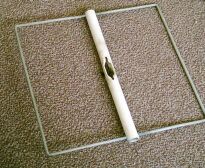
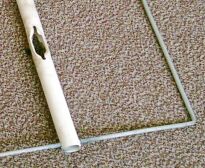


Quad antenna dimensions
- emitter circumference: 206 cm (side 51.75 cm and distance at power terminals 1 cm)
- reflector circumference: 216 cm
- Z – R spacing: 0.15 to 0.25 lambda according to the required impedance at the feed point. For a 50 ohm feeder, the optimal element spacing is about 35 cm
- diameter of element material: 6 mm
Tuning
2-el.quad is a relatively sufficiently broadband antenna and therefore it is sufficient to fine-tune it by changing the spacing of the elements to at least PSV. We connect to the antenna via PSV meter radio station and measure the PSV. Increasing the spacing increases the impedance, decreasing it decreases. The gain changes only minimally.