
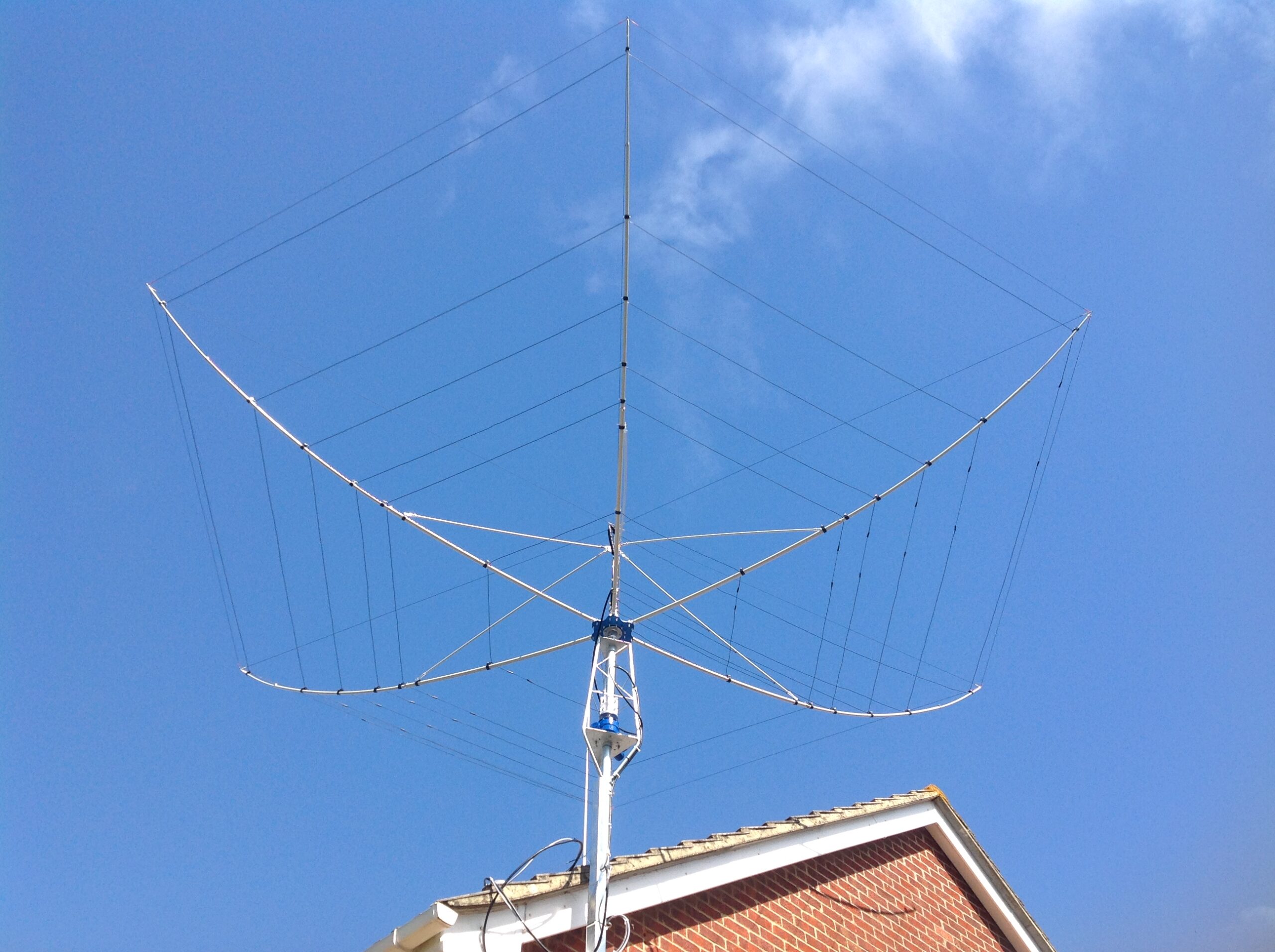
hexbeam is a wire directional antenna that combines the principles of yagi a Moxon antény. Verziu G3TXQ, produced by Anthony MW0JZE since 2009, is used today by a large number of radio amateurs as a replacement for the classic multiband Yagi or quad on land where there is no space for a larger structure. The article describes the principle of operation, mechanical structure, history of creation, addition of the 40 m band, balun solution and practical experience with the construction of a similar antenna in domestic conditions.
In the article you will read
Advantage of hexbeam antenna
The main advantage of the hexbeam is the combination of directional gain and small size. This design achieves a gain of approximately 5 to 6 dBi and a front-to-back ratio of up to 20 dB, making it close in parameters to a two-element Yagi antenna. With six parallel arms, up to six separate bands can be placed on a single central column, with each band functioning as an independent two-element antenna without coils and bandpass filters, i.e. without the losses that these elements normally cause.
The biggest practical advantage over a classic Yagi antenna is its size. The six-band hexbeam G3TXQ has a turning radius of only 3.25 m, while a comparable two-element Yagi antenna for the 20 m band needs a span of 10.75 m and a turning radius of 5.75 m. This makes the hexbeam fit in a regular garden and can be rotated even with a less powerful rotator.
The original hexbeam design from the 1990s had narrowband characteristics and required tuning. The G3TXQ version, on the other hand, is designed to be wideband - when properly assembled, it does not require an antenna tuner and the SWR remains low throughout the entire range of individual bands.
Hexbeam antenna features

Hexbeam G3TXQ is a full-size two-element Yagi antenna with bent wire elements. The driven element has an M-shape from a bird's eye view, the reflector is U-shaped. The antenna can be assembled as a single-band or multi-band version without significant performance degradation, because the individual bands practically do not affect each other - disconnecting or modifying one element has almost no effect on the other bands.
The total width of the six-band antenna is 6.5 m, the height from the base plate to the top of the central column is 107 cm. The weight of the current version with thicker inserts is given as of 2014 at 12 kg, the older version with thinner inserts weighed 9.5 kg.
The manufacturer states that the antenna is tested in the UK up to 400W, with some users routinely operating the antenna on SSB up to 2kW and on CW and digital modes up to 1kW. Mechanical resistance has been tested up to 75mph wind speeds, but this value only applies if the supporting mast can handle the same load.
| Band | Directional gain (dBd) | Front-to-back ratio (dB) |
|---|---|---|
| 20 m | 3.8 | 22 |
| 17 m | 3.2 | 19 |
| 15 m | 3.5 | 16 |
| 12 m | 3.0 | 13 |
| 10 meters | 3.6 | 16 |
| 6 meters | 2.7 | 11 |
The values listed were published by the manufacturer for the six-band HD version of the G3TXQ hexbeam; the gain is given in dBd, to convert to dBi it is necessary to add 2.15 dB.
History of the hexbeam antenna
The hexbeam concept was first designed by Mike Traffie, N1HXA, who published his design in Communications Quarterly in 1996. This original design, now referred to as the "classic" design, had a turning radius of approximately 2.9 m and covered the 20, 17, 15, 12 and 10 m bands.
British radio amateur Steve Hunt, G3TXQ, took a closer look at the original design, noting discrepancies in the gain, bandwidth and front-to-back ratio figures given by various builders. He published the results of his modification in the online magazine AntennaX in late 2007 under the title "Broadband Hexbeam", and from 2008 this broadband version began to spread among builders. He changed the dimensions and shape of the elements so that the antenna worked broadband without the need for tuning, while the excited element remained in the M-shape, but the reflector was given a more semi-circular shape. The price for the bandwidth extension was an increase in the turning radius to 3.25 m.
Commercial production of the broadband version of the G3TXQ began in July 2009 by Anthony, MW0JZE, initially based on a request for an antenna for the IOTA portable activity. Production is led by Steve Hunt, G3TXQ, and has been operating under the trading name Hexbeam UK since 31 March 2013. According to the manufacturer, over 3000 units of the antenna have been sold to over 65 countries to date.
Multi-band hexbeam antenna design
Central pillar
The core of the structure is the air coaxial central column of our own design MW0JZE, manufactured since August 2012. The outer conductor is an aluminum tube with a diameter of 35 mm and a wall of 3.5 mm, the inner conductor is a solid rod placed on nylon spacers in the center of the tube - the column itself does not contain any piece of coaxial cable. The structure is designed for an impedance of 50 ohms and is symmetrical, which improves the balance of the power supply and isolation from other parts of the structure. The top of the column is closed with a nylon pin for waterproofing, the power connector is SO-239, and on request also an N-connector.

Base plate
The base plate is made of 6mm T6 grade aluminum sheet, CNC machined, with engraved markings for precise placement of the spacers. All U-bolts and fasteners are stainless steel. The bottom flange is sized for a maximum support tube diameter of 50 to 40mm metric, or 1 and 7/8 to 1 and 5/8 inches, with a recommended minimum wall thickness of 2.5mm.
Fiberglass linings
Each of the six arms consists of three sections of extruded fiberglass profile, one of which is 353 cm long when folded.
| Section | Length | Outer diameter |
|---|---|---|
| 1. | 1.5m | 25.4mm (1″) |
| 2. | 1.5m | 19mm (3/4″) |
| 3. | 1.0m | 12.7mm (1/2″) |
The ends of the sections are reinforced with aluminum sleeves to prevent them from cracking when bending the struts into the shape of an antenna. Each arm is attached to the post and to the adjacent arm with Mastrant P2 tension cables with a tensile strength of 95 kg, which keep the struts in the correct arc. The conductors are guided on the struts in HDPE holders, which the manufacturer replaced with the original, less durable design in the January 2025 revision.
Wire elements
The antenna is supplied as standard in a five- or six-band design for a range of 6 to 20 m. Each element is a separate unit, so adding or removing one band will hardly affect the properties of the others. The conductors are made of seven-core copper wire with PVC insulation, there are polyester rope spacers between the driven element and the reflector.
Since January 2013, all elements have been fitted with specially developed insulators to prevent arcing during prolonged operation at high power in CW and data modes, typically during competitions or DXpeditions. All connections are sealed with heat shrink tubing.
According to the manufacturer, complete antenna assembly takes approximately one hour. The optimal height above ground is above 10.7 m, but the antenna gives satisfactory results from a height of about 6 m above free terrain without nearby obstacles, with the SWR decreasing with increasing height.
Expansion of the 40 m band
For owners of the six-band hexbeam G3TXQ, there is an additional 40m band extension kit in the form of a single dipole element. The kit includes six extension arms with accessories, one vertical extension arm, an adapter balun for direct connection of a 50-ohm power supply with a power load of up to 1.5 kW and the wire element itself for the 40 m band.
The kit replaced the older seven-band hexbeam design, which was discontinued due to its high complexity and labor-intensive nature. The new kit can be retrofitted to existing six-band antennas, adds only a few kilograms of weight, and takes about an hour to assemble.
According to modeling in the EZNEC program, the element itself achieves a gain of 3.77 dBi for 40 m in free space, the reference dipole has a gain of 2.14 dBi under the same conditions. When mounted at a height of 10 m above the ground, the modeling also showed an increase in the directional gain of the adjacent element for 15 m - from 9.12 dBi to 10.35 dBi, the front-to-back ratio increased from 16.51 dB to 16.94 dB, while the width of the radiation beam narrowed with better side attenuation, but with the formation of more pronounced rear lobes.
The bandwidth of the 40m element is, according to the manufacturer, approximately 175 kHz below the 2:1 SWR limit, which is within the range of most built-in antenna tuners in modern transceivers; the center of the range can be specified when ordering according to the preferred part of the band. The antenna's turning radius with the 40m kit increases to 4.1m, the kit weighs approximately 3.5kg.
Balun
The Hexbeam is powered by a single 50-ohm line and, according to the manufacturer, requires a balun or 1:1 choke placed as close to the feed point as possible – in practice, typically at 20 m near the top of the central column – to suppress common mode currents on the coaxial cable sheath.
In addition to the antennas, MW0JZE also supplies its own in-line isolation balun based on the W1JR concept with a FT240-43 toroidal core. The winding consists of 70 cm of RG-303 coaxial cable wound in eight turns around the core, the whole is housed in a waterproof case cast in polyester resin, with SO-239 connectors on both sides. The balun is tested to the full power limit valid in the United Kingdom; the FT-240 core can handle up to 1 kW of power on SSB at an ideal SWR ratio of 1:1, but not on full duty cycle modes such as CW or data.
When choosing a specific choke solution, the manufacturer refers to separate research by Steve Hunt, G3TXQ, who compared the impedance of different cores and the number of turns when suppressing common mode currents. Recommended options include, for example, eight turns of RG58 cable, or alternatively RG142, on an FT240-43 core, or six pieces of FB-31-1020 ferrite cores strung on an RG213 cable.
Construction experience

I built a Hexbeam for three bands at home. Despite its visual simplicity, it is a laborious antenna to manufacture, but not expensive in terms of materials, acceptable in size, and functional.
I used a base plate made of duralumin. A duralumin tube is fixed to it with angle brackets, which carries the end points of the radiators, the coaxial connections between them and the eyes for attaching the tensioning ropes. It is important to pay attention to the watertightness of this connection.

The supporting supports of the elements are ordinary fiberglass fishing rods, from which thicker parts are used. Each joint is additionally secured with a hose clamp with a rubber washer - an old bicycle inner tube. The inside of the rods is also filled with PUR foam; when using a longer tube, it is possible to fill the entire rod, making it stronger.
Making the antenna wire elements was easy – just measure them, crimp them, and solder the end lugs or install insulators.

The more difficult part was connecting them and tightening them to the supporting structure. I did it in the garden, in winter, and it wasn't easy - there are a lot of fasteners, connections and cables. The work also involved a bit of gymnastics, because sometimes you have to get to the fastener that is already behind the stretched wires, and there are a lot of connections.

After assembly, tuning followed. In my case, the antenna was tuned a little off and required fine-tuning. Since I shortened the radiators, some of the mounts also needed to be moved. However, the tuning responded exactly as it should, which is a sign of a well-designed antenna.
In operation, the hexbeam behaved exactly as expected. Compared to the moxon antenna, the gain was slightly lower, but the difference was not large. In front-to-back and front-to-back ratios, the moxon was significantly better.
After these experiences, I would say that the hexbeam is a good antenna for a small space, but it is very laborious to manufacture and it is more practical to reach for a finished product, for which the tuning and implementation are already verified.
Unfortunately, I was moving a few months after the antenna was completed, so the antenna had to move with me.
Video of the construction of a hexbeam antenna
An idea of the assembly of the original G3TXQ antenna from the manufacturer MW0JZE is provided by the official instructional video published directly on the manufacturer's website, which shows the assembly of the central column and base plate in the current revision of the design.
Where to buy a hexbeam antenna
The original manufacturer of the broadband version of the G3TXQ is a British company Hexbeams UK, run by Anthony, MW0JZE, who has been manufacturing and selling the antenna directly from his workshop in Wales since 2009. The website www.g3txq-hexbeam.com offers, in addition to the basic six-band HD version, a lightweight portable version for DXpeditions, an additional kit for the 40m band, a separate balun, a tilt plate for antenna service and other accessories. The original buyer is covered by a lifetime warranty and the manufacturer provides support by email and WhatsApp; payment can be made by bank transfer, card or PayPal.
For those interested in Italy, the manufacturer lists Giorgio, IZ3KVD, operating the website Hamproject.it, as an authorized distributor; a current list of other authorized dealers is listed in the Distributors section of the manufacturer's website.
Builders who want to build the G3TXQ antenna themselves can also use the website hex-beam.com, ktorú vedie K4KIO (LEO Shoemaker) and which offers detailed building instructions, a materials list, and individual more complex components, such as a central column or base plate, for those who do not want to or cannot make everything themselves.