
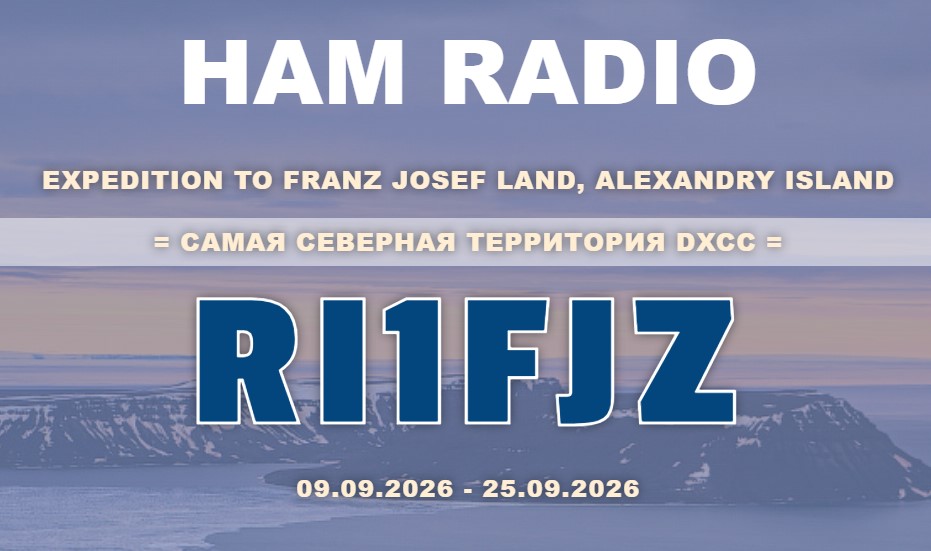
Franz Josef Land (a Russian archipelago in the Arctic Ocean) is one of the northernmost and most difficult DXCC entities in the world. It consists of approximately 191 islands and is the closest landmass to the North Pole in the Eastern Hemisphere – only about 900 km of sea and ice separate it from the top of the world. It is this remoteness that makes each activation of this entity a special event in the DX community. In September 2026, an expedition by RI1FJZ set out for Alexandra Island.
In the article you will read
A look into the history of DX expeditions to Franz Josef Land
Amateur radio activity from Franz Josef Land was extremely sporadic for many years. As late as the 1990s, it was possible to pick up station R1FJZ, which was confirmed as a SWL report by Dutch radio amateur PA7MDJ in 1995. The following years were spent in the silence of the airwaves - the archipelago remained practically inaccessible.
The turning point came in the mid-2010s, when Yevgeny Chepur, UA4RX, who was the head of the Sevmeteo meteorological group and signed on as RI1FJ, settled on Hayes Island. His activity was carried out from the Krenkel meteorological station, built around a shallow freshwater crater lake - the station was originally established in 1957/58 during the International Geophysical Year, abandoned in 2001 and reopened in a smaller, more modern form in 2004. RI1FJ's operation in individual seasons (2013 to 2016) was marked by technical problems, lack of transport to the mainland and poor propagation - many operators waited years for a connection. Franz Josef Land (DXCC RI1F, IOTA EU-019) was therefore included among the entities in high demand.
In parallel with the preparation of the RI1FJZ expedition, plans were also underway in 2026 by the competing team RUDXT, which, under the call sign RI1FJL, planned the activity of six operators from Heiss Island, departing from Murmansk at the end of August 2026 and with a planned stay of 15 days. This is a separate project with its own team, different from the RI1FJZ expedition, which was heading to Alexandra Island.
RI1FJZ Operators' Lineup
The RI1FJZ team consists of five operators with extensive experience from previous DXpeditions and a sailboat captain.
| Call sign | Name | Task |
|---|---|---|
| RA1ZZ | Vasily | CW/SSB/DIGI operator, expedition leader |
| R9LM | Alex | CW/SSB/DIGI operator |
| R9LR | Vladimir | SSB/DIGI/SAT operator, QSL manager |
| R3CN | Nikolai Andreevich Litau | Captain of the sailing ship Apostol Andrej |
| RA9USU | Dmitry | CW/SSB/DIGI operator |
| RW6MD | Evgeny | CW/SSB/DIGI operator |
Vasilij, RA1ZZ, dedicated himself to the Franz Josef Land expedition with such determination that he quit his job to do so. His previous activations include: 5V7RU, A25R, TY0RU, Z21RU, 7Q5RU or EP6RRC. Vladimir, R9LR, is returning to Franz Josef Land for the second time and is an enthusiast of satellite radio operations – he also took on most of the financial costs of the expedition. The captain of the sailing ship Apostol Andrej is Nikolaj Litau, R3CN, an honorary master of sports, holder of the Order of Courage and an experienced sailor with several trips around the world on a sailing ship that he himself designed specifically for long-term Arctic expeditions.
The expedition is also supported by a team of pilots and organizational support: Igor, UA3EDQ (expedition pilot), Alex, UA3RF (website, information support), Sergej, RN3RQ (organizational support), Sergej, RW3XA (technical support), Igor, UA9KDF (organizational and technical assistance) and Slav, UB1ZCO (organizational assistance).
Video: Franz Joseph Land
The following video presents the Franz Josef Land archipelago itself - it is not an official recording of the RI1FJZ expedition, but rather a documentary material describing the geography and character of this Arctic region:
DX Expedition Plan RI1FJZ
According to the expedition's official website, the station RI1FJZ was on the air from September 9 to 25, 2026. Departure from the port of Murmansk was planned for September 1, the journey to the island takes approximately five days depending on ice conditions, technical readiness of the sailboat, fuel availability and weather. The activity was planned for at least two weeks of continuous operation on all HF bands and satellites in CW, SSB and digital modes, knowing that wave propagation can be extremely capricious at high latitudes.

The team brought with them sufficient sets of equipment and antennas for all bands, but based on experience operating in the Arctic at this time of year, they expected the main bands to be 40, 30, 20, and 17 metrov. Plánovaná bola aj aktivita na VHF vrátane nízko obiehajúcich satelitov (LEO SAT), QO-100, ako aj Es a EME na 144 a 432 MHz, prípadne aj prevádzka v móde /mm (Maritime mobile) during the voyage.
Since Franz Josef Land had never been activated in FT8 mode (nor FT4, FT2) before, the team expected a significant surge of interest in these digital modes if the propagation was favorable. They therefore planned to spend most of their time outside the main areas of the digital subbands (see band plan below). Since they might not have internet access on the island, it was not possible to rely on their own self-spotting – the operators therefore invited the community to monitor the mentioned frequencies and possibly insert them into the DX cluster themselves. A Starlink terminal will be installed on board the sailboat for emergency communication, but its use for other purposes is unlikely; important operational information was to be transmitted via the expedition pilots during their stay on the island.
Rozpočet expedície presiahol 50 000 USD. Podľa vyjadrenia Vasilija, RA1ZZ, pre DX-World.net išlo o piatich skúsených operátorov plánujúcich prevádzku až na siedmich rádiostaniciach s výkonovými zosilňovačmi – dvoch pre CW/SSB a piatich pre digitálne módy.
Band plan RI1FJZ
For operation in CW, SSB and FT8, the team has published the following reference frequencies (in kHz), taking into account common QRM on the individual bands:
| Band | CW | SSB | FT8 |
|---|---|---|---|
| 160 m | 1835 | – | 1839.0 |
| 80 m | 3535 | 3675 | 3570.0 |
| 40 m | 7035 | 7175 | 7056.0 |
| 30 m | 10135 | – | 10133.0 |
| 20 m | 14035 | 14175 (14275) | 14095.0 |
| 17 m | 18085 | 18155 | 18097.0 |
| 15 m | 21035 | 21275 | 21095.0 |
| 12 m | 24905 | 24975 | 24925.0 |
| 10 meters | 28035 | 28475 | 28095 |
When operating in FT8 mode, the team will use frequencies outside the main subband. If they are not called by a sufficient number of stations on the frequencies listed, they will move to the main FT8 area. The software used for FT8 operation was MSHV in multithreaded mode, explicitly not in superfox mode. On VHF bands and satellites, EME operation was planned at 144.108 MHz and 432.065 MHz (both ± according to drift), the middle of the frequency band of satellite transponders for LEO SAT operation and QO-100 according to the frequency distribution plan of individual modes on this transponder.
QSL card RI1FJZ
Kompletný denník expedície mal byť po ukončení nahratý do Club Log aj LoTW. Darcovia a sponzori expedície by mali mať nahranie do LoTW zabezpečené rýchlejšie. QSL potvrdenie je možné vybaviť cez byro alebo priamo (direct), pričom QSL manažérom je R9LR, Vladimir. Pre ruských rádioamatérov je možné objednať QSL lístok na domácu adresu cez stránku Legendy Arktiky (rt9k-club.ru/OQRS). Pre bežnú žiadosť o QSL sa odporúča použiť vyhľadávací formulár denníka priamo v Club Log. Sponzorom a darcom boli QSL lístky zasielané priamo (direct) automaticky.
Summary
Expedition RI1FJZ represents one of the few opportunities in recent years to work Franz Josef Land, an entity that remains a difficult target for most DXpers due to its extreme remoteness and challenging logistics. The team around Vasiliy, RA1ZZ, will bring extensive technical equipment, including seven radios, a wide range of antennas for both HF and VHF bands, and satellite equipment for QO-100 and EME operation, with the planned activity from September 9 to 25, 2026 from Alexandra Island. Given the difficult Arctic conditions, limited internet access, and unpredictable propagation at this latitude, we recommend following ongoing updates directly on the ri1fjz.ru website, where the team has been posting current spots and news from the expedition.