
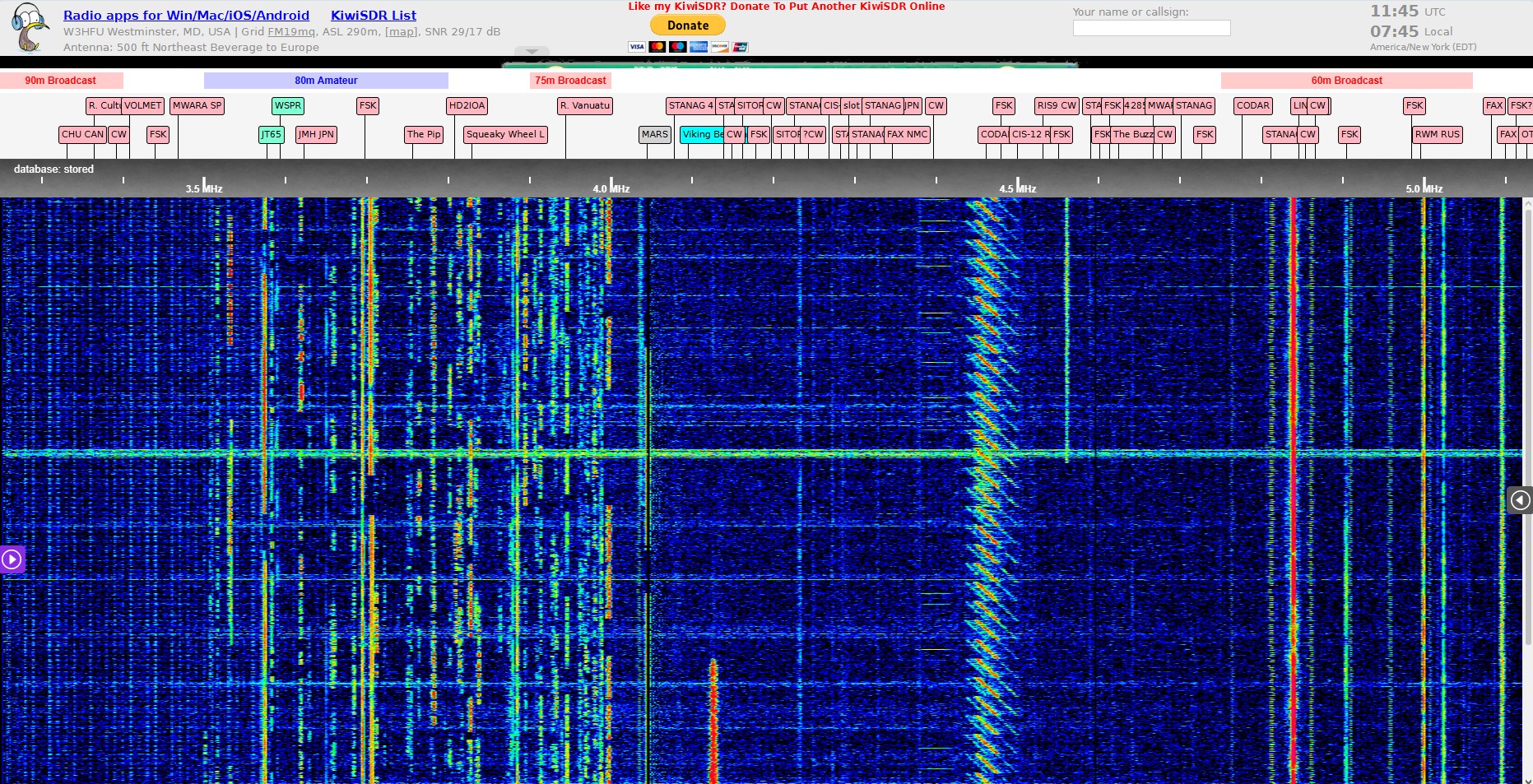
Who is looking for weak DX signals in the noise on 160 or 80 m can build his own receiving antenna or borrow someone else's through the browser: public KiwiSDR connected to beverage. Prijímač pracuje na vzdialenom, často vidieckom mieste a anténa je nasmerovaná tam, odkiaľ prichádzajú zaujímavé signály. Ward Silver, NØAX, a Frank Donovan, W3LPL, in an article from QST (November 2021) pripomínajú, že beverage antenna it remains relevant precisely because of its noise suppression capabilities.
You will read in the article
What is KiwiSDR

KiwiSDR je širokopásmový SDR prijímač with a GPS module in the form of a board for BeagleBone Black. It exists in two versions, KiwiSDR 1 and KiwiSDR 2. It is operated only through the browser. Jeden prijímač zvláda najviac štyri súbežné pripojenia, každé s vlastným zvukovým a vodopádovým kanálom. Vodopád ponúka 14 úrovní zväčšenia, režimy ako AM, USB a CW, S-meter a rozšírenia vrátane dekodéra WSPR. This has a practical advantage for the radio amateur: you don't need your own antenna or receiver to find out how your band is spreading and how to be heard on the other side of the Atlantic.
The principle of the beverage antenna
Harold Beverage, W2BML, received the first patent for his receiving system on June 7, 1921. Antennas of this type were used in transatlantic radiotelegraphy reception and reached lengths of up to 9 miles. Beverage's discovery was that a long horizontal wire, which itself has a bidirectional characteristic, becomes unidirectional if it is close to the ground and one end of it is terminated with a resistor.

The vertically polarized component of the electric field of the wave reflected from the ionosphere is tilted forward near the ground. The horizontal part of this inclined field induces a voltage along the entire length of the wire. Signals coming from the side practically do not excite the wire, and the horizontally polarized component near the ground is strongly attenuated by losses in the ground. The wire above the ground, together with its mirror image, forms an asymmetrical line with a characteristic impedance of around 500 Ω for most beverage antennas. If the line is terminated at the far end with a resistance approximately equal to this impedance, the signal coming from behind will be absorbed in it. The antenna then attenuates signals from all directions except the direction where the terminating resistor is, so it receives signals that go from the resistor to the feed point. It is a traveling wave antenna: it does not generate standing waves and is therefore non-resonant.
The advantages of this combination are therefore twofold. The Beverage antenna improves the signal/noise ratio by directivity and noise suppression, and KiwiSDR makes it possible to use an antenna that you would not build at home, for example due to lack of space. This is a receiver, not a replacement for your own station: you will not affect the antenna setting, direction or termination.
Length, height and impedance
Silver and Donovan report that the beverage works over a wide range of frequencies where it is about 3/4 to 5 λ long, with good results around 1 to 2 λ. It already has a useful directivity above approximately 1/2 λ, the full benefits are manifested at a length of around 1 λ. Above 5 λ, the sensitivity starts to decrease. A longer antenna has a narrower main lobe and better suppresses interference outside of it.
| Band | Recommended length (QST) | Recalculation |
|---|---|---|
| 160 m | 500 to 1,200 feet | approximately 152 to 366 m |
| 80 m | 300 to 600 feet | approximately 91 to 183 m |
| 40 m | 200 to 500 feet | approximately 61 to 152 m |

A typical height of the wire is 6 to 10 feet, which is about 1.8 to 3 m, mainly to prevent animals from bumping into it. Insulated supports about every 50 feet (about 15 m) are sufficient. The antenna is not sensitive to small variations in height, unless they exceed approximately 0.1 λ, which is around 15 m at 160 m. A transformer with a turns ratio of 1:3, i.e. an impedance ratio of 9:1, is used at the feed end, which adapts the antenna to a 50 Ω coaxial cable. Part of the system is grounding.
A practical example is provided by CQ.sk from OM0A. Anténa mala 180 m plného drôtu na najmenej ôsmich podperách vysokých 2 m, bezindukčný zakončovací odpor 470 Ω / 2 W, transformátor 9:1 na dvojotvorovom jadre Amidon BN 73-202 podľa W8JI a dve zemniace tyče dlhé 1,5 m. V CQ WPX Conteste on 80 m towards the northwest suppressed the European interference. Stations from the USA were therefore easier to receive, although the S-meter did not show a higher value. This is typical: the beverage does not increase the signal level, but the signal/noise ratio.
Preamplifier and trade-offs with KiwiSDR
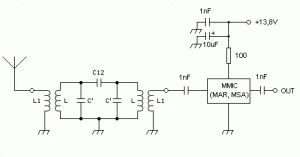
Beverage has a lower gain than a regular antenna, and the signal drops noticeably after switching from the broadcast antenna. That's why cq.sk describes a preamplifier with MMIC, where the author prioritized a low noise figure and resistance to strong signals over the gain itself. At the input there is a 9:1 transformer on a BN73-202 core. At a load of 450 Ω, there were no measurable reflections, at 470 Ω they measured ČSV 1:1.1 (4 W, MFJ-864). Since the MMIC is wideband, it has a bandpass for 80m with a measured width of 3.6 to 3.98 MHz at −3 dB.
It is also used preamplifier according to W7IUV based on the 2N5109 transistor.

Earth influence
The conductivity of the earth has a great influence on the result. Lossy ground improves beverage performance, high conductivity, especially seawater, significantly worsens it. Unlike broadcast antennas, beverage needs medium to low conductive soil. According to Silver and Donovan, the basic version is one-way. Reception from both directions will be ensured by separate feeders or relays at the ends.
KiwiSDR receivers with beverage antenna
KiwiSDR W3HFU
- Location: Westminster, Maryland, USA (locator: FM19mq).
- Antenna: 500 feet (approx. 152 meters) long receiving Beverage antenna directed to the northeast (primarily aimed at Europe).
- Technical background and frequencies: The receiver works in the range 0-30 MHz (VLF, LF, MF, HF). QTH is located in a rural area with the advantage of relatively low radio noise (low noise floor).
KiwiSDR EI5IN
- Location: Mullingar, County Westmeath, Central Ireland.
- Antenna: 580 meters (1900 feet) long Beverage antenna with bi-directional orientation Northeast / Southwest (NE/SW).
- Frequencies: Range 0-30 MHz, the receiver is optimized primarily for the lower VLF to MF bands.

KiwiSDR G8URE
- Location: Westergate, near Chichester, Great Britain (locator: IO90qu).
- Antenna: One-way Beverage antenna directed to the north ("Beverage - North").
- Frequencies: The device covers the range 0-30 MHz (includes VLF, LF, MF, HF).
KiwiSDR BIRMINGHAM KIWISDR2
- Location: Birmingham, central Alabama, USA.
- Antenna: Receiving Beverage antenna.
- Frequencies: Reception is standard broadband in the range of 0-30 MHz.
The combination of the classic Beverage antenna and modern KiwiSDR technology opens up completely new possibilities for radio amateurs when hunting for weak DX signals on the lower bands. Although directionality, significant noise suppression and a favorable SNR ratio make the Beverage antenna an unsurpassed receiving tool to this day, its spatial requirements are unfulfillable for many. Online access to remote receivers located in quiet rural locations elegantly solves this problem. Whether you are building your own system or using shared SDR stations, this combination will allow you to reliably hear signals that would otherwise be irretrievably lost in the noise.