
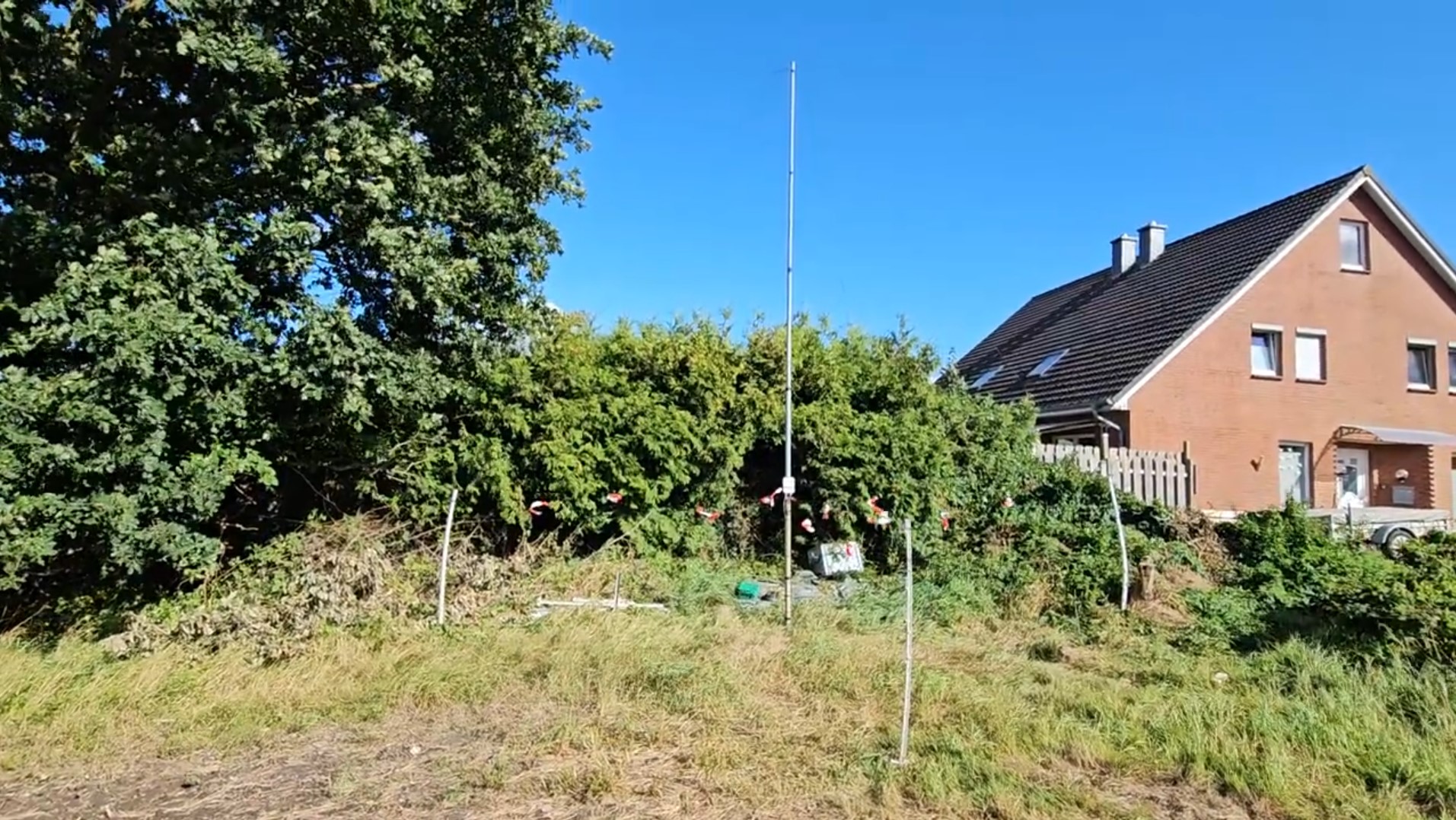
On the lower bands, good reception is often more difficult than good transmission. Local noise from switched sources, static from storms or a strong station on the same channel can destroy even the best session. The classic answer is a directional receiving antenna. But what to do when the disturbance comes once from the north and in an hour from the east? The British manufacturer QuietRadio offers a solution called Aziloop DF-72: nízkošumový prijímací systém pre pásma od VLF po KV, ktorý mení smer príjmu bez toho, aby sa anténa pohla čo i len o milimeter. Túto anténu používali aj DX expedície ako J51A or 9L8MD
You will read in the article
An antenna that rotates electronically
Behind Aziloop is Dave Evans, GW4GTE, from Buckley, Wales. In his own words, he needed a remote-controlled LF/KV receiving antenna that could be rotated immediately. There was nothing like it on the market, so he started developing it himself more than six years ago. The name "Azi" refers to Azimuth. The DF-72 model replaced the older 24-way version of the DF-24.
According to the user manual, the Aziloop is a dual-mode electronically rotatable receiving antenna with a main range of 20 kHz to 10 MHz. It works up to 30 MHz, but with reduced directivity and sensitivity, which ultimately depend on the size of the antenna. The system is intended for SWL listeners, radio amateurs and professional users.
Video: Dave Evans GW4GTE introduces Aziloop
Stepped-Azimuth™: 72 directions without rotator

The heart of the system is Stepped-Azimuth™ technology. The antenna consists of two loops of the same size, which are perpendicular to each other and have a common vertical axis. Below them are four radials as a ground plane or a ground rod. A circuit in the control unit near the antenna processes the signals from both loops and electronically synthesizes a single antenna rotated in any of 72 directions in 5° increments.
The manufacturer says it clearly: the antenna does not move, the rotation takes place electronically. Changing direction with the mouse wheel takes only 60 ms, according to the QuietRadio website. So the Rotator, waiting and mechanical wear are eliminated.
Video: ZL1IU at 80 m over the greyline
The recording of station ZL1IU from New Zealand on the 80 m band shows how reception with Aziloop looks in practice.
Two modes: Loop and K9AY
Aziloop offers two antenna modes in one device:
- K9AY – load-terminated loop with unidirectional cardioid characteristic, rotatable in 72 steps of 5°,
- Loop – a classic small loop with a figure-of-eight characteristic at low angles, which is omnidirectional at higher angles, with 36 selectable axes.
This gives a total of 108 combinations of direction and mode. On the home page, the manufacturer describes them as "108 antennas in one". The load in K9AY mode can be varied from 250 to 950 Ω in steps of 50 Ω. This shifts the rear minimum of the characteristic. The mode is switched by clicking on the compass in the application: outside the center circle you turn on K9AY, inside the Loop circle.
The manual also explains when to use which mode. The K9AY offers better reception at low angles and suppression of signals from behind, making it suitable for DX. Loop mode has side lows that will be used for both noise suppression and targeting.
Video: Aziloop at station IQ4FA
Control and hardware
The system consists of two units. The LCU (Loop Control Unit) is mounted directly to the antenna in a waterproof box with IP67 protection made of ASA material. CIU (Common Interface Unit) is a small aluminum box near the receiver. Both power and control go to the LCU via the power coaxial cable, so you do not need a separate control cable.
Main features according to the manufacturer:
- switchable symmetrical Preamplifier with a gain of 18 dB, located directly next to the antenna,
- a four-stage Attenuator in CIU (0, −6, −12 and −18 dB) and an “infinity” position that disconnects the receiver,
- together with a preamplifier of approximately 36 dB of level control,
- three 7-pole filters (two low-pass and one high-pass) and a fourth 1.7 to 5.5 MHz bandpass filter created by their combination,
- two auxiliary inputs/outputs, for example for muting on transmission (PTT),
- Omni-Rig support for synchronization with the receiver and automatic filter selection.
The antenna is controlled by an application for Windows 10 and 11. The application works in local mode, as a client or server. The CIU has a built-in Ethernet server, so you don't even need a computer on the antenna side. Aziloop can be controlled from anywhere there is an internet connection. This is a big advantage for remote locations where listeners move away from the local noise.
The system needs a clean 13.8V power supply. The draw is about 250mA, with the Ethernet server on 100mA more. The manual warns that the Aziloop is intended for reception only and must not be connected to the output of the transceiver.
What will Aziloop be used for in practice?
The manual presents several practical scenarios. They apply to any K9AY loop or antenna. However, Aziloop handles them much faster because it changes both mode and direction in milliseconds.
- Local noise from switched sources, ADSL and similar devices can be significantly suppressed or completely eliminated in steps of 5°.
- Atmospheric static from summer storms can be suppressed by suppressing signals from behind in K9AY mode or side minima in Loop mode.
- Nearby stations can often be separated from each other by changing the setting. A variable load that moves the rear minimum towards the unwanted station also helps.
- Aiming: a resolution of 5° means a theoretical error of no more than 2.5°. In Loop mode you can find the minimum axis and in K9AY mode you can determine which side the signal is coming from.
Video: noise from a solar MPPT controller
A typical example of local interference is shown in a video with noise from an MPPT solar controller.
What is in the package and where to buy
The package includes the CIU and LCU units, power cable, USB cable, AUX cable from 3.5 mm jack to cinch, two SMA/BNC adapters, four adhesive feet, two adapters for mounting the LCU on the mast and four pull straps. You build the loops yourself from a 24/0.2 conductor and a non-conductive central column. Refer to the manual for recommended dimensions.
The manufacturer does not state the prices on the website. In Great Britain, it is the exclusive dealer of ML&S, which also supplies to the EU with customs and tax equipment. PileupDX is available for EU customers and DX Engineering for North and South America. You can find the download guide and review from the May 2024 RadCom magazine on the website QuietRadio.
Summary
Aziloop DF-72 is the answer for listeners and radio amateurs who struggle with noise and interference on the lower bands. Electronically rotatable antenna with 108 direction and mode combinations, antenna preamplifier, filters and remote control via ethernet offers flexibility that a fixed loop can never achieve. However, you have to consider building your own antenna and a computer with Windows. Anyone looking for a directional receiving antenna for VLF to KV should definitely consider Aziloop.