
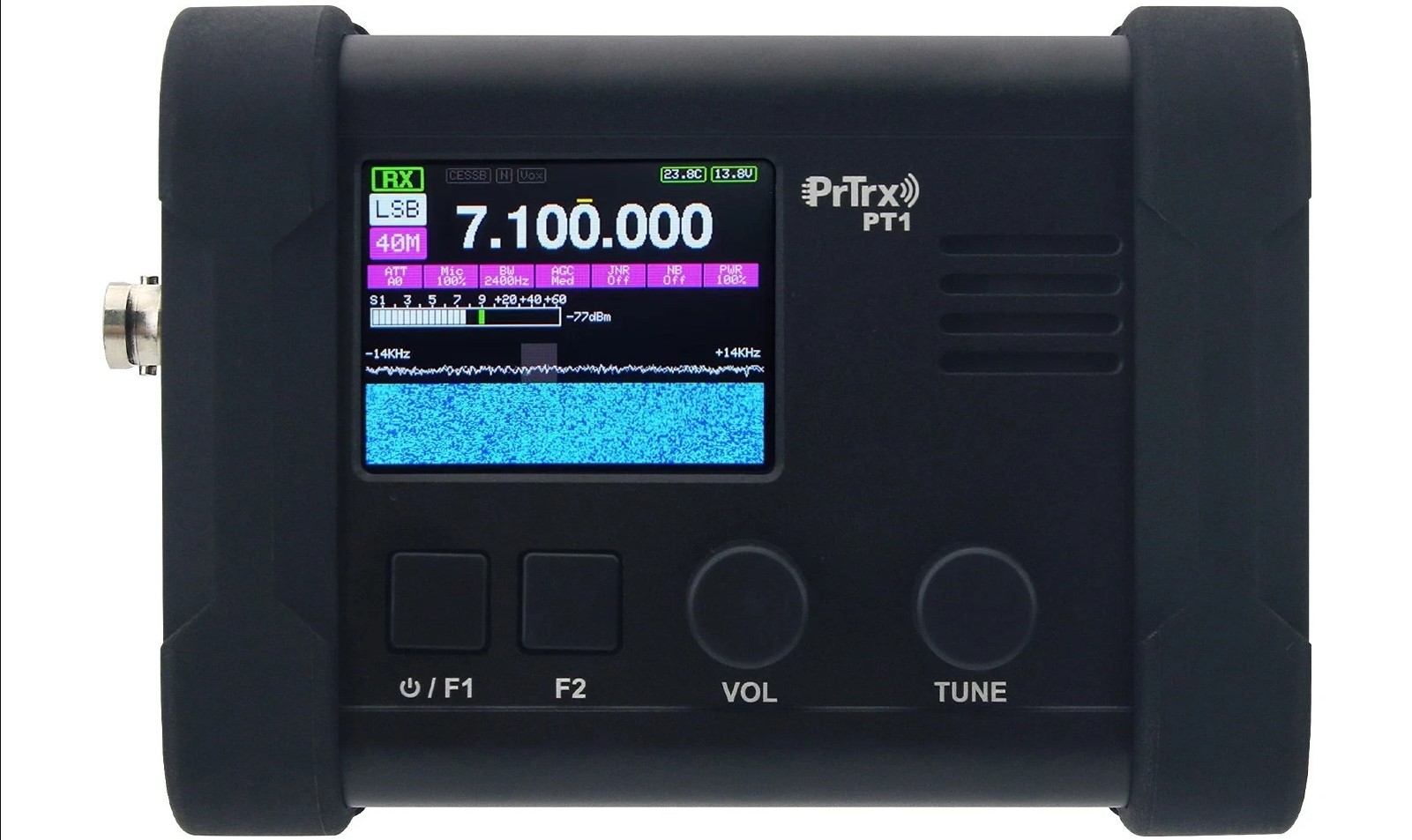
A few years ago, Fr SDR transceiveroch hovorilo ako o výsade drahých značiek. Dnes prichádzajú aj malé QRP stanice, ktoré sa zmestia do dlane, majú farebný displej, spektrum aj vodopád. K zaujímavejším patrí PrTrx PT1, a compact portable shortwave transceiver marketed by HamGeek that originated as a project on the GitHub.
The PT1 receiver covers 3.5 to 30 MHz and can be broadcast in all amateur bands from 80 to 10 meters. Let's see what the manufacturer offers for it and where to be careful.
You will read in the article
Origin and architecture
According to the project description on GitHub (by csqwdy), part of the hardware and software design is based on an open source project MBPTRX by VK7IAN. The original author allowed development on his architecture.

It is based on a Raspberry Pi Pico2 (RP2350) microcontroller and a QSD (Quadrature Sampling Detection) architecture for reception with QSE (Quadrature Modulation) for transmission. The signal is processed by a 24-bit codec. The manufacturer presents a zero-IF (homodyne) concept with a spectrum width of 28 kHz.
You can work with a 2-inch IPS display with a resolution of 320 × 240 pixels, which displays both the spectrum and the waterfall. Check out the first of the device videos below:
Operating types and filters
PT1 works in SSB, CW, AM and NFM modes. In the menu, they are marked as LSB, USB, CWL, CWU, DGL, DGU, AM and NFM, with DGL and DGU being data modes.
The bandwidth can be switched with digital filters. For SSB it is 2.0 to 2.8 kHz, for CW 50 to 500 Hz, for AM 6 and 10 kHz and for FM 11 kHz. NR noise reduction, NB impulse noise suppression and a notch filter are used to suppress interference. The manufacturer also mentions JNR technology.
Performance and power supply
It is a QRP station. The output power is continuously adjustable from 0.1 to 5 W. Up to 10 W is only available with improved cooling.
The author of the project on GitHub is honest about this. The hardware uses LDO stabilizers for lower noise and therefore heats up more than DC-DC converters. He does not recommend broadcasting the FT8 above 5 W without additional cooling. According to him, even 10 W can be safely transmitted with normal connections.
At 10 W PEP, according to the author, the station has IMD3 better than −35 dBc (measured −38 dBc). The power supply is 11 to 15 V DC (typically 13.8 V). Consumption during reception is a maximum of 280 mA, during transmission up to 2.5 A.
Connecting to a computer
The station can be controlled from a computer via the USB port, and the manufacturer states that it is suitable for data operation modes. On the back you will also find connectors for the antenna, key, microphone and speaker.
Dimensions and weight
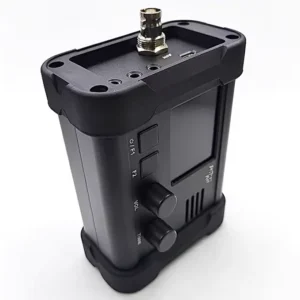
The PT1 measures 116 x 87 x 48 mm and weighs approximately 0.38 kg (station itself). The backpack also fits the microphone and cables. The operating temperature is 0 to 50 °C. However, the author admits that the cooling is not exceptional for the small size, so heating must be expected for longer transmissions of higher power.
Open hardware, closed software
V zhrnutí k téme sa objavilo, že ide o open source projekt. Presnejšie je to takto: hardvér je plne otvorený and diagrams, boards (Gerber), parts list and 3D parts can be found in the repository csqwdy/PrTrx_PT1. Softvér je však uzavretý. Radio amateurs can use it for free, but a registration code must be requested from the author after building the station.
In addition, according to the author, the construction is difficult: it is an advanced project with SMD soldering, fine-tuning and the need for measuring devices. It is not intended for beginners. Commercial sale of a station assembled from these documents is prohibited, DIY is only allowed for personal non-commercial use.
Price and availability
The finished piece is being sold by HamGeek for 9 (originally 9). At the time of writing, this is a pre-order, with orders from November 7, 2026 scheduled to depart between December 7 and 17. There was a bid on eBay for 1 plus shipping, but it was sold out. The package should include a station, hand-held microphone, power cable and instructions. The eBay offer also includes a three-year warranty.
Technical parameters
- reception: 3.5 – 30 MHz,
- broadcasting: 3.5–3.9; 7–7.2; 10.1–10.15; 14–14.35; 18.068–18.168; 21–21.45; 24.89–24.99 and 28–29.7 MHz,
- SSB/CW sensitivity: better than 0.20 μV (−121 dBm), MDS better than −136 dBm at 500 Hz,
- tuning step: 10 Hz, 100 Hz, 1 kHz, 10 kHz and 100 kHz,
- frequency stability: ±1 ppm after 30 minutes of warm-up,
- antenna impedance: 50 Ω, microphone 2 kΩ,
- sound power: 1 W at 8 Ω; 2 W into 4 Ω.
It is worth observing one note of the author about the speaker. FM uses phase demodulation, and with a 4 Ω speaker, power supply fluctuations can add 2 to 3 dB to the noise. He therefore recommends 8 Ω / 1 W.
Summary
The PrTrx PT1 is an interesting toy for QRP operators who want a small KV station with a waterfall and don't mind that it is a young product. On the one hand, it has good parameters and open hardware. On the other hand, software remains closed and cooling is a compromise. If you are looking for a station to try out QRP operation from the field, it might be an interesting choice. If you want 10 W permanently, count on additional cooling.