
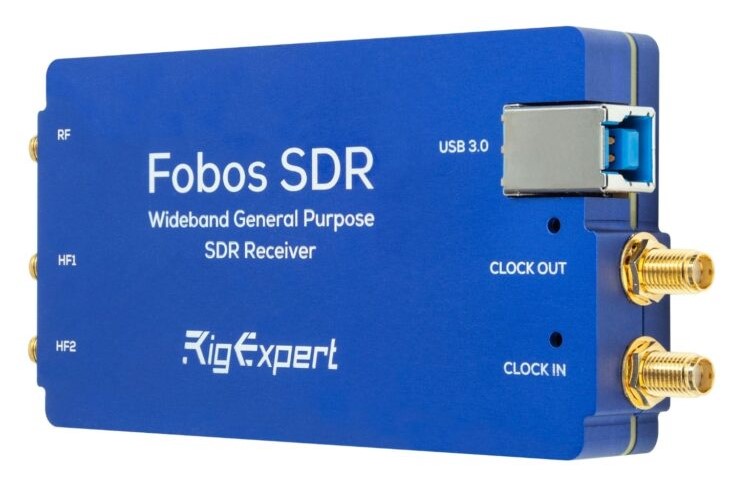
RigExpert Fobos Software Defined Radio is a broadband software-defined receiver whose design differs from conventional universal SDR receivers by combining two receiving architectures. For frequencies approximately 100 kHz to 25 MHz, it uses two coherent inputs with direct sampling, while the main receiving path covers VHF, UHF, and microwave bands up to 6 GHz and employs double superheterodyne conversion. The maximum sampling rate is 50 MS/s at 14-bitovom ADC a zariadenie prenáša IQ dáta cez USB 3.0.
Fobos is therefore not just a receiver designed to monitor a single narrow channel. Its hardware is designed to provide a continuous stream of digitized data to a computer that performs DSP, demodulation, recording, and further processing. This design is particularly interesting for the amateur radio operator who wants to work with multiple software environments, a wide range of IQ data, or experiment with their own signal processing.
In the article, you will read
Frequency range and two different receiving paths
The overall coverage of the Fobos SDR is specified in the range of 100 kHz to 6 GHz. However, the technical documentation distinguishes the individual inputs more precisely. Two auxiliary inputs, HF1 and HF2, are designed for direct sampling in the range of approximately 100 kHz to 25 MHz. The main RF input is intended for frequencies from 50 MHz to 6 GHz, with the documentation stating coverage from 25 to 6025 MHz. These data should therefore be read as the characteristics of the individual receiving paths, not as a single homogeneous receiver with an identical architecture across the entire range.

Direct sampling is used at HF. Therefore, the signal is not converted through a conventional frequency converter before the ADC. The advantage of this architecture is the absence of a local oscillator and mixer in the signal path before A/D conversion. On the contrary, the user must pay attention to signals outside the desired Nyquist band and appropriate input filtering. At a full sampling frequency of 50 MHz, the first Nyquist zone is up to 25 MHz.
Two coherent HF inputs
Dvojica vstupov HF1 a HF2 patrí medzi technicky najzaujímavejšie vlastnosti Fobos SDR. It's not just two independent connectors. The manufacturer refers to them as coherent channels with direct sampling, so they can be used in applications where the mutual phase relationship of the signals is important. RigExpert lists the use for diversity reception, correlation and direction finding based on phase difference.
V praxi to otvára space, for example, for experiments with two antennas. AB9IL uvádza možnosti diversity príjmu pri obmedzení fadingu, určovaní smeru, vytváraní riadeného nulového bodu proti rušeniu alebo výberu lepšieho signálu podľa SNR. However, such applications are not a matter of the receiver itself. They require suitable antennas, filters, preamplifiers and, above all, software capable of working with coherent channels.
VHF and UHF: double superheterodyne path

At frequencies above HF, the Fobos SDR uses a main RF receiving path with double frequency conversion. The datasheet specifies a double heterodyne, switchable preselector, and intermediate frequency filters. This concept differs from the direct sampling used in HF and takes into account significantly higher input frequencies up to the microwave range.
For amateur radio operators, the range above 50 MHz is particularly important. Thus, the Fobos can be included in receiving systems for 6 m, 2 m, 70 cm, and other VHF/UHF bands, as well as for higher microwave frequencies. AB9IL, in his test, describes good reception capabilities for VHF, UHF, and microwave signals when using an appropriate antenna, low-noise preamplifier, and sufficiently powerful computer.
14-bit ADC and up to 50 MHz IQ data
The Fobos SDR uses a 14-bit analog-to-digital converter and allows sampling in the range of 8 to 50 MHz according to the technical documentation. The manufacturer specifies a 50 MS/s IQ stream for maximum configuration, or two simultaneous 25 MS/s paths for direct sampling. Importantly, the device is designed for continuous data streaming without interruption of data blocks.

14-bit resolution provides significantly more levels of digitization than simple 8-bit SDR receivers. AB9IL, in analyzing the HF part, mentions a possible dynamic range of approximately 84 dB in ideal conditions and also points out that higher resolution means greater demands on data transfer and the performance of the host computer. Therefore, in a full 50 MHz sampling configuration, USB 3.0 is practically an essential part of the system.
Dynamic range, selectivity, and input level
The manufacturer specifies a blocking dynamic range of 86 dB for HF and 82 dB for VHF/UHF. The combined selectivity is specified at -110 dBm, and the software IQ image suppression reaches 52 dB. The maximum RF input level is +10 dBm. These numbers should be viewed as parameters of a specific receiving architecture and not as universal sensitivity or dynamic range values for every configuration.
In real-world use, the entire RF path is important. AB9IL points out especially at HF the possibility of ADC overload from strong local transmitters. An external LNA can improve receiver performance at weak signals, but too much gain can have the opposite effect. With strong AM or shortwave transmitters, an attenuator, band-stop filter, or narrower preselector may be necessary.
Direct sampling HF and aliasing issue
Direct sampling has one fundamental condition: strong signals that fall outside the desired Nyquist bandwidth must not reach the ADC. At 50 MS/s, the first Nyquist zone is up to 25 MHz. Reducing the sampling frequency further lowers this boundary. Therefore, AB9IL recommends a suitable low-pass filter, especially when using lower sampling frequencies.
This is an important practical feature for the designer of the receiving system. The Fobos SDR should not be automatically understood as a device to which any broadband antenna can be connected without further consideration of the RF environment. External filters can be very useful in the presence of strong local QRM. Additionally, in diversity reception, equal attention must be paid to both antenna branches.
Continuous data stream and spectrum recording
One of the main features of the Fobos SDR is the continuous IQ data stream. The manufacturer presents it as the basis for recording signals and real-time spectrum analysis. The device thus transmits digitized data to the computer, which ensures further processing. For amateur radio experiments, this means the ability to work with the entire captured spectrum instead of a single demodulated channel.
Such a concept is interesting, for example, in analyzing contest bands, monitoring short-term signals, satellite reception, or developing custom DSP algorithms. However, it should be noted that the Fobos does not have an onboard FPGA designed for complete DSP processing. More complex filtering, demodulation, and decoding are performed on the host computer.
Band Scan up to 14 GHz/s
In December 2024, RigExpert expanded the Fobos SDR with a fast spectrum scanning mode. The firmware and API allow for quick retuning to a specific frequency or to a list of up to 256 frequencies with a resolution of 1 Hz. In sequential scanning, the manufacturer states a speed of up to 14 GHz/s and a resolution of up to 0.6 kHz. This is a special feature that enhances Fobos beyond a classic SDR receiver.
For amateur radio practice, such a mode can be interesting for quickly searching for activity across a wide frequency range. It is also significant for custom software development, as RigExpert provides the API, firmware, examples, and documentation needed to utilize the scanning mode.
USB 3.0, power supply, and mechanical design
Komunikáciu, napájanie aj prenos IQ dát zabezpečuje USB 3.0 Type-B. Datasheet uvádza power supply 3.8 to 5.5 V and current consumption of 450 mA at idle, 670 mA in direct sampling mode, and 850 mA in full operation. Samostatný power supply Cooling is not required according to the documentation. The board has six layers with controlled impedance, and the RF section is shielded against electromagnetic interference.
The dimensions of the board are 110 × 60 mm, the external dimensions of the device are 130 × 60 × 16 mm, and the weight is 143 g. There are three SMA RF connectors available: one main RF input and two HF inputs. The connector set also includes a reference clock input and output.
10 MHz reference and synchronization
Fobos SDR has an internal reference oscillator and supports an external 10 MHz reference signal. The external clock input has high impedance, while the output provides a 10 MHz signal with an impedance of 5 Ω and a level of 3.0 Vpp. This configuration allows Fobos to synchronize with other SDR receivers or measurement devices.
The precise reference is particularly interesting for coherent measurements and weak digital modes. The datasheet states a frequency stability of ±0.5 ppm. AB9IL notes that for demanding applications, an external GNSS disciplined reference may be beneficial, especially in modes like WSPR, FT4, or FT8.
Software and open interface

Fobos SDR is not tied to a single application. RigExpert provides native support for μSDR and Software Defined Radio++, further plugins for SDR#, HDSDR via ExtIO, SoapySDR, and a source for GNU Radio. In 2026, native support was also added in SDRangel, and Fobos is supported through a plugin in SatDump.
For the technical experimenter, the availability of an API for Windows and Linux and sample source code is also essential. The datasheet provides examples of setup and tuning, acquiring IQ data, TCP streaming, and recording. Thus, Fobos can be used not only as a ready-made receiver but also as a hardware basis for one's own application.
Fobos SDR in amateur radio practice

In the amateur radio station, Fobos makes sense where wide frequency coverage, IQ data, and the ability to experiment with the receiving chain are important. VHF UHF can serve as a broadband receiver for monitoring activity, satellites, or telemetry. On HF, it offers two coherent inputs that can be utilized for diversity reception, correlation, or direction finding. However, for weak signals, the antenna, filters, LNA, and clock reference need to be properly designed.
For contesting, the wide IQ capture and the ability to record entire segments of the spectrum for later analysis can be particularly interesting. For the builder, the openness of the API and the possibility to connect custom software are important. However, Fobos should be understood as a receiver dependent on a host computer. Its high data rate and lack of onboard FPGA shift a significant part of the processing to the PC.
Who makes sense of Fobos SDR
Fobos Software Defined Radio is particularly interesting for the amateur radio operator who does not want to stick with a classic SDR interface with a single receiving channel. The combination of a 14-bit ADC, 50 MHz IQ data, two coherent HF inputs, a main VHF/UHF/microwave receiving path, external 10 MHz clocks, and an open software interface creates a platform suitable for experimentation.
However, when designing the station, one must also consider the other side of this concept: at full data flow, Fobos requires USB 3.0 and a sufficiently powerful computer, while for HF, external filtering may be necessary, and for weak signals, a suitably chosen LNA. The ability to select these elements according to the specific application is a fundamental part of the Fobos SDR concept.
Technically, Fobos SDR is therefore a building element of a receiving system rather than a classic stand-alone receiver. For a user who just wants to tune in to a station and listen, its concept can be unnecessarily complex. However, for the radio amateur dedicated to DX, VHF, satellites, digital modes, measurement, SDR programming or own RF experiments, it offers a combination of hardware interfaces and data access that allows you to build a receiving system according to a specific task.