
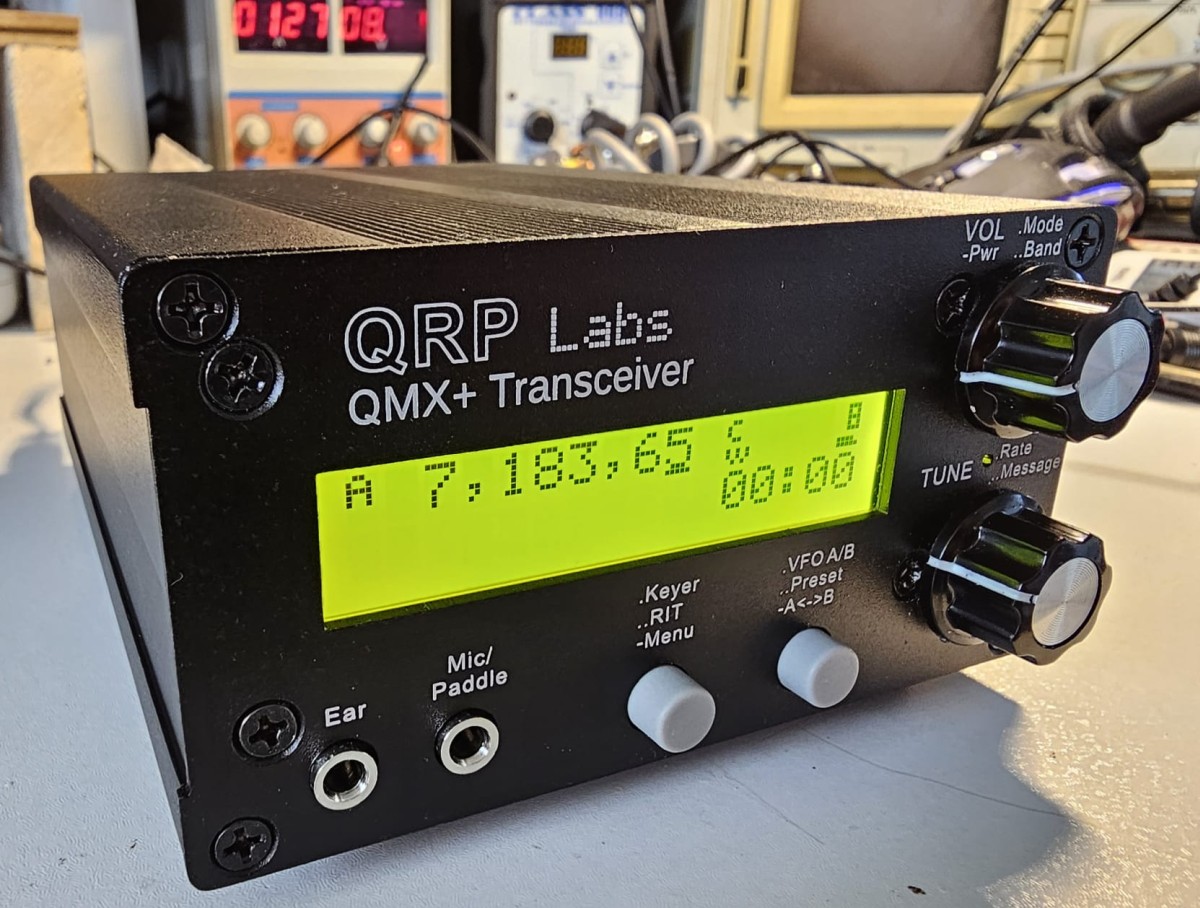
When Hans Summers G0UPL presented in May 2024 at Dayton Hamvention nástupcu svojho úspešného QMX, komunita QRP designers have caught the attention. The QMX+ 160-6m multi-mode transceiver is not just another five-watt output kit — it's a device that integrates in one compact chassis SDR receiver, 24-bitovú zvukovú kartu, CAT rozhranie, TCXO referenčný oscilátor, RTC clock and full coverage from 160m to 6m, all for a kit price of 5 (assembled 5). For the licensed radio amateur looking for a portable or backup TCVR vhodný rovnako na CW, FT8, WSPR, RTTY, PSK31, SSB či SOTA aktiváciu, je to ponuka, ktorú je ťažké ignorovať.
In the article you will read
Who is behind QMX+: Hans Summers G0UPL and the QRP Labs philosophy
Hans Summers G0UPL is a British radio amateur with a long history in QRP construction. His company QRP Labs, has become synonymous with exceptional price/performance ratio in the KV kit segment over the past decade. The line started with simple QRSS beacons, continued with the popular QCX series (five-watt CW transceiver available on individual bands), QDX (digital transceiver), and culminated in the QMX and QMX+.
Summers approaches the construction systematically: all SMD components are mounted on the PCB using industrial technology, so the kit builder works exclusively with classic components with leads (toroids, connectors, encoders, display). As a result, the kit can be handled even by radio amateurs without experience with SMD soldering. The PCB itself is of high quality, with through-holes and silkscreen printing — a quality that few people expect from a kit priced at 5.
Hans is also a regular speaker at international events. In July 2024, he spoke for RSGB in the “Tonight at 8” series, where he explained in detail the QMX+ architecture and the development path from QCX to the current device. In September 2024, he also attended NARC Live!, where he reported on the progress of the SSB firmware development. Both talks are available on YouTube and are a valuable resource for anyone who wants to understand what is going on inside this TCVR.
What makes the QMX+ special: SDR architecture in a QRP kite
The technological basis of the QMX+ is an architecture that would have previously belonged exclusively to expensive professional equipment: an embedded SDR receiver with 60 to 70 dB of unwanted sideband suppression. In practice, this means that the QMX+ receiver is not a classic superheterodyne, but an SDR solution implemented directly in the STM32 microcontroller, with the I/Q signal processed by DSP software in real time. This has a fundamental impact on the quality of SSB reception and the ability of the device to receive future firmware updates without any hardware changes.
Equally important is the philosophy of digital transmission in digi modes. While most cheap transceivers use an added tone modulator for FT8, WSPR or RTTY SSB transmission (which inevitably produces unwanted sidebands, residual carrier and intermodulation products depending on the linearity of the PA), the QMX+ in digi mode generates a pure FSK signal with a single sideband. The result is significantly reduced unwanted sidebands, minimal residual carrier and minimal IMD. On the bandscope in a DX cluster or skimmer, the QMX+ signal looks as clean as the signal of a station with a kilowatt linear and a professional transceiver.
For PSK31, VARA Winlink and other multi-tone or phase-modulated modes, the device's SSB mode (USB/LSB) is used, with audio input from either an external microphone or via USB audio from a PC. This combination means that virtually every digi mode used by radio amateurs today — FT8, FT4, WSPR, RTTY, JS8Call, Olivia, MSK144 are exceptions — is covered by a single device.
Another system-critical feature is the built-in 24-bit, 48 ksps USB sound card and USB Virtual COM port for CAT control. The QMX+ connects to the PC with a single USB-C cable and the operating system recognizes it as both a sound card and a serial port at the same time. You can configure WSJT-X, JS8Call or Fldigi just as you would a full-fledged stationary transceiver. No external audio interface, no Rigblaster, no complicated patch cables are required.
Bands, modes and performance: what QMX+ covers

QMX+ provides full coverage from 160 m to 6 m, specifically 11 bands: 160, 80, 60, 40, 30, 20, 17, 15, 12, 10 and 6 m. All WARC bands (30, 17 and 12 m) are of course included. The output power is 3 to 5 W at a supply voltage of 12 V (or 3 to 5 W at 9 V depending on the chosen construction configuration). The current consumption during reception is only 80 mA, when transmitting 5 W at 9 V it is about 1.0 to 1.1 A, at 12 V about 0.7 A. For SOTA activation with a LiPo battery, this is the parametric minimum that can last all day.

Band switching and receive/transmit switching are implemented relayless, solid-state switches controlled by firmware — no mechanical clicking, no contact wear, with instant response when controlled via CAT. The VFO is generated by the popular Si5351A synthesizer with a 25 MHz TCXO reference as standard, which guarantees sufficient frequency stability for operation without GPS correction. For maximum accuracy (for example, when operating WSPR with your own position in the WW locator) an internal QLG3 module is available.

The QLG3 is a miniature GNSS module with multi-constellation capability, designed directly as an internal option for the QMX+. Unlike the older QCX-series, where the GPS had to be connected externally via a Paddle port, the QLG3 in the QMX+ uses an independent USART microcontroller, so it can be permanently connected, without conflicts with the keyboard. The GPS provides automatic frequency calibration, RTC clock synchronization and provides QTH coordinates for WSPR beacon mode.
CW features: QMX+ as a full-fledged telegraph transceiver
Although the QMX+ is a multimode device, its CW functions are on par with those of a purely CW transceiver. The built-in Keyer supports iambic mode A and B, ultimate mode, and the classic straight key. Keying speed, dit/dah ratio, Sidetone, and all relevant parameters are adjustable via the menu.
There are 12 message memories available, each with a capacity of up to 50 characters. For contest operation, where the operator needs to quickly send CQ, own call, connection number or 73, this is a comfortable basis without the need for an external keyer. Sending a stored message is triggered by a long press of the relevant encoder.
The device also includes a real-time CW decoder, displaying decoded text directly on the LCD display — a handy aid in monitoring activity on the band, especially when a PC with skimmer software or RBN link is not at hand. For QRP operation in SOTA, POTA or WWFF contexts, where minimizing weight and computer dependency is key, the internal decoder is a significant added value.
An important detail for CW operation is the way the RF envelope is shaped during keying. The QMX+ implements raised-cosine envelope shaping, which eliminates clicks and sharp edges in the signal. The result is a clean, click-free CW signal that will be appreciated by neighboring stations on the band and receivers at the DX end of the link.
In addition to standard CW keying, the QMX+ also supports autonomous CW beacon and FSKCW mode — without a PC connection. The frequency for beacon mode can be set manually or automatically synchronized using GPS. For WSPR beacons, GPS is almost essential, as WSPR requires second-by-second timing accuracy and correct WW locator QTH coordinates. With the internal QLG3, the QMX+ can do it all on its own, without any computer.
The VFO offers dual-VFO operation (VFO A/B), split operation for pile-up situations, and RIT (Receiver Incremental Tuning) for fine-tuning the receive frequency without changing the transmit frequency. Frequency and message memories complete the picture of a transceiver that does not look like a compromise for CW operation.
Design and expandability: Dev kit and QLG3

The QMX+ is available as a kit (5) or as a fully assembled, tested, and configured transceiver (5). The chassis is optional — a black anodized extruded aluminum case measuring 106 × 55 × 146 mm with milled front and rear panels and laser-etched markings. The weight of the entire device, including the cover, is 578 grams.
The connectors on the rear panel include: 2.1mm power jack, USB-C (audio and CAT), BNC RF in/out, 3.5mm jacks for audio out, paddle/GPS/microphone/PTT in and PTT out. All digital interfaces are therefore covered without the need for any adapters.
For experimenters, an optional Dev kit is available: an unpopulated PCB on a 0.1-inch matrix grid, mounted above the main board on 11 mm spacers. The Dev kit provides access to 11 GPIO ports (0 to 10), an I2C bus (SDA, SCL), signals for selecting BPF and LPF bands, an RF output (suitable, for example, for installing an Auto-ATU module), powered by 3.3 V and 5 V rails, and other signals. This is the basis for integrating an Arduino Nano or other microcontroller, adding an external diplexer, automatic antenna tuner, or a custom display. The case also has 11 GPIO ports, one of which is output to a 3.5 mm stereo jack marked "AUX", configurable as a serial port.
The RTC clock uses the internal RTC peripheral of the STM32 microcontroller with a CR2032 battery, whose theoretical lifespan under this load is 20 years. The clock thus remembers the time even after the power is disconnected, which is welcome for repeated use in the field.
YouTube: where to find QMX+ in action
The best way to get your own picture of the QMX+ before building or purchasing is to watch the videos available directly from the device's creator and from independent builders.
RSGB Tonight at 8 — Hans G0UPL on QMX+
Hans Summers G0UPL's RSGB talk on July 8, 2024 is the most detailed public explanation of the QMX+ architecture yet. Hans explains the SDR approach, the history of development from QCX to QMX+, the details of the PA connection, and the reasons for specific design decisions. Ideal for anyone who wants to understand the device in depth, not just use it.
NARC Live! — SSB firmware update and Q&A with Hans G0UPL
The recording from the September 2024 NARC Live! event captures Hans presenting the latest state of development of QMX+'s SSB capabilities. It also includes a live Q&A in which Hans answers specific technical questions from the community — an interesting read (watch) for anyone planning QMX+ for SSB operation.
QMX+ build by Hannes DL9SCO
Hannes DL9SCO documented the entire QMX+ kit build in the form of a YouTube video. For future builders, this is probably the most valuable resource: seeing the process of a real constructor, his solutions and recommendations, is irreplaceable. The video also points out practical aspects of assembly that written instructions do not always fully cover.
A complete playlist of QRP Labs videos about QMX, including operational demonstrations, tests, and firmware updates, can be found on the QRP Labs YouTube channel.
Conclusion: A QRP kit that will surprise you
The QMX+ 160-6m is not a device for everyone. Those who expect a touch screen, a spectrum analyzer or hundreds of watts into the antenna should look elsewhere. For the radio amateur who is interested in a clean signal, proven SDR architecture, autonomous CW and WSPR operation, full coverage of all HF bands including WARC and 6m, and the joy of building a kit with a professional PCB — the QMX+ represents one of the best designed and most valuable products the QRP community has seen in recent years. The fact that it is behind it all, Hans Summers G0UPL, who regularly publishes new firmware, manuals and schematics on his website, only confirms that when you buy a kit for 125 USD, you are also buying active support from the designer.
For those interested in details: complete documentation, schematics, firmware and purchase are available directly at qrp-labs.com/qmxp.html.