
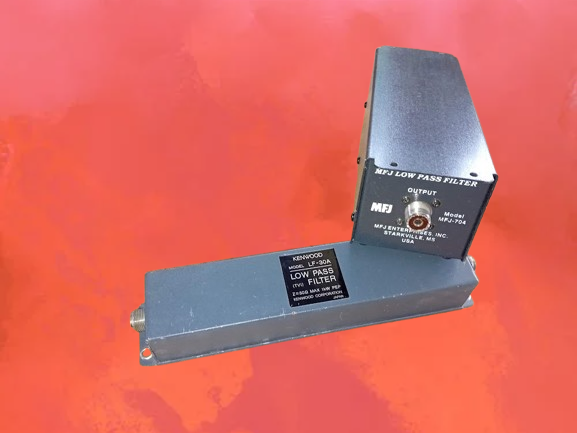
Low-pass filters serve to suppress unwanted products, especially harmonic frequencies, produced by the transmitter. Short-wave commercially manufactured devices have these products suppressed mostly well, but in the case of connecting the final stage, it is necessary to include a low-pass filter with a cut-off frequency of 30 MHz behind it.
Schematically, these filters are quite simple - a multipole pi cell. Parts for larger outputs are mostly hard to come by, and that's why some radio amateurs will certainly welcome commercially produced filters. You can find three such filters in the review - Kenowood LF-30A, MFJ-704 and Vectronics LP-30. Designers can also take inspiration from the sketched solution.

You will read in the article
Kenowood LF-30A
Kenwood LF-30A is a small filter (244x50x40mm). The manufacturer states the dimensioning for 1kW PEP power and inherent losses below 0.5dB at frequencies below 30MHz. Notice the mechanical arrangement in the photo – the capacitors are made up of massive disks that are insulated from the grounding partition by a thin PTFE film. All coils are thus mutually shielded.

Vectronics LP-30 and MFJ-704
Vectronics LP-30 and MFJ-704 they are mechanically constructed very similarly. In the boxes, which are the same size (220x77x71mm), there is no shielding partition. The capacitors are formed by a double-sided printed circuit board and the coils are soldered at different angles. The manufacturer assumes that the distance between the parts and their orientation are sufficient so that no unwanted bonding between them occurs. The load capacity of these filters is 1.5kW PEP and inherent losses lower than 0.5dB at frequencies below 30MHz.


Measurement and test result
All filters were subjected to measurement using a HP signal generator and a selective voltmeter. The results can be seen in the graph. Here, the advantage of the LF-30A design was shown, which achieves better values in the area of the stop band. While the LP-30 and MFJ-704 achieve about -50dB of rejection, the Kenwood more than -66dB, which was the meter's range. Vectronics and MFJ also have a few at higher frequencies where the rejection is lower but also higher.
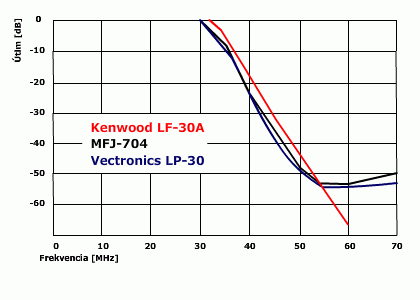
The winner of the test was the Kenwood LF-30A, which is also the cheapest. The MFJ/Vectronics design is more of an inspiration for domestic production of such a filter.