
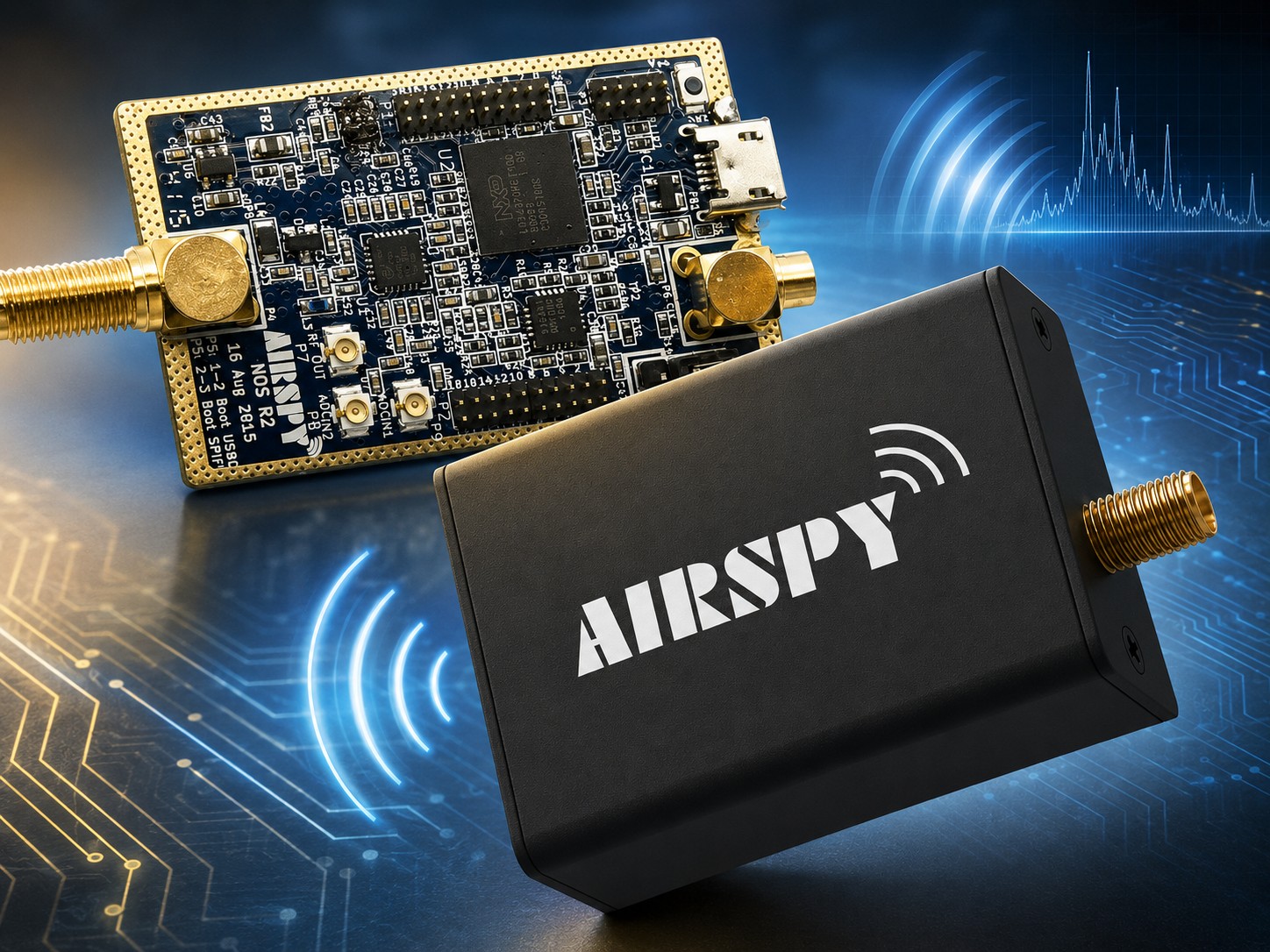
Airspy R2 is a software-defined receiver (SDR) designed primarily for the VHF and UHF bands, which has established itself as a reference point in the mid-price range of SDR hardware since its launch. Unlike conventional RTL-SDR keychains, which are built on a TV tuner with an 8-bit converter, the Airspy R2 is based on a different conceptual basis - it uses an architecture with a low intermediate frequency filter (low-IF), a 12-bit ADC s vysokým rozlíšením a výkonný ARM procesor Cortex M4F. Výsledkom je prijímač schopný práce v podmienkach, kde lacné dongle zlyhávajú: pri veľkých anténach, v RF-hustom prostredí alebo pri príjme slabých signálov vedľa silných staníc.
The manufacturer of Airspy – French developer Youssef Touil and his team – is also the author of the SDR# (SDR Sharp) software, which means that the hardware and primary software are developed as a single unit. This synergy is reflected in features that are not available with other SDR hardware/software combinations or require complicated configuration.
In the article you will read
Unique features of Airspy R2
Oversampling and resolution up to 16 bits

The physical ADC in Airspy R2 operates with a resolution of 12 bits at a sampling rate of 20 MSPS (effective number of bits 10.4 ENOB, SNR 70 dB, SFDR 95 dB). In oversampling mode, the receiver combines analog RF and IF filtering with software decimation, thereby increasing the effective resolution to 16 bits for narrowband channels. For a radio amateur, this means a significantly lower noise floor and better sensitivity when receiving weak signals.
Absence of IQ imbalance and DC offset
One of the main practical differences compared to cheaper SDRs is the absence of IQ imbalance, DC offset and 1/f noise in the center of the spectrum. These artifacts are a common problem of RTL-SDR dongles and several other SDR platforms - in the panoramic display they appear as false signals or significant increases in noise at the tuned frequency. According to the manufacturer, the Airspy R2 is free from these phenomena, which simplifies the work with a panoramic spectrum analyzer.
Reference oscillator with 0.5 ppm accuracy
An integrated oscillator with low phase noise and ±0.5 ppm accuracy ensures long-term frequency stability, which is essential for decoding digital modes, airband reception or FM DX monitoring. An external reference signal in the range of 10 to 100 MHz can be connected to the MCX connector - for example, a GPS-disciplined oscillator (GPSDO) or a rubidium standard, which opens up the possibilities of phase-coherent receiving sets.
Panoramic view of 10 MHz without aliasing
The 10 MSPS IQ output provides an instant view of 10 MHz bands (9 MHz without aliasing). This is practically useful for scanning monitoring: the entire 108–137 MHz airwaves can be monitored in a few steps, the FM broadcast band in two. In conjunction with the Frequency Scanner plug-in for SDR#, carrier signals can be scanned in such a band at a speed of a few seconds over the entire covered band – without retuning.
Bias-T, GPIO and expandability
The Airspy R2 features a software-controlled 4.5V bias-T on the SMA input, allowing an external low-noise preamplifier (LNA) or SpyVerter converter to be powered directly via the coaxial cable. The board also features 16 SGPIO lines, 8 programmable GPIO pins up to 100 MHz, 3 synchronized clock outputs up to 160 MHz, and a JTAG header. For experimenters and designers, the Airspy R2 is more of a development platform than a closed consumer product.
Compatibility and open-source ecosystem
The firmware and libairspy library are available as open-source on GitHub. The receiver is supported in all major SDR software environments: SDR# (primary), SDR Console, HDSDR, GQRX, GNU Radio, SDRangel and others. Under Windows Vista and later it works as plug-and-play - no driver installation required. Under Linux it is enough to install the host package for Airspy.
Airspy R2 technical specifications
| Parameters | Value |
|---|---|
| Received frequency range | 24 – 1700 MHz (native); expandable to DC with SpyVerter |
| Noise figure (NF) | 3.5 dB (between 42 and 1002 MHz) |
| Maximum input power | +10 dBm |
| IIP3 (3rd order intercept point) | +35 dBm |
| ADC resolution | 12 bit at 20 MSPS (10.4 ENOB, SNR 70 dB, SFDR 95 dB) |
| Effective resolution (oversampling) | up to 16 bit for narrowband channels |
| IQ output | 10 MSPS (standard); 2.5 MSPS (experimental, Raspberry Pi) |
| Maximum sample rate (custom FW) | 80 MSPS |
| Panoramic spectrum | 10 MHz (9 MHz without alias) |
| Processor | ARM Cortex M4F @ 204 MHz + dual M0 |
| Reference oscillator | ±0.5 ppm, low phase noise |
| External reference input | 10 – 100 MHz (MCX connector) |
| RF input | SMA, ESD protection up to 30 kV |
| RF output (loopthrough) | U-FL, ESD protection up to 15 kV |
| Bias-T | 4.5 V, software controlled |
| GPIOs | 16× SGPIO, 8× programmable up to 100 MHz |
| Hourly outputs | 3x synchronized up to 160 MHz |
| PC interface | USB 2.0 (Micro USB) |
| Operating power supply | via USB |
| Operating temperature | −10°C to +40°C |
| Drivers (Windows) | not required (plug-and-play) |
Practical example: Airspy R2 and SDR#
The following video demonstrates setting up and working with Airspy R2 in a Sharp SDR environment, including firmware updates and basic spectral display configuration.
Hardware and software requirements
Minimum hardware requirements
Airspy R2 je z hľadiska nárokov na počítač nenáročný: samotný receiver potrebuje menej ako 1 MB operačnej pamäte. Výpočtový výkon si však vyžaduje hostiteľský softvér, predovšetkým pri spracovaní 10 MHz pásma v reálnom čase. Výrobca udáva minimálne požiadavky: procesor Intel Core i3 3. generácie s taktom 2,4 GHz alebo ekvivalentný, 2 GB RAM a vysokorýchlostný radič USB 2.0. Pri nižšom vzorkovaní 2,5 MSPS možno Airspy R2 prevádzkovať aj na minipočítačoch Raspberry Pi alebo Odroid – táto konfigurácia je vhodná pre jednoúčelové dekódovacie stanice (ADS-B, ACARS, digitálne módy).
Supported operating systems
Airspy R2 is fully supported under Windows 10 and 11 (historically Vista, 7, 8, 8.1), Linux, *BSD and macOS. Under Windows, no driver installation is required - the device is automatically detected. Under Linux, the open-source libairspy package needs to be installed, after which the receiver works without further configuration in most SDR applications.
Software support
The primary and best supported software is SDR# (SDR Sharp), which is developed in parallel with the hardware by the manufacturer. SDR# has a modular plug-in architecture allowing for expansion with CTCSS/DCS decoding, fast band scanning (Frequency Scanner), band planner (bandplan), as well as direct decoding of digital modes including DMR and TETRA via appropriate plug-ins. Other supported applications include SDR-Console, HDSDR, GQRX, SDRangel and GNU Radio. Commercial solutions Krypto500 and Krypto1000 are available for professional signal analysis.
Pre rádioamatérov sú relevantné najmä tieto kombinácie: SDR# s plug-inmi pre digitálne módy, GQRX pod Linuxom pre všeobecný príjem, alebo integrácia s WSJT-X resp. JTDX prostredníctvom virtuálneho audio rozhrania pre príjem FT8, FT4 and other weak signal modes on VHF/UHF. For tracking satellites including QO-100 je Airspy R2 zaujímavým riešením. QO-100 Downlink is in the 3cm range, which of course needs to be addressed LNB s konverziou do vyhovujúceho rozsahu.
HF band expansion – SpyVerter
An additional upconverter is used for reception of HF bands and below. SpyVerter R2, which is designed specifically for the Airspy R2 and uses the same housing and bias-T power supply. The SpyVerter pushes the input signal up to the native range of the Airspy R2. User experience with this combination is mixed - results depend on the quality of the external filtering and the SpyVerter version. For pure HF reception, the dedicated Airspy HF+ Discovery receiver is more suitable.
Preview: Airspy R2 – a look inside
The video below takes a detailed look at the Airspy R2's construction and explains its hardware architecture.
Summary
Airspy R2 occupies a well-defined position in the SDR receiver ecosystem: it is a device for those who have outgrown the limitations of RTL-SDR but do not need or cannot invest in a full-fledged communications receiver. Its main advantages – high IIP3 (+35 dBm), low noise figure, absence of IQ artifacts, 10 MHz panoramic window and accurate oscillator – are features that matter in real-world operation with an efficient antenna connected.
For the radio amateur, the Airspy R2 has practical applications in monitoring VHF/UHF bands, DX reception on FM, decoding digital modes (FT8 on VHF, satellite downlink, ADS-B, DMR, P25), or as a second receiver in a contest to monitor activity on the band without loading the main transceiver. GPIO connectors and programmable clock outputs make it an interesting platform for designers of coherent antenna arrays or experimental DF (direction finding) systems.
The limitation is the limited native range from above (1700 MHz), which for some applications (2.4 GHz satellite downlink) requires an external downconverter. Sensitivity in the band above 1 GHz gradually decreases and at frequencies above 1.2 GHz a tuned antenna with a preamplifier is recommended. Another practical limitation is the dependence on a PC - unlike the network SPY Server mode, where Airspy R2 works as a remote receiver accessible via the network, in the field it always needs an active host.
The overall construction quality – aluminum case, multilayer PCB, local oscillator shielding – corresponds to the price category of the device and explains why the Airspy R2 remains one of the recommended choices in the SDR experimenter and radio amateur community, despite its years on the market.