
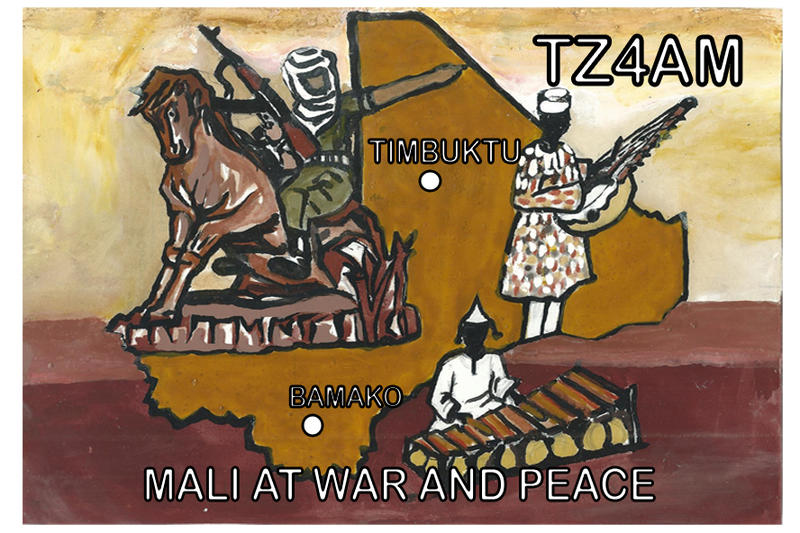
The TZ4AM station from Bamako is one of the most stable sources of connections with Mali. Jeff, who broadcasted in his youth under the callsign K1MMB, returned to radio in 2015 after a fifty-year break, announcing his return to the air from October 22 to December 2, 2026. He will primarily operate CW and SSB on bands from 80 to 6 meters. QSL is managed by KX4R (Greg Carter).
In the article, you will read
Mali: a Sahel country on the Niger River
Mali is one of the Sahel countries – the Sahara reaches almost to the gates of the capital. The country covers an area of 1,240,000 km², and the official language is French. The lifeblood of the country is the Niger River, on which the capital Bamako, the financial and industrial center, is located.
The country was once the heart of great African empires; from those times, legendary Timbuktu remains, the center of West African scholarship on trans-Saharan trade routes, and Djenné with its Great Mosque – the largest structure in the world made of adobe, listed as a UNESCO World Heritage site. The station's QTH (locator IK52) is located on a three-story building; hills and cliffs to the west can, according to the operator, shade signals in the azimuth of 240–300° at elevations below 9°, but there is a valley leading towards North America, and other directions are clear.
Station and antenna systems of TZ4AM
Hlavnú stanicu tvorí Elecraft K3S a koncový stupeň KPA1500. Both devices have been repaired by the manufacturer and according to the operator, they will be back in operation at the beginning of November; until then, he is working on ICOM IC-7300, ktorý v Bamaku zanechal hosťujúci operátor Ulmar, TZ1CE/DK1CE. The maximum power is approximately 1,400 W, but during pile-ups, it typically runs around 400 W and full power is mainly used during the first call.
For the 20 to 10 meter bands, the OptiBeam OB16-5 – a 75 kg heavy antenna on a Rohn 45 (9 m) mast installed on a roof at a height of 13 m. Its installation is a good lesson in mechanical sizing: the original lighter Rohn 25 mast could not support the weight of the antenna, and its upper section bent under the load. The mast had to be dismantled, the base reinforced, and the antenna was finally raised by a local team without a crane, using only a helper pole and a pulley. Compared to the previously used log-periodic Yagi 59+ (Wimo/EAntenna), the OB16-5 provides approximately one S-unit stronger signal on most paths, especially to Asia and the Pacific. zhruba o jednu S-jednotku silnejší signál na väčšine trás, najmä do Ázie a Pacifiku.
On a 12-meter mast at a height of 25 m above ground, there is a 10-element Yagi 50LFA10 for 6 m and below it a full-size 3-element Yagi for 30 m, designed by Gary, K9RX. For 80 m, a vertical antenna on 11-meter bamboo poles is used. An Inverted-L for 160 m and receiving beverage antennas are currently out of service – thieves repeatedly steal the wire from them, even after switching from copper to steel.
Power: solar system instead of public grid
Electricity supply from the local company EDM is unreliable in Bamako – outages last on average 18 hours a day, and the price is approximately Dodávky elektriny od miestnej spoločnosti EDM sú v Bamaku nespoľahlivé – výpadky trvajú v priemere 18 hodín denne a cena je približne 0,42 USD za kWh. Situáciu zhoršila palivová blokáda zo strany džihádistov, počas ktorej EDM dodávala prúd približne 6 hodín denne, často mimo denného svetla. Stanica preto beží na solárnom systéme s regulátormi a meničom Victron a batériami LiFePO4. Ten pokryje potreby domácnosti, kancelárie aj vysielania a po skončení obdobia dažďov dokáže batérie nabiť do súmraku bez obmedzovania prevádzky..42 per kWh. The situation worsened due to a fuel blockade by jihadists, during which EDM supplied power for about 6 hours a day, often outside daylight hours. Therefore, the station runs on a solar system with Victron regulators and inverter and LiFePO4 batteries. It covers the needs of the household, office, and broadcasting, and after the rainy season, it can charge the batteries until dusk without limiting operation.
RFI from neighboring inverters
Paradoxically, solar energy is currently the biggest problem for reception. Neighbors on three sides of the house (the fourth being a cemetery) have installed cheap low-quality inverters that produce significant interference from 160 to 10 m and even on 6 m. The DC lines to the panels act as effective transmitting antennas. The noise level has increased from the original S2–S3 to S4–S9 on most HF bands, with the situation being worse at night than during the day. A comparative test with IC-7300 the battery showed an S0 level in the countryside, while at the QTH it was S1–S3 and up to S7 on 160 m.
This has a direct impact on European stations: weak signals, QRP stations, and distant expeditions are lost in the noise. The operator openly requests advice on noise reduction and ferrite cores of Mix 31 and 43 materials for chokes.
DXCC, 6m, and operating rules
In the DXCC Challenge, TZ4AM has 2,263 points, Mixed 300, CW 299, and Phone 228 entities. On 6 m, he has achieved 106 entities, of which 100 are in CW. From Europe, he still lacks entities like 1A, 3A, HV0, OJ0, OY0, Mount Athos, Island, and ITU HQ on 6 m. The beacon TZ4AM/B transmits on 50.050.5 kHz with a power of 50 W most days between 10:30 and 18:00 UTC; after spotting, the operator switches to 50.105 kHz simplex and announces the beacon direction in the ON4KST 50/70 chat. He is currently not using FT8 – any FT8 activity under his call sign is pirated.
operation is almost always split. In CW, listen from 1.5 kHz down to 1.0 kHz UP, so it makes sense to call higher outside the main pile-up. Give your callsign twice, in SSB always in full - does not respond to partial calls. If he has your callsign correct, just RRR and report; repeating the callsign leads him to think he wrote it down incorrectly. Tail-ending and calling during another QSO leads to temporary ignoring. Duplicate QSOs on the same band in the same calendar year are not welcome.
Guest operator TZ1CE/DK1CE made around 8,800 QSOs from this station in 2026, mostly FT8 on 40 to 6 m, and also participated in the mast exchange.
QSL TZ4AM Mali
The preferred confirmation is LoTW; KX4R uploads the log approximately twice a week. A paper QSL card direct to KX4R with 2 USD and a self-addressed envelope. Bureau cards are not processed, QRZ.com log, eQSL, or digital cards are not used.
Security situation
Bamako is under pressure from armed groups that have blocked ground transport to and from the city. The operator states that in case of emergency, he will leave the city - the planned operating date should therefore be taken as tentative. Internet connectivity is unreliable; the Reverse Beacon Network node, which was established in Bamako by N4ZR, DK1CE, and DK9IP, has been out of operation since February 2025 due to a provider outage.
Current information about TZ4AM operation, beacon direction, and QSL can be found on the callsign's page on QRZ.com. The log is uploaded to LoTW continuously - 'insurance' duplicate QSOs are not needed.