
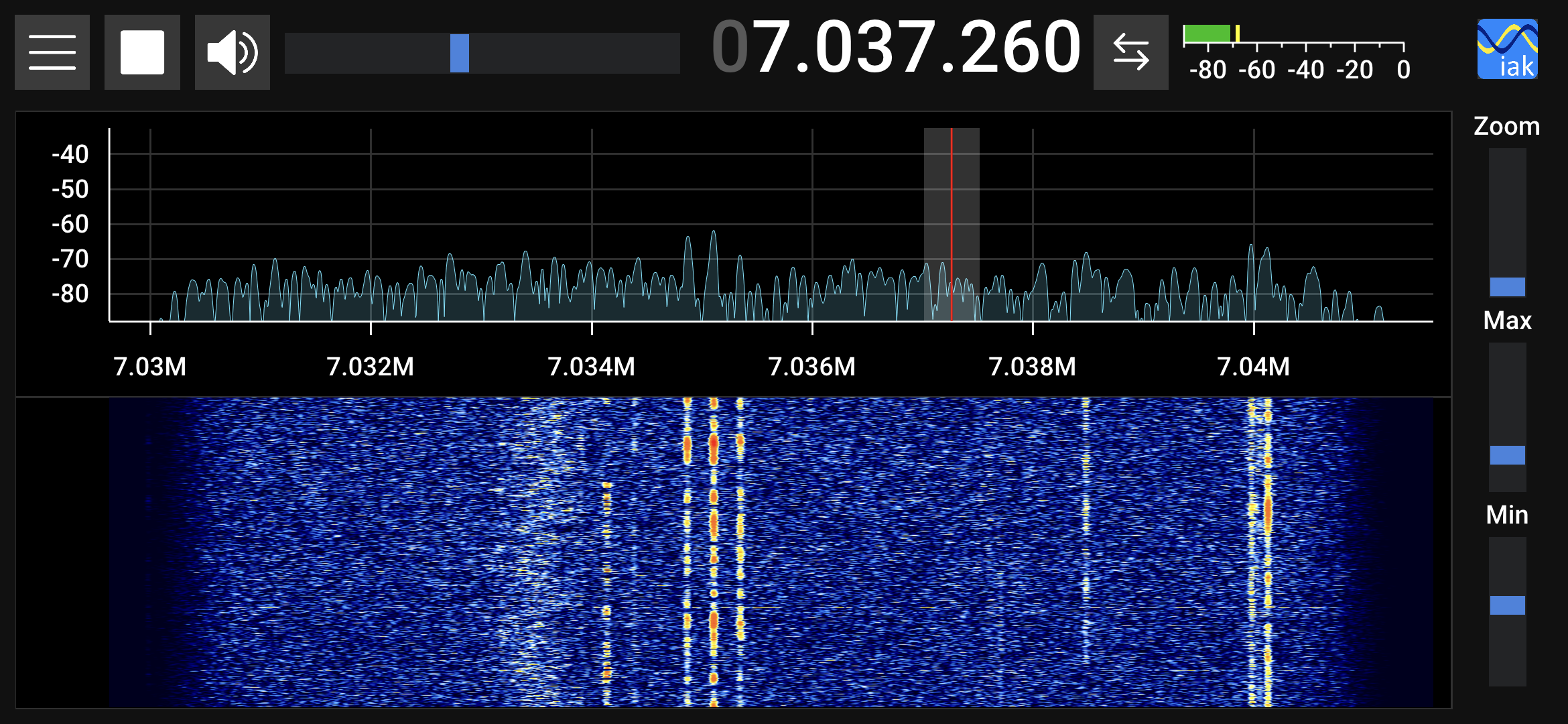
SDR++ is a popular, general-purpose software-defined radio program commonly used by RTL-SDR enthusiasts around the world. It runs on all major platforms including Android, but the original author showed no interest in officially publishing it on the Google Play Store, so for Android devices, the only option for a long time was sideloading the APK file from outside the store. This changed with the arrival of the unofficial fork called SDR++ iak.
In the article, you will read
Reason for creating SDR++ IAK by Vojtěch OK1IAK
The SDR++ iak fork is maintained by Vojtěch Bubník, OK1IAK, since March 2026. It builds on the original SDR++ project by Alexander Roum and is regularly merged with the current upstream master. According to the official description in repositories on GitHub the reason for the creation of the fork was the support of the transceiver QRP Labs QMX by Hans Summers, G0UPL – as literally stated in the changelog, it is the 'reason why this fork exists'.
The key feature is a direct USB IQ source for QMX, with native backends for Windows, Linux, macOS, and Android: IQ streaming at 48 kS/s at 24-bit resolution, bidirectional CAT synchronization of VFO frequency and mode (including CW-R), and sound muting during QMX transmission. For remote reception, there is also a QMX server source that streams IQ data over the network from QMX connected to a remote device – for example, using the companion Android app qmxserver-android, built on the enet library (extended with IPv6 support specifically for this fork).
Fork installation occurs simultaneously with the original SDR++ (custom package names, configuration folder, and Android App ID), so both versions can be installed side by side without conflict.
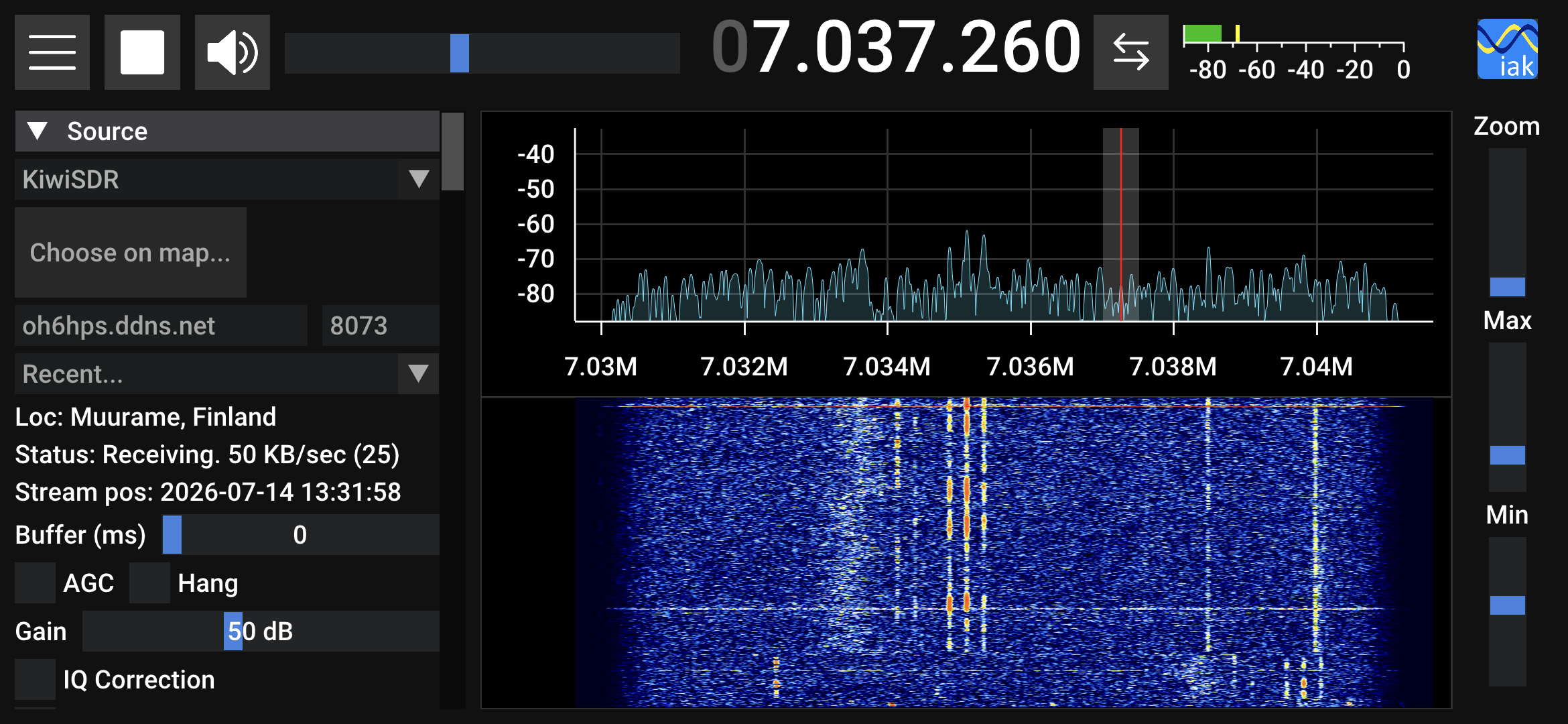
The first public release of SDR++ iak was labeled v1.2.2 and was released on July 14, 2026. The later version v1.4.0-beta brought extensive improvements to touch control – a redesigned interface tailored for touch controls sized appropriately for Android, a dark theme in Material 3 style, swipe scrolling with inertia, and haptic feedback; the touch style can also be tried on desktop.
Which devices are supported?
In addition to the direct USB connection to the QRP Labs QMX transceiver (and remote reception via the QMX server), the fork has also adopted and expanded many other signal sources from community forks of SDR++. These include the KiwiSDR client with a world map of servers (showing the day and night boundary and a tooltip with information about individual servers), the WebSDR module, the radiosonde decoder, and Dragon Labs CR8-1725. The PlutoSDR driver has also received improvements (selection of RX1/RX2 input, larger IIO buffers, underflow and overflow indicators) and SDRplay devices (PPM calibration for jednotlivé zariadenia).
| Category | Supported devices / features |
|---|---|
| Direct USB connection | QRP Labs QMX (Windows, Linux, macOS, Android) |
| Remote reception | QMX server (via companion Android app) |
| Network sources | KiwiSDR client, WebSDR module, SDR++ Server, SpyServer |
| Others SDR devices | PlutoSDR (RX1/RX2), SDRplay (per-device PPM), Dragon Labs CR8-1725 |
| Decoding modules | Radio sonde decoder (RS41), CTCSS squelch |
The fork also took various DSP and audio enhancements from other community branches of SDR++ – manual/automatic AGC for SSB/CW/AM, seven types of FFT windows (up to Blackman-Harris with seven terms), calibration of FFT amplitude to true dBFS, signal level meter with peak hold, intermediate frequency noise reduction module (LogMMSE/OMLSA), recording of baseband in FLAC format and lossy audio compression Opus.
Availability on Google Play
SDR++ is directly available in the Google Play store under package org.ok1iak.sdrpp, making it the first version of SDR++ officially available in this store for Android. The Android version underwent modernization of the entire toolchain (Kotlin, Gradle, current NDK, SDK 36, Java 17), with signed release builds and packaging for the Play Store in the form of a universal .aab file along with separate APK packages for ARM and x86 architectures, generated via CI. The audio output has been rewritten to the Oboe library (compatibility from Android 7), with audio output switching, reliable waking from sleep mode, and multi-touch waterfall zoom.
Video: QMX in SDR mode with IQ mode
Summary
SDR++ iak is an example of an actively maintained fork of the popular open-source SDR software, which arose from a specific practical need - a direct USB connection to the QRP transceiver QMX from QRP Labs. In addition to this main goal, Vojtěch Bubník, OK1IAK, continuously integrates improvements from other SDR++ community branches (KiwiSDR map, WebSDR, radiosonde decoder, DSP improvements) into the fork and brings a touch-optimized interface for Android. The fork installs concurrently with the original SDR++ and is licensed under GPL-3.0. The source code, changelog and releases are available on GitHub in the bubnikv/SDRPlusPlus-iak repository, the Android version can be downloaded directly from Google Play.