
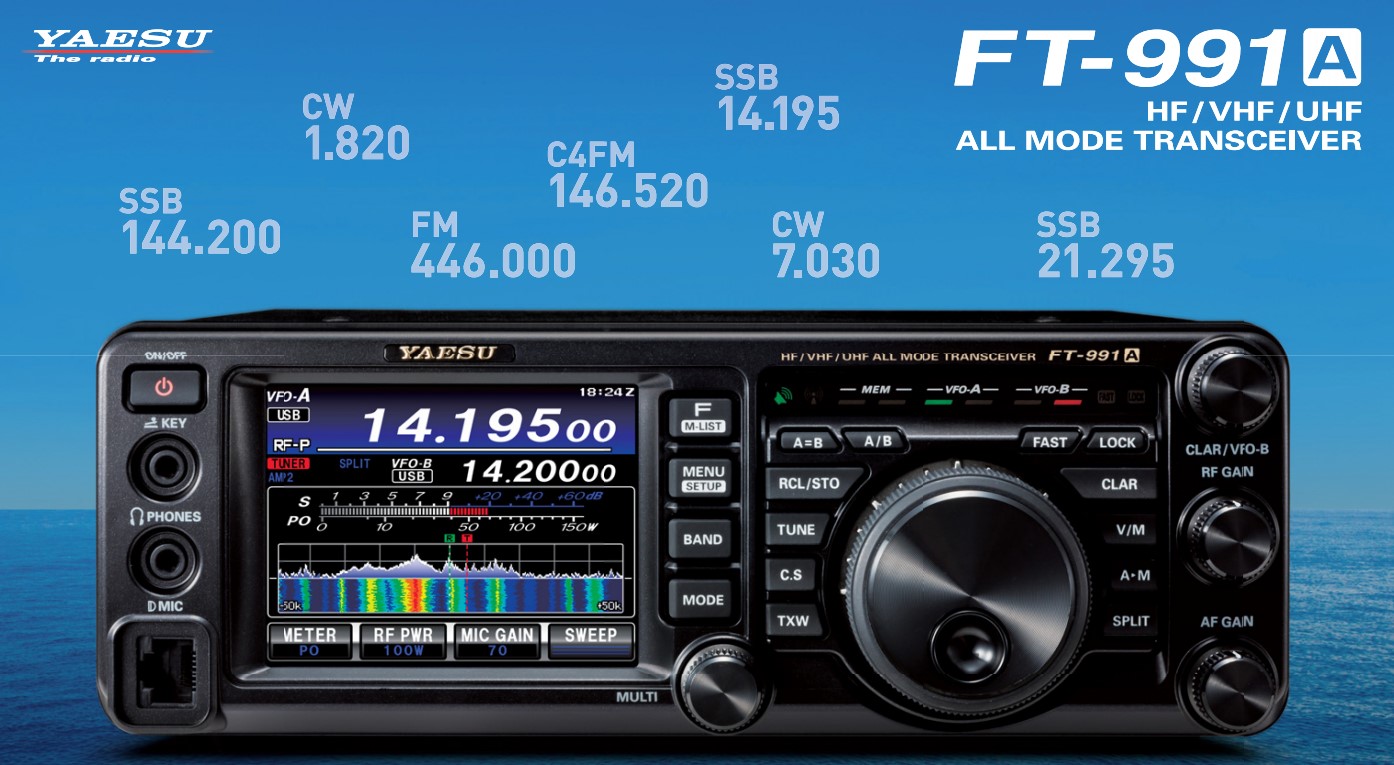
According to the portal hamlife.jp and information from Japanese dealers, the production of the FT-991A series has been discontinued. The news spread quickly: several Japanese dealers published information from the manufacturer on social networks that the stock in the company's warehouse is almost zero and the reason is the unavailability of production components. The FT-991/FT-991A series is thus definitively closing its chapter after almost twelve years on the market. For many radio amateurs who acquired this transceiver as their first device, this is news with a certain nostalgic undertone.
In the article you will read
Why was the FT-991 so popular?
When Yaesu introduced the FT-991 in 2014 and its improved version, the FT-991A, in 2016, it offered something that had no direct competition in this price segment: a single compact transceiver covering HF/VHF/UHF from 160m down to 70cm, with all the basic modes including digital C4FM (System Fusion). All of this fit into a chassis measuring 229 x 80 x 253mm and weighing 4.3kg.

Koncept „Shack in a box” – the whole chess in one box – made practical sense for many operators. One power supply, jedna anténna zostava (pri vhodnom diplexeri), jedno CAT interface to a computer. For stations with limited space, for mobile and field operations, but also for new licensed operators who did not want to invest in two separate devices, this was a logical choice.

The FT-991A version, released at Hamfair 2016, added a key feature over the original FT-991: integrated spectrum scope a waterfall zobrazením. Práve táto funkcia bola odpoveďou na ICOM IC-7300, which had recently shaken up the market with its SDR-based design and excellent panoramic imaging. The FT-991A was based on a different architecture (hybrid superheterodyne architecture with DSP IF spracovaním), no vizuálna informácia o pásme sa stala nutnosťou pre moderný transceiver.
Technical parameters
The following table summarizes the key parameters of the FT-991A according to available documentation.
| Parameters | Value |
|---|---|
| TX frequency range | 1.8-54 MHz (HF + WARC + 6 m), 144-148 MHz, 430-450 MHz |
| RX frequency range | 0.03-56 MHz, 118-164 MHz, 420-470 MHz |
| HF output power / 50 MHz | 5-100W (SSB/CW/FM/RTTY/C4FM), 2-25W (AM) |
| Output power 2 m / 70 cm | 2-50W (SSB/CW/FM), 1-12W (AM) |
| Operating modes | SSB, CW, AM, FM, NFM, RTTY, PSK, C4FM (DV) |
| IF architecture (SSB/CW/AM) | Triple conversion: 1st IF 69.450 MHz, 2nd IF 9 MHz, 3rd IF 24 kHz |
| IF architecture (FM/C4FM) | Double conversion: 1st IF 69.450 MHz, 2nd IF 450 kHz |
| Roofing filters | 3 kHz and 15 kHz (standard) |
| SSB/CW Sensitivity (HF, 10 dB S+N/N) | 0.158 µV (1.8–30 MHz, Amp2 on) |
| SSB/CW Sensitivity (2 m / 70 cm) | 0.11 µV |
| Image rejection HF/6 m | 70 dB |
| Frequency stability (TCXO) | ±0.5 ppm (−10 to +50 °C) |
| SSB selectivity (−6 / −60 dB) | 2.4kHz / 3.6kHz |
| CW/RTTY selectivity (−6 / −60 dB) | 500Hz / 750Hz |
| Internal ATU | Yes, range 16.7–150 Ω (HF/6 m), 100 channel memory |
| Display | 3.5″ color TFT touchscreen |
| Memory | 99 regular + 9 PMS + 5 QMB, alpha tag 12 characters |
| Power supply | 13.8 V DC ±15%, max. 23 A at TX |
| Dimension (W × H × D) | 229 × 80 × 253mm |
| Weight | 4.3 kg |
| Antenna connectors | SO-239 (HF/6 m), SO-239 (VHF/UHF, exceptionally N (market dependent)) |
| PC interface | USB (CAT + sound card), GPS/CAT port (9-pin D) |

The DSP block is based on a high-performance floating-point processor from Texas Instruments, which provides quality functions such as DNR (Digital Noise Reduction), IF Notch, Contour filter, and for CW also APF (Audio Peak Filter). The internal ATU covers an impedance range of 16.7 to 150 Ω for HF and 6 m, which is usable with mismatched antennas, but will not replace an external tuner for larger mismatches.
Discontinuation and successor
According to information published by the Japanese portal hamlife.jp on May 16, 2026, Yaesu informed dealers on May 15, 2026, that it had discontinued production of the entire FT-991A series (models FT-991A, FT-991AM and FT-991AS). The reason is the unavailability of production parts. The manufacturer's warehouse was practically empty at the time, and dealers quickly informed customers via social networks.
The FT-991 series was introduced at Hamfair 2014, almost twelve years ago. The FT-991A series followed in 2016. This is a long life cycle in today's amateur electronics market, comparable to IC-7300 from Icom.
The ideological successor to the FT-991A series is considered to be the FTX-1, which Yaesu introduced in 2025. The disadvantages compared to the FT-991A are the significantly higher price and the absence of a built-in ATU in some configurations. Initial user experiences from the community (e.g. M7MCQ) indicate some firmware nedostatky pri štarte, no celkovo ide o perspektívnu platformu.
YouTube – FT-991A videos
Nasledujúce videá patria k najuznávanejším zdrojom praktických informácií o FT-991A na YouTube. Prvé z nich od Ham Radio Concepts je komplexný prehľad funkčnosti and nastavenia transceivera, vhodný pre nových aj skúsenejších operátorov:
The second video M0FXB brings information about the end of production:
User ratings and experiences

On the portal eHam.net acquired the FT-991A Average rating 4 out of 5 stars across 181 reviews. Users highlight the versatility of the band coverage, compact format and relatively good price/performance ratio. Repeated praise goes to the receiver sensitivity, quality of the NR function and the integrated ATU, which switches on smoothly with the FT-991A without interrupting the audio signal.
British radio amateur M5POO writes in his review that the audio quality on both reception and transmission was very good, the DSP noise reduction is among the best he has had the opportunity to compare, and the AGC works smoothly without the parasitic pumping characteristic of some other devices. He points out the need to adjust the microphone equalizer as a weakness, because the included MH-31 is too bassy without adjustments.
This shortcoming was also confirmed by independent reviewer N9EWO: the included MH-31 dynamic microphone has significantly exaggerated bass frequencies in the factory configuration. However, a solution exists directly in the transceiver menu via a parametric microphone equalizer, where the bass region can be suppressed and the midrange frequencies emphasized. Many users share specific settings on forums and YouTube.

Another feature that has been criticized is the depth of the menu system, which contains over 120 parameters divided into several categories. Changing a common setting such as microphone level or output power requires multiple steps. This is not unusual for Japanese transceivers of this class, but it can be frustrating for operators accustomed to a more straightforward interface. It helps to use the M-List function, where you can map the most frequently used functions to 4 quick buttons.
Historically important note: the original FT-991 (without A) had a problem with the PA stage overheating in some units at lower output power, where the amplifier could go into oscillation and be damaged. The FT-991A version also eliminated this problem with an improved heat sink with an automatic fan. Those interested in used units of the original FT-991 should check if it was repaired by an authorized service.
"For voice, digital, Wires-X and GPS tracking – the FT-991A seems to be a good performer. The radio probably has more features than I'll ever dream of using."
– Reviewer on WorldwideDX forum
Unique tip: NB and Contour for POTA/SOTA field operations

One of the less used settings of the FT-991A, which you will appreciate when operating in a busy RF environment (for example, during POTA or SOTA activations near a road or industrial site), is the combination of the Contour filter with the manual IF Notch.
The Contour filter in a positive setting creates a narrowband peak in the audio spectrum, effectively enhancing the desired signal on SSB or CW without reducing the overall audio performance. Unlike DNR, which operates statistically on the entire signal, Contour lets operátor presne určiť, kde má špička ležať. V praxi: nastavte Contour na frekvenciu, kde je koncentrovaný hlas protistanice (typicky 700–900 Hz), a SSB signal is clearly separated from the surroundings. When combined with the IF Width narrowing to 1.8 kHz, you get very selective reception that will stand up even in a crowded DX pileup.
This setting is documented in the FT-991A manual, IF Passband Tuning section, but in practice many operators will only discover it after a while. It is worth spending 20 minutes on a test QSO before activating it for the first time in the field.
Conclusion
FT-991A bol funkčne zrelý, overený and v komunite dobre zdokumentovaný transceiver. Nie je optimalizovaný pre high-end serious contesting ani pre EME na VHF – na to existujú špecializovanejšie TCVR. Ale pre operátora, ktorý chce jedno zariadenie pre HF DX, digitálne módy, lokálne VHF/UHF FM and C4FM repeaters, and pritom zachovať mobilitu and nízku cenu prevádzky, splnil FT-991A svoju funkciu spoľahlivo.
Stocks at retailers will last for a while – but those who have the FT-991A in their plans should act sooner rather than later. The successor to the FTX-1 is technologically ahead, but in terms of price and configuration it is in a different category.