
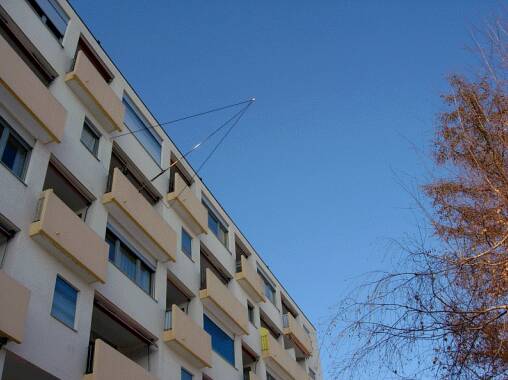
The following description of the handy panel radio amateur antenna is written by Ivan HB9CSM/OM2CS. It was published in French in HB9 magazine Old Man 11/2005. Thank you!
When the radio amateur changes QTH, je to obyčajne katastrofa …. Stalo sa to pred niekoľkými rokmi aj mne. Po určitom čase som situoval moje možnosti z rádioamatérskeho hľadiska asi takto:
- internal antenna, or
- external antenna, or
- change QTH
Since I'm in a nice, sunny and quiet apartment in a 4th floor apartment building with a rather large balcony where it wouldn't be possible to install an indoor antenna, I decided to develop an efficient balcony antenna.
Conditions:
- squeeze the antenna into the width of my apartment on the facade - about 6 meters
- overhang from the balcony max. 7 meters
- feeding with a 50 Ohm coaxial cable
- all KV bands
- no TVI (although there is tons of cable TV)
- power to the antenna 100 W
I have a relatively decent balcony measuring 3.5m x 1.8m. After searching in radio amateur magazines and books, where I did not find anything useful, I began to think about the best form of antenna for my case. My friend HB9ARY mentioned to me some time ago that he sometimes used an antenna with fishing rods. It started with me buying a 3 meter wooden curtain rod. The antenna in the form of a simple horizontal V seemed short to me, so I tried adding wires inward on each side. The attempts continued and still with a negative result. Through it all, I usually managed to make an antenna on one or two bands with high PSV a TVI. Na prispôsobenie som používal „klasické“ továrenské pí-články, ale prispôsobenie sa nedarilo. Nie som špecialista v tomto obore a mám málo skúseností s anténami (som chemik) a tak som sa obrátil na mojich priateľov-špecialistov o radu a dostal som tieto odpovede:
- don't do what you don't understand...
- you're on the right track, but unfortunately I don't have time at the moment
- I will suggest you an antenna that will work (LW on a nearby fir tree+TVI...)

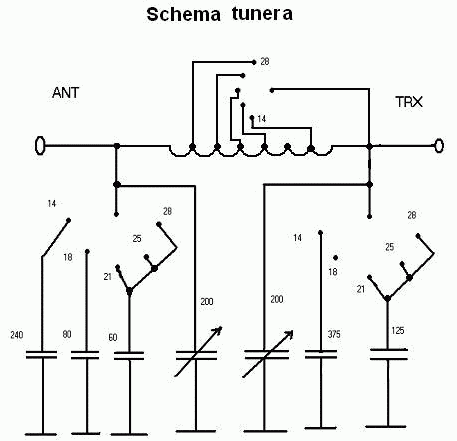
So one Sunday afternoon I turned on my summer watch and was determined to try everything! I started by winding a small coil (12 turns of 14mm diameter and 55mm length, 1.5mm wire) which was wound so that each turn was about 1 microHenry. I also found two 200pF rotary air capacitors and a couple of ceramic capacitors (they must be ceramic and at least 500V) in the drawer. I mounted it all in a pi-cell that I made some time ago, which also accommodated the switches:
- 2 times 5 positions for capacitors
- 1 time 6-10 positions per coil
- (or 3 times 5 positions for more convenient switching)
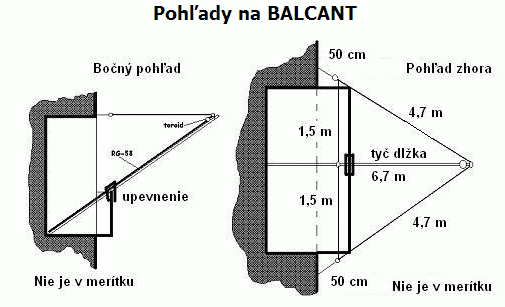
Koncom popoludnia už som skúšobne vysielal na 14MHz, 18MHz, 21MHz, 24,9MHz a na 28MHz… Aj keď som nepozoroval žiadne TVI pri vysielaní na všetkých pásmach, pridal som aj tak veľký fialový toroid with a diameter of 5 cm and wound the RG-58 power cable on it (as much as it could fit) close to the connection to the antenna. The length of the power cable from the power point to the pi-cell is 7.5 meters in my case. Over time, I added a 5 meter long fishing rod to the curtain rod, which also allowed me to move the two antenna anchors 50 cm away from the facade. This visibly (and audibly) improved reception on all bands. So the final dimensions of the antenna are - the length of the rod is 6.7 m, of which it exceeds 5 m from the balcony. The length of the wires is 2 times 4.7 m plus 1.5 m.
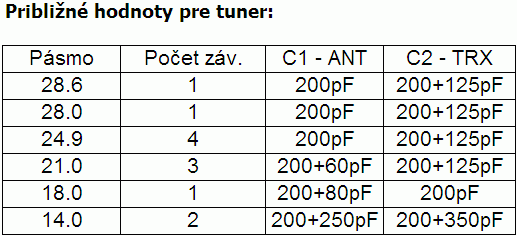
The use of 500pF rotary capacitors will simplify the entire tuner design.
Approximate values on the Drake MN7 tuner:
| 10.1 | Well 3 | pos. 40 m | REA 2.8 | RES 2.5 |
| 7.0 | Well 3 | pos. 80 m | REA 1.0 | RES 3.5 |
One summer day I tried to see if by any chance this antenna could be used on 50 MHz. FANTASTIC!!! With a small classic pi-cell (coil - 4 turns on a diameter of about 10 mm, length 15 mm, two small rotating air capacitors 150 pF) the antenna could be adapted to this band as well. That day I went to the 50 MHz contest and due to lack of time I only did 13 QSO (najdlhšie spojenia – LY1, YR5, EC7, EO6).
After quite a long search, I managed to adapt this antenna to 10.1 MHz, 7 MHz (and even 3.5 MHz). I connected the MN-7 (Drake) tuner in series with my classic pi cell. Also works with FC-20 (Yaesu). Of course, there is no need to have illusions about high efficiency in these bands...
My best DX with this antenna was a QSO in December 2003 on 10.1 MHz with K6AR via LP (long path) exactly to the southeast where my balcony faces...
In conclusion, I would like to point out that this antenna is a portable, i.e. temporary, antenna. This means that it is folded after the end of operation. Only stable and firm attachment of the antenna in at least two points can possibly be used for permanent installation of the antenna.
I hope that my experience will help radio amateurs who have the same problem as me. For information you can find me at: yvskop@yahoo.com
Vy 73 a DX. Ivan, HB9CSM
Thank you Ivan for a nice and interesting article! Best regards, team CQ.sk!