
On Saturday, May 9, 2026 at 2:00 PM, a balloon mission will take place from the Serock area in Poland, which will bring the possibility of receiving and decoding video and data transmissions in OFDM mode.
The organizers from the SKYEDGE Team have prepared a project that builds on previous successful attempts. The main goal is to involve the widest possible community of radio amateurs in the active reception of signals from a high-altitude balloon and the subsequent processing of transmitted data.
In the article you will read
OFDM transmission at 144.500 MHz
The main activity will take place on the 144.500 MHz frequency in the 2-meter band. This is where the balloon will transmit digital data containing images and files using OFDM modulation. This transmission method is known for its immunity to interference and the ability to efficiently transmit larger volumes of data even in difficult conditions.
For successful reception, stable VHF equipment, ideally a directional antenna, and the ability to record or directly process the audio signal from the receiver will be required.
Decoding software and its use
The key to success is choosing the right software. The organizers recommend two main solutions – for mobile devices and for computers.
Android users can use the Assempix application, which has been successfully used in previous flights. The application allows direct reception and decoding of images from the phone's audio input. It is available for download from the developer's website:
https://www.aicodix.de/cofdmtv/assempix/apks/v1.13/
Alternatively, it can also be found in the Google Play store:
https://play.google.com/store/apps/details?id=com.aicodix.assempix
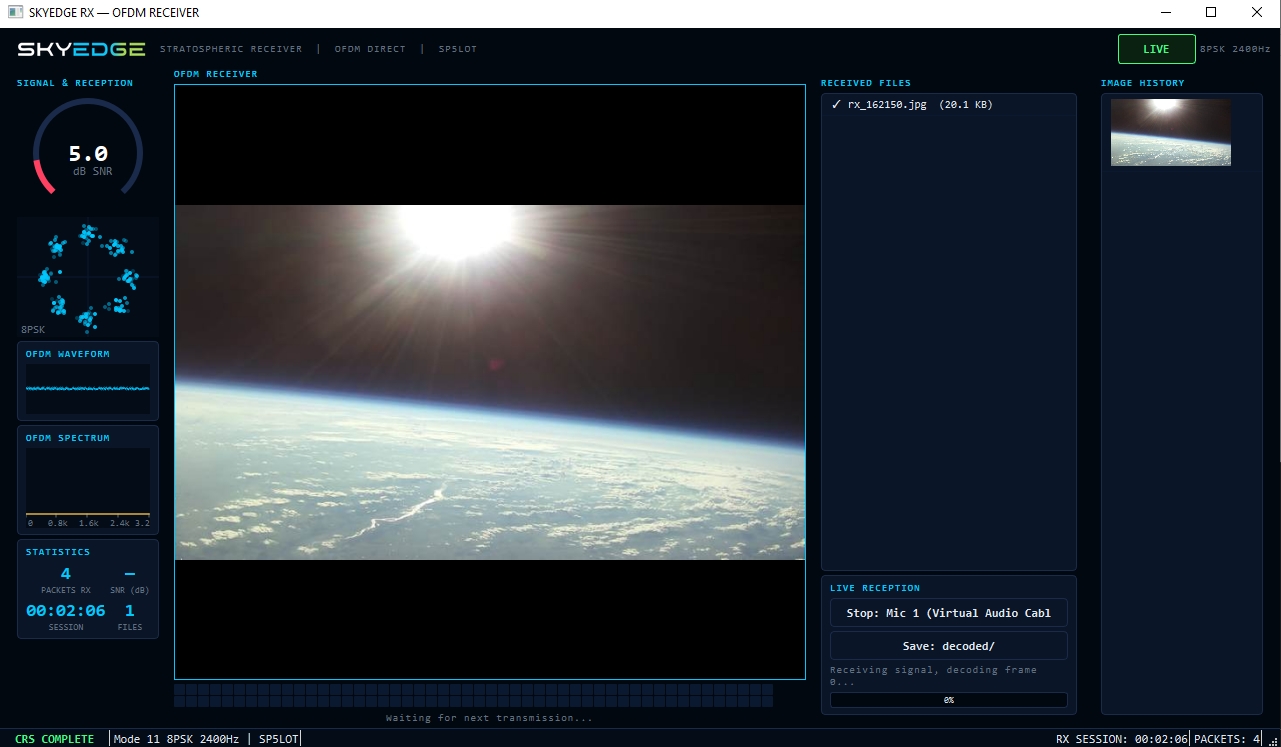
For PC users, a new application, skyedge_rx, is available for Windows. This software brings more advanced signal processing capabilities and better control over decoding parameters.
It can be downloaded from the official repository:
https://github.com/SP5LOT/skyedge-rx/releases/download/v1.0.1/skyedge_rx_onedir.zip
After unpacking the archive, just launch the application and select a suitable sound source. It is ideal to use a virtual audio cable that connects the receiver to the software. The functionality can be easily verified by playing a test signal and watching the SNR indicator:
In case of problems with the application, you can contact the author at the email address: sp.five.lot(zav)gmail.com
Other telemetry transmissions
In addition to the main OFDM transmission, additional signals will be transmitted from the balloon. Traditionally, these will be telemetry in the Horus V3 system and APRS on standard frequencies. These systems will allow tracking the balloon's position in real time and provide additional technical data about the flight.
Another interesting feature of the upcoming mission is the planned beacon in the 10 GHz band, which will transmit a CW signal. The exact frequency will be announced later.
To track the current position of the balloon, you can use the panel at https://skyedge.plThe map is interactive – you can control it similarly to Google Maps 3D or Google Earth.

Diplomas for participants
The organizers have also prepared a motivational element for the participants. Radio amateurs who manage to capture and decode at least 20 images will receive a commemorative diploma. This element encourages active participation and at the same time brings an interesting challenge for all those interested in digital fashion.