
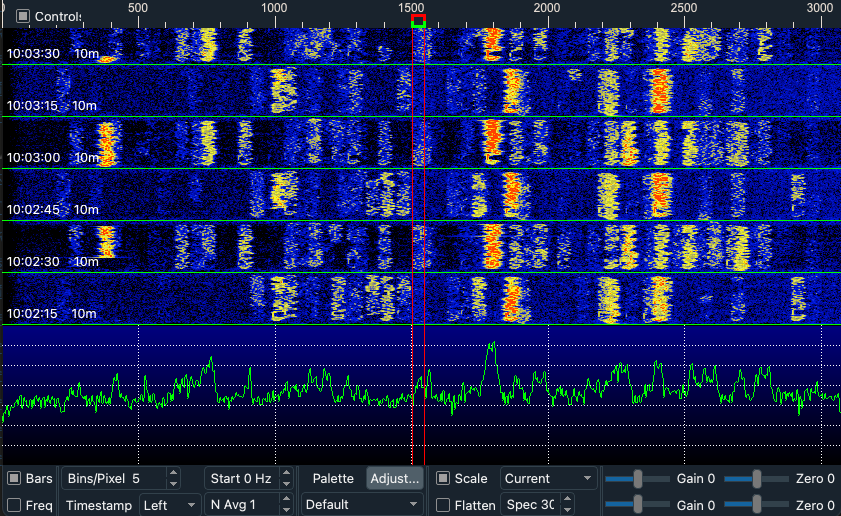
Ako človek zaujímajúci sa o nové technológie som sa nemohol vyhnúť súčasnému trendu využívania módu FT8. Dlho som sa mu snažil vyhýbať, ale keď som zistil, že potrebujem určitú DXCC, which operated only on FT8, I had no choice. I had to try this 'mode', and since I have no problem working with computers, I installed WSJT-X, prepojil ho s mojím logovacím programom, ktorý považujem za najlepší (súkromný názor) – Rumlog, although it is designed only for Apple computers. I also installed GridTracker and everything works perfectly together. I entered a world where many amateur radio operators operate, although I am still examining the reasons. However, it is important not to judge anything without thorough examination. Let's look at FT8 from different perspectives.
In the article you will read
What is FT8?

I will start with what FT8 actually is. FT8 (short for Franke-Taylor design, 8-FSK modulation) is a digital mode of radio communication using frequency shift. It was developed by Joe Taylor, K1JT, and Steve Franke, K9AN. Currently, it is the most widely used digital mode on HF bands. I still fondly remember PSK31, SSTV, and RTTY. Yes, these modes are still used, but really minimally, with RTTY prevailing in contests.
FT8 includes 77-bit blocks of messages transmitted at regular 15-second intervals, consisting of 12.64 seconds of transmission time and 2.36 seconds of decoding time, resulting in a digital data rate of 6.09 bits per second. The source coding provides efficient message transmission equivalent to approximately 5 words per minute. The required signal-to-noise ratio in a bandwidth of 2500 Hz is −21 dB, so the corresponding Eb/N0 is 10 log10(2500/6.09) = 26.1 dB greater, or −21 dB + 26.1 = 5.1 dB.
From my perspective as an IT expert, I appreciate that the software can handle the differences between RX and TX in nearly two seconds. This distinguishes FT mode from others, as this error correction helps achieve reliable communication. When I used PSK or RTTY, not everything was always decoded at 100%; often it was necessary to manually interpret and repeat, but in FT modes, this is taken care of.
Impersonal FT8
From this perspective, it really looks interesting. Back to my research. I must say with some regret that although I know that for many of you, FT mode is the main mode being used, this digital mode has overshadowed SSB and CW. Why the regret? Personally, I like it when I can 'hear' the other side, I hear the other operator even in deep noise, I hear their accent, I hear how they try to establish a connection even when conditions are not ideal. In competitions, even though it's just about the call sign and 599, each side must also strive to capture and record everything correctly so that they are as najrýchlejší a najefektívnejší. To isté platí aj pri CW. A nie, nie som CW operátor, hoci tento rok mám viac CW spojení ako SSB, telegrafiu sa len učím, to ale neznamená, že som si tento mód neobľúbil. Práve naopak. Už viem rozlíšiť aj v pileupe, ktorá je to tá DX stanica, ktorú potrebujem, podľa toho, ako vysiela, akou rýchlosťou, aký má zvuk/tón, ako sa správa, aký je štýl vysielania, čo preferuje, keď ide splitom.
Template connections
What about FT8? This mode cannot be listened to because it would get on one's nerves. It is, after all, just a set of zeros and ones sent through the computer and your TRCV. In the software, you only see decoded connections that have a certain form: either someone calls CQ, exchanges a report, or ends with 73/RR73 and nothing more. You can't wish the other party a good day, good health, tell them what the weather is like, what you're using...nothing personal. It's clean, too "clean," and you've got a locator. It's a very impersonal mode. Actually, I don't even know what to add to that. Nothing that is inherent in SSB and CW applies to FT8.
Automatic FT8

After spending countless hours with this mode, I noticed how people respond to calls, or rather how they work with this mode. I can say it directly: in my opinion, more than 80% of people using FT modes have them set to automatic. This means that the software automatically calls CQ or responds to CQ, so the operator basically doesn't have to do anything. An effective filter can be set up to call and respond only to those you need, and you can ignore other stations. The software can be configured to monitor which states in the USA orwhich grids you need. Thus, the entire operation can be automated. The remaining percentage of people tries, even calling you or attempting to maintain a connection, especially when signals are not at their strongest, to successfully make the connection. Many might argue that this is not the case, that they diligently sit at the computer and click on every call or response. But the reality is often different...
Stop over FT8
But I will stop here as I compare FT8 and SSB/CW operation. I ask myself where we have come when we no longer want to hear the other side – one of the main reasons we became amateur radio operators? Have we really become that lazy? Perhaps that is a harsh word. I somewhat defend myself by understanding that there are those among us who cannot speak or have other health issues, and for them, a mode like FT is much more suitable.

Yesterday I wrote to my good friend Viliam that I will make 300+ countries on SSB, CW, and also DIGI. But I will consider DXCC 'done' and confirmed only when I have it on SSB and CW, and only then will I personally accept my DIGI contacts as well. Otherwise, no. And here I come to the most important point, my private opinion, which may be condemned today and most will not agree with it. However, we live in a democratic society and have the freedom of expression, which I will fully utilize now. I will try to summarize it in a few simple points:
FT8 and its role in amateur radio
Combined usage for DXCC: FT8 and its derivatives should be usable for DXCC only in combination with an additional connection of CW or SSB with the given DXCC entity.
Identification key for software: Software used for FT modes should include a special key that identifies the operator and the software, similar to what is already established for DX-peditions, to ensure that it is not an automated form of software and connection. The key should be issued similarly to how it works with LoTW.
Purpose of FT modes: FT modes should primarily be used for exploring propagation, openings, and directions. They should not be modes that are exclusively used and accepted for all possible awards and certificates. Only in combination with CW and SSB.
In recent weeks, I have managed to make FT8 contacts with DXCC that I do not have on SSB or CW, and I follow these operators, but they exclusively operate only on FT8. Have we really become such introverts that we do not want to talk or learn telegraphy? Yes, I am glad to have these contacts, but I see them superficially; they do not hold the same value for me as contacts on SSB and CW. When I do make a contact with an operator using another mode and then FT8, it pleases me.
In my opinion, we really need to think about how we evaluate FT connections compared to SSB and CW. They should only complement our operations on HF bands, not be the primary part of it. I believe it is not correct to label digital modes like FT8 as unnecessary and we should not use them. I have noticed that connections using FT can be made even when conditions are really poor and SSB/CW simply wouldn't make it. This is a significant advantage of this mode.
But how does everyone feel about it? Are you really happy that you made a connection with RARE DXCC? A few weeks ago, I attended an international HAM meeting where one operator boasted that he made a connection with KH5 – Palmyra & Jarvis Island using only five watts. I thought to myself, how clever he is, and I almost shook his hand. Then he added that it was on FT8. From Central Europe, especially from where I come, that is OM, but also OK, the direction to KH5 is one of the hardest. So any connection in that direction is extremely challenging for us. I had to work really hard and it took me a long time to make one connection on CW and one on SSB, both with about 500 W and a 3-element beam. The FT mode has the advantage that you don't need top-notch equipment for such connections; wire and QRP are really sufficient to connect with the whole world. And that's what I really like about this mode. As I write, I do not condemn this mode, just the way we approach it. I would even say it should be exclusively used with QRP power levels, but the question is how to control that. That simply can't be done. tak mi trvalo dlho, kým som urobil jedno spojenie na CW a jedno na SSB, oboje s asi 500 W a 3-elementovou smerovkou. FT mód má tú výhodu, že nepotrebujete špičkovú výbavu na takéto spojenia; drôt a QRP naozaj postačujú na spojenie s celým svetom. A to sa mi na tomto móde naozaj páči. Ako píšem, nezatracujem tento mód, len spôsob, akým k nemu pristupujeme. Dokonca by som povedal, že by sa mal výlučne používať iba s QRP výkonmi, ale otázka je, ako to kontrolovať. To sa jednoducho nedá.

I want to 'wake' us all up and I don't want to lose the chance to hear you, whether it's your voice or how you work with the CW key. I think that has power. The FT mode really lags behind in this. If we allow FT8 to overshadow what we have built here and how we have worked for decades, in a few decades the entire operation will be only through DIGI mode and people won't even say good day, won't laugh, won't talk about the weather, and how happy they are to have a wife/husband. We will lose all of this.
DXpeditions are also starting to exaggerate, where FT mode prevails over all others. I believe that yes, DIGI should be a part, but not the main one. In my opinion, we should finance DXpeditions only on the condition that DIGI can be a maximum of 1/3 of all contacts, the rest must be CW/SSB. DIGI is becoming, as several have pointed out, a quick profit for such groups of people, as they can establish a large number of contacts in a relatively short time even under very poor conditions.
Let's start saying no, so we don't lose what we are already losing. Just look at the cluster, few SSB and CW spots and a lot of FT. Do we really want to reach a situation where we turn the VFO and hear nothing on the bands, only 'strange' sounds that our brain can't decipher?
Let's approach this sensibly, let's also use DIGI modes, as they are great. Regarding their validity, since most are done automatically, they are 'dry,' impersonal, and can be used for awards, DXCC, WAS, etc., only with supplementary contacts on CW/SSB. If you have WAS CW or SSB and want WAS DIGI/FT8, great, you can... here’s a beautiful certificate. If you don't have it, then strive for it and then that DIGI certificate will have much greater value for you.
Thank you.
Oliver OM0RX
I have exactly the opposite opinion and FT8 is the only mode I use today. My reasons are:
1. From my home QTH (apartment building, 1st floor, antenna – a coil-extended vertical on the balcony) nothing else works for me, SSB and CW are drowned in noise.
2. I only have 5W and I'm fascinated by QRP operation.
3. I'm interested in the technical aspects of wave propagation and how the antenna I build works. With FT8, I get an exact report, I don't even have to make a contact, and pskreporter shows me where I am heard.
4. I go to the pub to chat, I don't need a radio for that 🙂.
I'm not the youngest, I spent my youth behind the Iron Curtain and I understand that back then a voice contact with someone 'from another world' was enriching. Today, however, I communicate with foreign countries daily via the internet and I don't need a similar kind of communication on the bands.
It's interesting to read this article and see you calling almost every station on FT8 every day.
Thank you, Peto. We take your response as a 'typical' reply from someone who is not interested in constructive debate. Look above at Martin; he explained his actions and wrote it reasonably. For such people, a mode like FTX is indeed a form of 'salvation', and they can still make connections even if it wouldn't be possible in other modes. In the article, Oliver explained his position, his opinion; what is yours? Besides, when someone writes something reasonable, you immediately point fingers. This is how most of Slovakia operates. And that's why we are in such a mess as a country. We look atTV, we complain about politicians, the system, everything. And we don't try to change anything ourselves. Let's rather ride on tractors. It's probably all we know.
I prefer FT8 since there are kids running around here all the time. I chat on DMR for a few hours every day, so I love to talk, but there's no one to talk to. Some enjoy Lora, some EME, while others claim that only CW and SSB are the real deal... Let's each do what we enjoy...
Just as PSK modes came, I consider FT modes a very significant milestone in development.
To clarify, I am a radio amateur who has more connectors on antennas than connections in a year, not to mention DXCC.
In my opinion, it doesn't matter where development goes because it cannot be stopped.
It is possible to boycott or ignore development, but it cannot be stopped.
Digital modes that are not demanding in terms of power and consumption, antennas, and equipment are essential.
I recommend hardcore CW operators switch to devices like Pixie or Rockmite, where they can achieve the seemingly impossible on large antennas.
..
For amateur radio activities, the time during the global COVID pandemic was excellent, for example.
When my eyes hurt from the waterfall of FT8, it was possible to grab the microphone or even dust off the CW key.
There was more time than necessary to kill boredom, locked at home, stocked with rice, toilet paper, and bottled water, canned goods, and sore fingers from sewing masks.
..
However, times have progressed, and there is again less time for fun, hobbies, and even for broadcasting.
..
Another emerging thing where FT modes are entertaining is on vacation; a microphone for HF equipment is not necessary, but it can be.
When the weather is worse, or we are tired of eating and draining the all-inclusive bar and dining hall, it's time to stretch the antenna, ceremoniously and pompously do what we haven't had time to do properly or intensely all year.
If after 2 hours of CQ our mouths start to hurt, at 5W, somewhere from 9A, SV... on a piece of wire, we will work all stations I, 9A circles SV, and OK2BQX will break circle 3.7?, it will turn into invective, where we are almost like a prominent expedition station, it's time to switch on FT.. 8, 4..
For young, newly licensed operators taking their first steps on HF and VHF bands, it is also a very good experience because they are used to spending time at the PC and are not pulled away from this activity, for example, by talking or learning CW.
My experience is that currently the youngest and most progressive have started exploring bands on QRP, digital, and when they got bored watching the waterfall, they started talking and telegraphing.
Top operators are no longer born in non-commissioned officer schools, or conscription courses, or summer camps, forced training in CW and teleprinter operation.
OM1ARH