
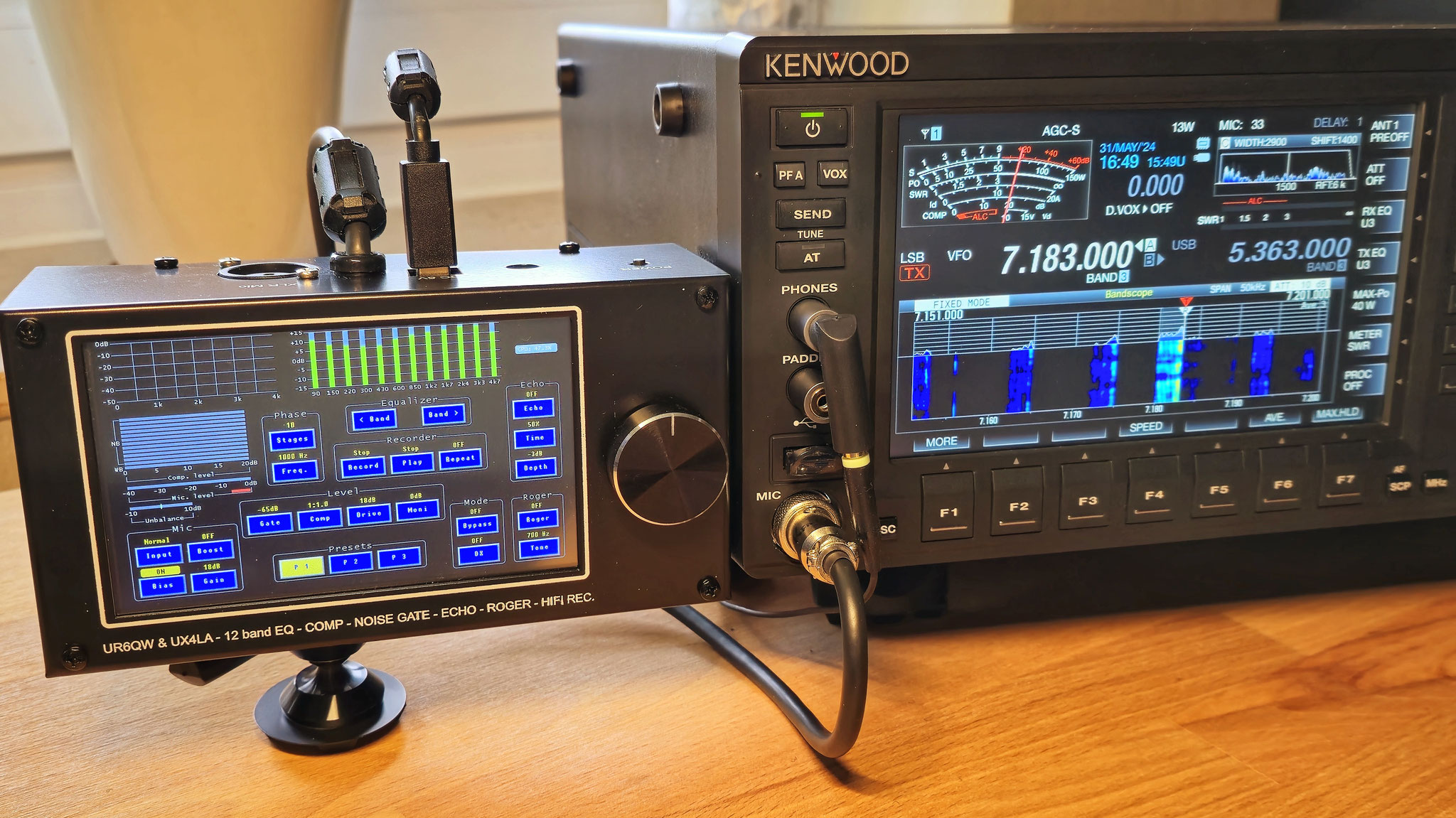
Every modern transceiver has a built-in microphone amplifier and a simple equalizer, but they only work with a global frequency profile and are not able to correct narrow bands independently. As a result, a dynamic microphone connected directly to the radio sounds either dull in the low frequencies or squeaky in the highs. An external microphone processor solves this problem outside the transceiver, allowing the operator to fine-tune without interfering with the radio's internal settings. The UR6QW series of devices was created in Ukraine and is available directly from the author or through the European distributor DB6QW in Germany.
In the article you will read
Series history: from Echo to EQ V.8
Echo – first module
The first product in the series was the Echo module: a low-noise microphone preamplifier with an echo processor and adjustable delay. The module is intended primarily as a basis for further connections or for CB operation, where the echo effect is more useful than in amateur SSB operation.
EQ V. 1
Version V.1 added the first graphic equalizer to the low-noise preamplifier. It was an analog solution in a steel shielded case with RFI protection, designed for TX powers up to 2 kW. The device was powered from the transceiver's microphone jack and did not require an external power supply.
EQ V.2 and EQ V.3
Versions V.2 and V.3 brought an expansion of the number of frequency bands of the equalizer and added a signal compressor. EQ V.3 was the first version for which Chinese counterfeits appeared on eBay - the original device bears the call sign UR6QW on the front panel and is sold through verified distributors.
EQ V.4
EQ V.4 was another step towards more professional signal processing. The device included an 8-band graphic equalizer, compressor, echo processor and noise gate with adjustable threshold. The steel shielded housing remained standard.
EQ V.5
Version V.5 brought a significant improvement to the noise gate section - adjustable threshold and attack/release times enabled transparent suppression of background noise without artifacts when opening the gate. An audio demo of EQ V.5 with the ICOM-756PRO transceiver, recorded directly from the air via an SDR receiver, is available on YouTube.
EQ V.6
EQ V.6 retains the 8-band graphic equalizer, compressor, low-noise microphone preamp, echo processor, and noise gate. The case has a slanted front panel for more comfortable operation on the operator's desk.
EQ V.7 and EQ V.7 Pro
Version V.7 has switched to fully digital signal processing with a color touch screen. The number of equalizer bands has increased to 10, support for XLR input with 48V phantom power for condenser microphones and Roger beep with adjustable frequency have been added. Version V.7 Pro has expanded connectivity and mechanical design. For CB radios with a 4-pin connector, it is based on the V.7 base.
EQ V.8: the current flagship of the series

EQ V.8 is a joint development of UR6QW and UX4LA and represents the most comprehensive solution in the entire series. The device integrates a 12-band graphic equalizer, dual compressor (NB + WB), soft-saturation limiter, noise gate, echo processor with multipath emulation, phase rotator, roger beep and voice recorder into a box measuring 170 × 90 × 80 mm and weighing 0.63 kg.
ADC/DAC and audio bandwidth
The signal conversion is carried out with a resolution of 24 bits. The audio bandwidth is configurable according to the operating mode: Normal Mode 5.2 kHz, DX Mode 3.2 kHz, Wide for CB 8 kHz and Bypass 8 kHz. The suppression of mains hum (50 Hz and 60 Hz) is more than 30 dB.
Microphone inputs
The device has two independent low-noise microphone amplifiers with adjustable gain from 0 to +40 dB. The first has an unbalanced 3.5 mm jack input (front panel, labeled MIC) for dynamic and electret microphones; for electret type, the Bias power supply is active +3V. The second has a balanced XLR input (rear panel) for dynamic and condenser microphones with optional +48V phantom power (range +35 to +48V). An additional +10 dB boost is available for microphones with low sensitivity. The device supports electret, dynamic and condenser microphones as well as common hand mics.
Caution: never connect a dynamic microphone to the XLR input with the +48V Bias turned on - you will damage the capsule. Never connect or disconnect a condenser microphone while the device is turned on.
12-band graphic equalizer

The equalizer operates at mid frequencies of 90 / 150 / 220 / 300 / 430 / 600 / 850 / 1,200 / 1,700 / 2,400 / 3,300 / 4,700 Hz with an adjustment range of ±15 dB per band. The signal frequency response is displayed in real time on a spectral monitor with a dynamics of 50 dB and an FFT of 256 points in the range of 0–4 kHz.
Compressor NB + WB

EQ V.8 contains two compressors connected in series. The first is a Multiband narrow-band compressor (NB): the signal is divided into 12 bands, each band is compressed by a separate compressor with an attack of 1–44 ms and a release of 5–219 ms according to the frequency range. This achieves a more even frequency response than with a single-circuit compressor - excess bass in the range of 100–300 Hz will not affect the compression in the range of 300–4,700 Hz. The second is a wideband compressor (WB) with an attack of 5 ms and a release of 50 ms, placed after the equalizer. The ratio is adjustable from 1:1 (no compression) to 1:10. A soft-saturation limiter prevents overloading at the output even if the equalizer is set incorrectly.
Noise gate
Adjustable noise gate with threshold from –70 to –30 dB, can be deactivated. Suppression of background noise reaches up to 20 dB. It is recommended to set the gate last, after completing the other blocks.
Operating modes and presets
The device has four operating modes: Bypass, Normal, DX and Wide. In DX mode, there is a narrowed bandwidth, pre-emphasis and a harder compressor - suitable for working with DX stations or being singled out in a pile-up. There are three independent presets (P1, P2, P3), each with its own set of parameters, which allows you to have different microphones configured in one device.
Recorder, Roger and echo
The voice recorder allows recording up to 16 seconds directly from the microphone with the possibility of loop playback. During recording, the signal is stored before the processing blocks (only the preamplifier is active), during playback it passes through all active blocks. The Roger beep function generates a sinusoidal tone of adjustable frequency with a duration of 150 ms at the end of the PTT. The echo processor with multipath emulation has an adjustable depth of 0 to –20 dB (1 dB step) and a duration of 5–100% (5% step).
Audio sample EQ V.8
An unboxing and first look at the EQ V.8 is available on YouTube:
EQ V.8 Technical Specification – Overview
| Parameters | Value |
|---|---|
| ADC/DAC resolution | 24 bits |
| Audio bandwidth (Normal / DX / Wide / Bypass) | 5.2 / 3.2 / 8 / 8 kHz |
| Hum suppression (50/60 Hz) | >30dB |
| Microphone amplifier gain | 0 to +40 dB (+10 dB boost) |
| XLR phantom power | +35 to +48V |
| Number of equalizer bands | 12 |
| EQ adjustment range | ±15dB |
| Compressor ratio | 1:1 to 1:10 |
| Noise gate threshold | –70 to –30 dB |
| Background noise suppression | up to 20 dB |
| Output level | up to 200 mV |
| MON output | 2 × 30 mW (32 Ω load) |
| Power supply | 4.5–5.5V / max 500mA (USB) |
| Dimensions (without cables) | 170 × 90 × 80mm |
| Weight | 0.63 kg |
Prices and where to buy
The EQ V.8 is available directly from the author (UR6QW, Ukraine, contact ur6qw.ua@gmail.com) or through the European distributor DB6QW Electronics in Germany at ssbhifi.com. The price of the EQ V.8 with an 8-pin connector via DB6QW is 319 EUR (as of June 2026). The device is also available on eBay through sellers hfvhfparts and XADO Store. Older analog versions (EQ V.5, V.6) occasionally appear second-hand for significantly lower amounts.
For those who want to achieve unique modulation
If what your transceiver's internal audio processor can do is not enough, the UR6QW series offers a path from a simple 8-band analog equalizer to a fully digital 12-band V.8 EQ with touch screen, dual compressor and phantom power. Each version is manufactured with a cable for a specific transceiver (Icom, Yaesu, Kenwood, Elecraft and others) - when ordering, it is necessary to specify the radio type and connector. Always disable the transceiver's internal compressor and equalizer before connecting the device to avoid duplicating the processing chains.