
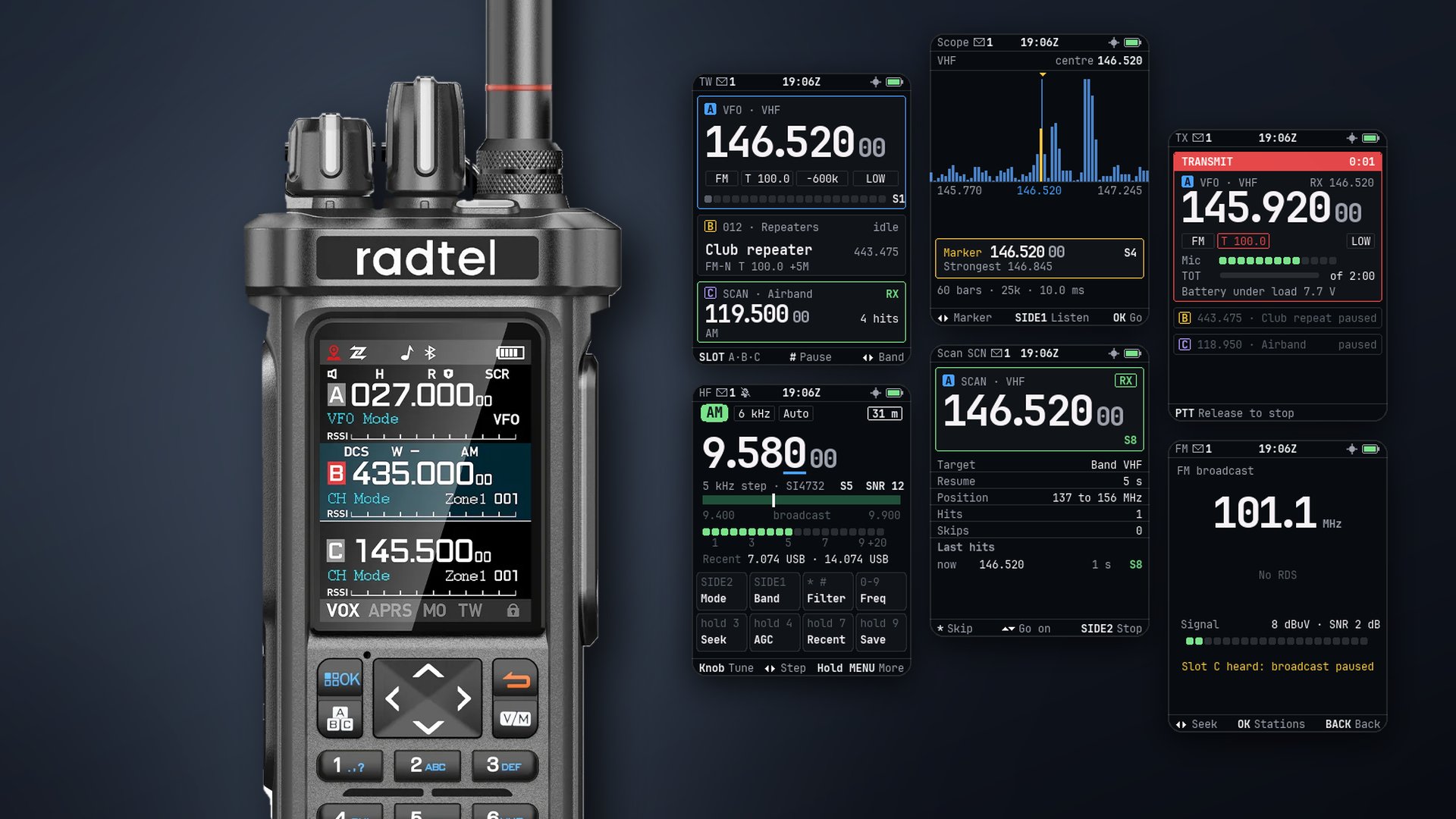
Replacement firmwares for Chinese handheld radios are no longer new. However, rarely does someone rewrite the entire firmware from scratch, and even more so in the Rust language. That's exactly what Alex Harvey, VA7IF, did with the Ferrite project for the Radtel RT-950 Pro radio and hardware-matched models.
The result is not just a different currency. Ferrite manages the processor differently, divides the receivers differently and adds things that cannot be found in the original firmware.
You will read in the article
Rust and 107 hours on the battery
The heart of the radio is an AT32F403A microcontroller with an ARM Cortex-M4 core, two BK4829 transmitter circuits, a SI4732 receiver for radio and short waves, plus GPS and Bluetooth. The original firmware keeps the processor permanently at 120 MHz. Ferrite pulls it down to 24 MHz at rest and jumps to full clock only when necessary: when pressing a key, scanning, broadcasting, decoding or playing sound. It will go back a second after the last request.

The numbers that the author measured on a station with a 2000 mAh battery are telling. The original firmware draws around 130 mA at rest, which works out to about 15 hours. Ferrite with a fixed clock of 120 MHz has 64.7 mA, or 31 hours, and with clock scaling only 18.6 mA, which corresponds to about 107 hours.
It is fair to add under what conditions: closed squelch on the quiet channel, screen off, GPS and Bluetooth off. It's a best case scenario, not normal operation. Even so, it's a difference you'll notice on the trip.
Three slots, converter and reception from KV to radio
The radio operates with three slots A, B and C, each of which can be on a VFO or a channel. The Watch function watches two or three at a time, the active slot gets priority, and the radio itself never switches it. PTT A transmits on the active slot, PTT B always on slot B. Use the star to mute or turn off the slot without losing the settings.

Between the slot on VHF a slotom na UHF viete postaviť Crossband prevádzač. K dispozícii sú tóny CTCSS a DCS, vyhľadávanie tónu, 1750 Hz burst, VOX, DTMF, CW ID and broadcast timer, while the shift for the converter is added by the firmware from the band plan.
There is an interesting HF mode on reception, which covers both shortwave and radio amateur KV bands, in AM everywhere and in FM from 18 MHz. If you also want SSB on short waves, you attach your own original .BTF file during installation, from which the necessary patch is downloaded. FM radio works with stereo and RDS text on any slot and there is also a band scope with an overview of the activity around the tuned frequency.
APRS in the background
APRS has reserved slot C for Ferrite, leaving A and B free for phono. In addition to beaconing, also intelligent according to speed, it handles messages with repetition up to five times until confirmation, a list of heard stations with distance and direction, digipating, Mic-E, telemetry and FX.25 error correction. Via cable or Bluetooth, the radio also functions as a KISS TNC for applications on a computer or phone.
Installation via Ferrite Console

The whole operation goes through the Ferrite Console application, which is available for Windows, Linux and macOS. The procedure is insured: you must first make a full backup of the radio, otherwise the installation will not even start. Then a signed image is written, the signature of which is verified by Console before writing.
Importantly, the factory calibration remains intact and the original bootloader of the radio is not changed, so the write can be repeated if there is a problem. Channels are imported from a CHIRP CSV file and reverting to original firmware is a separate item for which you need a backup and the original .BTF file.
Six videos worth watching
The step-by-step installation is shown by M0FXB, while the Slovak track is provided by OM0ET, who filmed the installation on the RT-950 Pro and on the related Radioddity Trivox, as well as a tour of the interface.
Another M0FXB video shows how the band scope and KV bands are turned on, as well as a firmware update. In addition, the Executable Ham Radio channel compares Ferrite with the well-known nicFW.
License and project status
The source code is public but licensed under the PolyForm Noncommercial 1.0.0 license. It is therefore not open software in the sense of the OSI definition, and commercial use requires a special license. The author pledged that the project would pass under MIT if it were archived or if a new edition was not published for seven years.
Development is fast. The console had version 0.8.2 in mid-November 2026, and 0.9.5 ten days later. This is still a series of early public releases, so minor bugs are to be expected and reported.
Everything you need, including downloads, can be found at ferritefw.dev.
Frequently asked questions
Which radios is Ferrite designed for?
For Radtel RT-950 Pro and radios built on the same hardware. One of the videos shows the installation also on the Radioddity Trivox model.
Will I lose the factory calibration?
Nope. Ferrite never deletes the calibration data or changes the original bootloader of the radio, so the recording can be repeated if necessary.
Can the original firmware be returned?
Yes. There is a separate entry for this in the Ferrite Console, but you need a backup of the radio and the original .BTF file, so keep those.
Does it work on SSB shortwave?
Yes, but during installation you must attach your own original .BTF file from which the necessary patch will be downloaded. Without it, AM and from 18 MHz FM are available on KV.
Does the battery really last 107 hours?
This is the best possible case measured with the squelch closed, the display off and both GPS and Bluetooth turned off. Scanning, beaconing and illuminated display significantly increase consumption.