
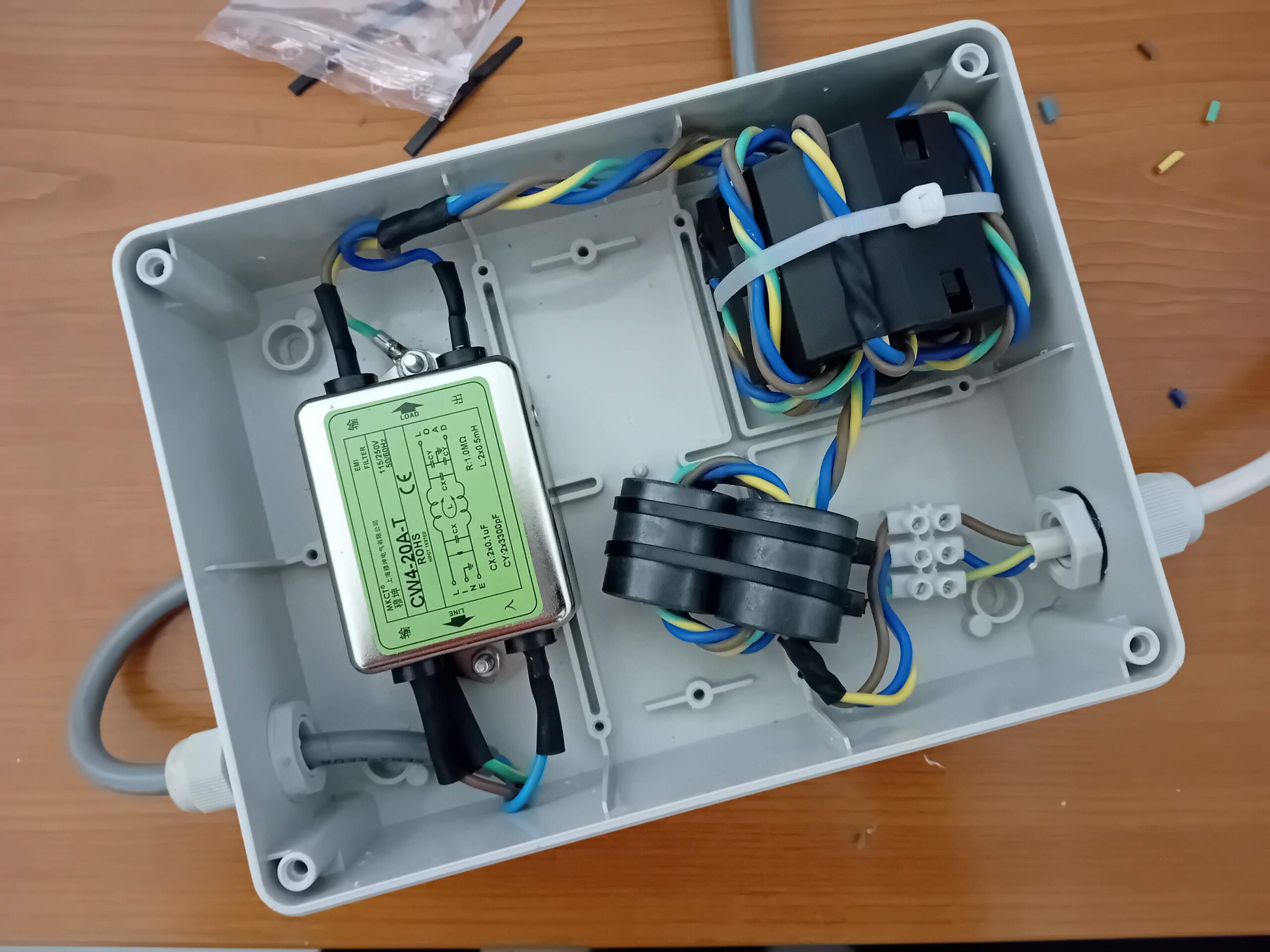
In radio amateur practice, we often encounter interference caused by the back penetration of a high-frequency (HF) signal through the power supply network - that is, the 230 V distribution. This interference can affect not only amateur radio technology, but also other household appliances. Ian White GM3SEK has delved into this issue and designed a simple but effective 230V mains filter that anyone can build.
You will read in the article
What does the GM3SEK filter solve?
The purpose of the filter is:
-
to prevent the leakage of the RF signal from the final stages back into the electrical network (the so-called backdoor EMC),
-
suppress interference from home electronics that can affect the receiver's sensitive inputs,
-
protect the transceiver, PA or other sensitive circuit from penetrating interference through the power supply.
Construction of the GM3SEK filter
GM3SEK designed a passive LC filter that consists of:
-
network filter based on filter chokes (e.g. 2x 4.7 mH on L and N), X-capacitors between L–N and Y-capacitors between L–N,
-
chokes on the Fair-Rite 0431177081 core, which is primarily intended for suppression on the lower KV bands
- of the second Fair-Rite oval core choke 2643167851, which is intended for suppression on the upper KV bands
-
everything placed in a plastic box
Its advantage is its low price and high efficiency of interference suppression in a wide frequency range (especially KV).
Safety and installation
Since the filter works directly with a mains voltage of 230 V, it is essential to observe the safety principles:
-
use only components designed for mains voltage,
-
isolate and mechanically secure all connections,
-
potrebné je zapojiť filter na začiatku rozvodu v hamshacku. Každé zariadenie v shacku bude napájané cez tento filter.
The document explains the principle and construction https://gm3sek.com/wp-content/uploads/2019/10/cuys-revisited-v1-extended-edn.ppsx Be sure to study it in detail.
Production of the GM3SEK filter
The most difficult part is probably getting the necessary parts, especially the Fair-Rite core 0431177081. Its availability is poor. That's why I reached for ferrite K25 from DX-Wire. But you might be able to find the original. I was able to get Fair-Rite 2643167851 cores through Ebay.

The mains filter may not be the Roxburgh RES5-F15 type listed. I used it CW4-20A-T, which I bought in Hungary. According to the manufacturer's data, it has suitable suppression of work in the frequency range of the KV bands. The plastic box and cable glands were provided by a local electrical store. Wires for connections and terminals come from a 3m extension cable.
The amount of material thus represents approx. €50. If you have carefully read the material from GM3SEK, you will surely have noticed that it is advisable to use other chokes as part of the solution. When you purchase ferrite materials, count on their purchase as well. It's definitely a good move.
First I drilled the plastic box: the holes for the cable glands and the attachment of the CW4-20A-T filter and the connecting terminal block. They are attached with M3 screws. I cut the extension cable into three parts. They consist of: inlet (approx. 50cm), section on coil chokes (approx. 2m) and outlet with sockets (approx. 50cm).
I connected the feed to the mains filter. I stripped the outer insulation from the longest part of the extension cord. I connected the ends of the wires with tin and twisted them together using a drill. Approximately every 30 centimeters, a shrink tube is stretched over the twisted cables. Both chokes are wound with cables prepared in this way. The windings are fixed with plastic retractable tapes. This part is the most laborious and it is not worth rushing. The last step is to connect the chokes to the CW4-20A-T filter and the output terminal block. It took me about 1.5 hours to make the filter.
Is such a filter worth it?
Keďže filter má prínos pre príjem aj vysielanie, tak aj keď v príjme nezaregistrujete rozdiel, pri vysielaní môžete byť pokojnejší, pretože rušenie, ktoré mohlo z hamshacku vychádzať do elektrorozvodnej siete sa zníži.
However, radio amateurs praise the filter the most during reception. I did not register a fundamental difference. But this is due to the fact that in my QTH most of the interference comes from the antenna, not through the 230V distribution.
Vidieť, že v niektorých prípadoch je rozdiel markantný. Aj keby nie, myslím si, že GM3SEK filter je vhodný doplnok do každého hamshacku. Rušenia, ktoré sťažuje príjem je každým dňom viac a viac. Preto by takýto sieťový filter mal byť súčasťou riešenia na zlepšenie príjmu spolu s ďalšími komponentami.