
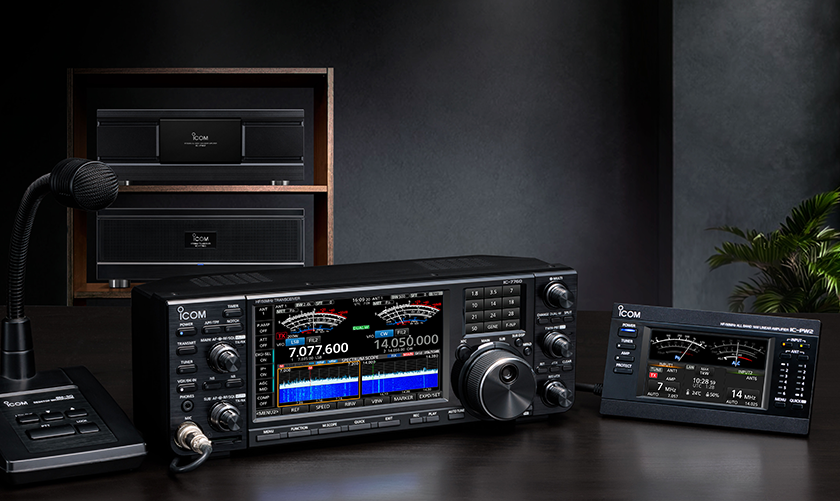
When choosing a modern HF transceiver, a radio amateur often encounters a number of technical parameters. Manufacturers list sensitivity, dynamic range, blocking, phase noise, selectivity or various IP3 values. Many of these are significantly more important than the transmitter's power output itself.
For normal operation, the differences between receivers may go unnoticed. However, in DX operation, during contests, when using beverage antennas or in environments with high levels of interference, it is the quality of the receiver that determines whether a weak station will be picked up at all.
V článku sa dočítate
Noise Floor (MDS)

The noise floor represents the lowest signal level that a receiver is able to distinguish from its own internal noise. It is often referred to as the MDS (Minimum Discernible Signal).
Rob Sherwood defines the noise floor as the level at which a weak signal is still audible above the receiver's own noise. His measurements use a 500 Hz CW filter and are given in dBm.
However, on the HF bands, the lowest noise floor is not automatically an advantage. The bands from 160 m to 20 m are often dominated by atmospheric and industrial noise, which is significantly higher than the receiver's own noise. The extremely low noise floor will therefore be particularly noticeable on the higher HF bands, on 6 m or when using low-gain receiving antennas.
Receiver sensitivity

Sensitivity determines the smallest input signal required to achieve a defined signal-to-noise ratio at the receiver output. It is traditionally given in microvolts or dBm.
During the measurement, the signal from the signal generator is fed to the receiver and its level is adjusted so that the resulting signal-to-noise ratio is 10 dB. The smaller the input signal required, the better the sensitivity.
In the past, sensitivity was one of the main parameters of a receiver. However, with modern HF equipment, the level has long been reached where the receiver is more sensitive than band noise alone. Therefore, today the dynamic characteristics of the receiver play a greater role.
AGC Threshold

Automatic gain control (AGC) ensures that the volume of the received signal remains approximately constant regardless of the input signal level.
The AGC threshold represents the signal level below which the receiver operates at maximum gain. If the received signal exceeds this level, the AGC begins to gradually reduce the gain.
On lower HF bands, the AGC threshold is less important, as the band noise itself often reaches a level of several S-meter units. On higher bands or in very quiet receiving systems, proper AGC adjustment can significantly affect the comfort of receiving weak signals.
Receiver Blocking (Blocking Dynamic Range)

Blocking occurs when a strong signal outside the receiving band begins to overload the receiver's input circuitry. The result may be a reduction in sensitivity or a complete loss of the ability to receive weak signals.
According to Sherwood, blocking is typically about 30 dB higher than the receiver's dynamic range. A value of around 130 dB is considered a very good result.
In practice, this parameter is manifested, for example, during a contest, when very strong stations are located near the working frequency. If the blocking is insufficient, weak DX signals simply disappear under the influence of a strong neighboring signal.
Fázový šum (Phase Noise)

Phase noise is one of the most important parameters of modern receivers. It arises in the local oscillator and manifests itself as noise sidebands around the carrier frequency.
If a very strong station is located near the receiving frequency, the phase noise of the local oscillator mixes with the strong signal and creates additional noise that can mask the weak DX station. This phenomenon is called Reciprocal Mixing.
Pri contestových staniciach, multi-multi prevádzke alebo počas Field Day phase noise is one of the decisive factors in the quality of a receiver. Modern SDR receivers achieve significantly better results in this area than many older synthesized superheterodynes.
Front-End Selectivity

Input selectivity determines the receiver's ability to suppress unwanted signals before they enter the main amplifier stages.
In classic superheterodynes, this role was performed by bandpass filters or preselectors. The legendary R-390A receiver used a mechanical preselector linked to tuning and is still considered one of the best solutions.
In modern SDR receivers, the importance of input selectivity has increased again. Direct sampling eliminates intermediate frequencies, but at the same time places higher demands on input filters, which must prevent the A/D converter from being overwhelmed by strong signals.
Stopband filter (Filter Ultimate Rejection)

This parameter expresses the filter's ability to suppress signals outside its passband.
In older receivers, a common problem was insufficient filter steepness or signal crosstalk around the filter. Typical rejection was around 70 dB. Modern receivers use multiple filters or digital DSP filters, which achieve significantly higher attenuation values.
In real-world operation, the quality of stopband suppression is particularly evident in situations where a strong station is located only a few kilohertz from the received frequency.
Dynamic range

Dynamic range is one of the most important indicators of receiver quality. It expresses the difference between the weakest and strongest signal that the receiver can process without causing interference caused by its own nonlinearities.
More precisely, it is the level at which the intermodulation products created by strong signals reach the noise floor of the receiver.
For contest use, the most important is the near dynamic range measured at 2 kHz signal spacing. This parameter shows how well the receiver copes with dense band occupancy. Sherwood reports that modern high-end receivers achieve values of around 100 dB and above, while older designs often did not even reach 70 dB.
Other influences affecting receiver quality
Technical parameters alone do not describe all the properties of the receiver. The resulting performance is also affected by the level of atmospheric noise, industrial interference, antenna quality, losses in the power line and the overall configuration of the receiving system.
The bandwidth of the filter used also plays an important role. Narrowing the received bandwidth alone leads to a decrease in the noise background and improved readability of weak signals. It is therefore possible to achieve better results in CW and digital modes than in wideband SSB reception.
In addition, SDR receivers add parameters related to the A/D converter, its resolution, overloading and effective number of bits. This is why it is not possible to evaluate a receiver based on just one parameter today.
Conclusion
Receiver sensitivity was once the main measure of its quality. However, modern HF receivers have now reached a level where their inherent noise is often lower than the noise picked up by the antenna. The resulting reception quality is therefore primarily determined by dynamic range, blocking, phase noise and input selectivity.

For DX operation, contesting and the use of special receiving antennas, these parameters are much more important than a difference of a few decibels in sensitivity. When comparing modern transceivers, it is therefore worth following not only the manufacturer's catalog data, but also independent measurements published by the ARRL or Rob Sherwood NC0B.
Videos
The video explains in detail the relationship between receiver sensitivity, noise figure, and dynamic properties of the receiving chain.