
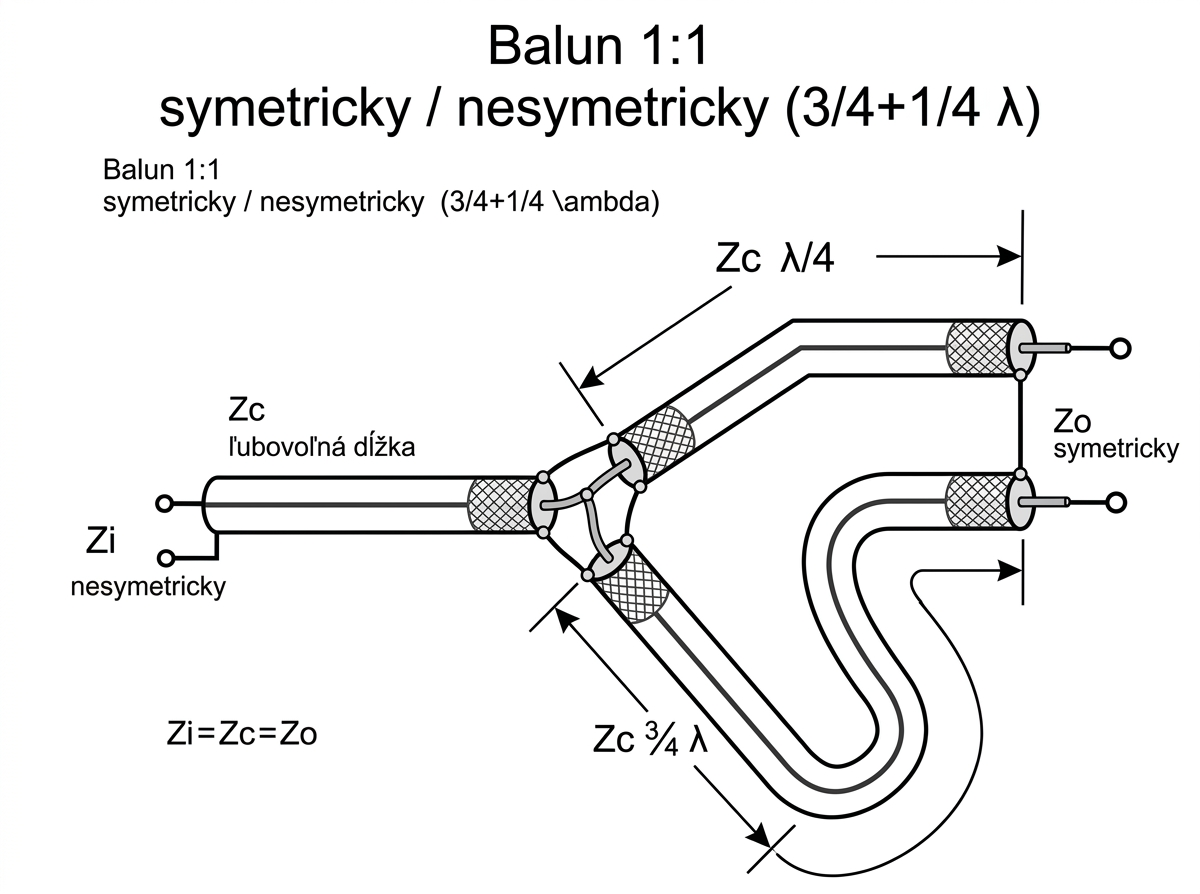
In the field of antenna design, proper adaptation is one of the basic prerequisites for successful operation. Many radio amateurs encounter the problem of transitioning between a balanced antenna and an unbalanced feed line. This is where the balun comes into play - a device that ensures not only impedance matching, but also correct symmetrical powering of the radiator. One of the lesser-known but very effective solutions is the I0QM 1:1 balun, which has gained recognition especially among VHF and UHF antenna designers.
You will read in the article
Why bother with a balun?

There are lots of balun designs on the internet - from simple choke solutions to complex transformers. The most frequently used are the so-called "choke baluns" that suppress unwanted current on the jacket of the coaxial cable. Although they are simple to implement, their efficiency may not always be optimal, especially with precisely tuned antennas.
The I0QM balun represents an alternative that is based on working precisely with the electrical length of the coaxial line. It is intended primarily for monoband yagi antennas with purely resistive impedance, where it can achieve very good results.
The basic principle of the I0QM balun
This type of balun uses a combination of two sections of coaxial cable:
- quarter-wave section (¼ λ)
- three-quarter wave section (¾ λ)
Both sections have the same characteristic impedance (for example, 50 ohms when using common coaxial cable type RG58 or RG213). The difference in electrical length between the two sections causes a phase shift of 180 degrees, which is necessary for proper symmetrical feeding of the dipole.

It is important to realize that this balun does not perform the function of an impedance transformer in the true sense of the word - if the input impedance is the same as the cable impedance, the result is again the same value. Therefore, it is referred to as a 1:1 balun.
Meaning of electrical length
When designing a balun, the electrical length of the coaxial line is key. It depends on the so-called velocity factor, which indicates how fast the signal propagates in a given cable compared to the speed of light.
Common values are for example:
- about 0.66 for RG213
- about 0.659 for RG58
In practice, however, it turns out that the manufacturer's declared values may not be completely accurate. Therefore, it is always advisable to fine-tune the balun by measuring. The author of the proposal recommends gradually shortening the cable and monitoring the resonance until the optimal response in the desired band is achieved.
An interesting knowledge from practice is that the calculated resonance can be outside the desired band - for example, around 48 MHz in the design for the 6-meter band. However, this is not a problem because the balun does not need to be tuned to a specific frequency.
Practical construction
The construction of the I0QM balun is relatively simple, but requires precision. Coaxial cables are connected in a protective box, where the shields are carefully tinned and soldered. The center conductors are connected to the connector (for example, N-type), while it is necessary to ensure good shielding - copper strip is often used for connection.
After completion, the entire joint is covered with epoxy resin to ensure mechanical resistance and moisture protection. This step is especially important for outdoor use on a mast.
As a practical matter, the 3/4 lambda section is often physically "folded" or rolled up to be the same length as the shorter section. However, this is only a mechanical solution – the electrical length remains unchanged.
Advantages over choke balun
The main advantage of the I0QM balun is its precise behavior in a narrow frequency band and excellent symmetry. With the right design, it provides:
- excellent symmetrical feeding of the antenna
- minimal losses
- stable impedance matching
Compared to the choke balun, which works more like a choke, this is a more accurate solution based on the wave properties of the line.
The disadvantage is a narrower working band, which means that it is especially suitable for monoband antennas. For broadband applications, it would be necessary to choose a different type of balun.
Practical experience
The author of the proposal tested this balun on several Yagi antennas for the 6 m and 4 m bands with very good results.
An important recommendation is not to rush the final completion of the balun. First of all, it is advisable to take measurements, fine-tune the lengths, and only then finally close the construction.
I measured symmetry over 30 dB with a high-quality coaxial cable. The value with a lower quality coaxial cable is lower, but still excellent.
Conclusion
The I0QM 1:1 balun is an interesting and effective solution for radio amateurs who want to achieve maximum performance from their monoband antennas. Although its design requires precision and patience, the result is a quality fit and reliable operation.
At a time when simple and universal solutions are often sought after, this balun is a reminder that physical principles and precise construction still have their place. For experimenters and technically oriented radio amateurs, this is a project that is definitely worth trying.
Other recommended sources:
https://sp3rnz.blogspot.com/2015/06/ a-masterpiece-i0qm-real-balun-for-yagi.html