
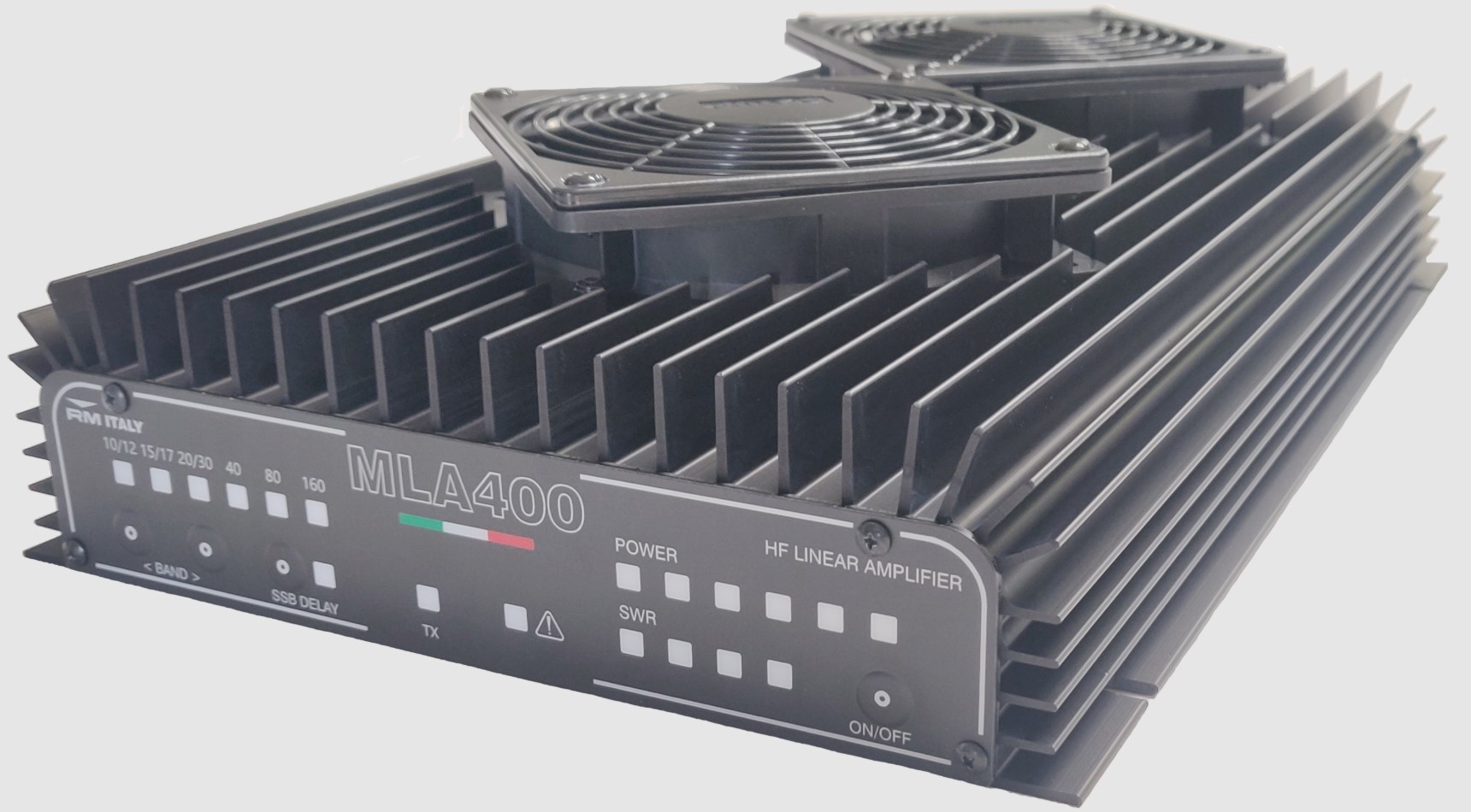
In the article you will read
Practical benefits of the RM Italy MLA 400 HF amplifier
The RM Italy MLA 400 is a transistor linear HF amplifier operating in the 1.8–30 MHz range, designed primarily for transceivers with an output of around 100 W, but it also works equally well with lower-power stations capable of delivering excitation power from 1 to 35 W. The practical meaning of such an addition is most visible when operating on crowded HF bands, in contests, during DX contacts or when working from the field, where increasing the output power from the standard 100 W to the declared up to 400 W of average power significantly improves the chance of a successful connection, especially in poor propagation.
Power supply from 13.6 V DC allows the amplifier to be used not only in a home station, but also in a mobile or portable installation - the manufacturer directly declares its suitability for both types of use. Automatic selection of the low-pass filter according to the operating band and microprocessor-controlled protection functions (against wake-up, high PSV, overheating and out-of-band operation) reduce the risk of damage to the output transistors during normal operation.
Features and technical parameters of RM Italy MLA 400
The output stage consists of four RF power transistors (RM1607 / 2SC2879 / MRF421) arranged in two parallel push-pull pairs operating in class AB, which ensures the linear waveform of the output signal necessary for SSB, AM and other modes sensitive to linearity. Harmonic components are filtered by a set of six low-pass filters with cutoff frequencies of 3, 4, 5, 8, 15, 22 and 31 MHz; the filter for the current operating band is selected automatically according to the sensed excitation frequency, or it can be selected manually from the front panel. The entire operation, including protection functions, is controlled by a built-in microprocessor.
Technical specification
| Parameters | Value |
|---|---|
| Frequency range | 1.8–30 MHz (160 m to 10 m bands) |
| Supported modes of operation | SSB, CW, AM, FM, SSTV, narrowband data modes |
| Terminal transistors | 4x RM1607 / 2SC2879 / MRF421, class AB, push-pull |
| Profit | 10.6 dB |
| Supply voltage | 13.6VDC ±1V |
| Maximum current consumption | 70 A |
| Input fuses (internal) | 4x 15 A, automatic |
| Input RF power | 1–35 W (all modes) |
| RF output power | max. 400 W (average power) |
| Throughput power in bypass mode | max. 50 W |
| Entry fee | 1.1–1.5 : 1 |
| Maximum allowable output PSV | 2.5 : 1 |
| Low-pass filters | 6 (cut-off frequencies 3 / 4 / 5 / 8 / 15 / 22 / 31 MHz) |
| Dimensions (L x W x H) | 420 x 242 x 92 mm |
| Weight | 4.6 kg |
Front and rear panel description
The amplifier's controls and connectors are divided between the front panel, where the controls and indications are located, and the rear panel, where all connections to the transceiver, antenna, and power supply are made.
Front panel

| No. | Element | Function |
|---|---|---|
| 1 | ON/OFF button | Long press to turn the amplifier on or off |
| 2 | Filter selector | Short press left/right to manually switch the current filter |
| 3 | Band indication | Displays the currently selected filter/band |
| 4 | Output power indicator | LED scale of current output power |
| 5 | Antenna PSV indicator | LED PSV scale at the amplifier output |
| 6 | LED TX | Lights up red during transmission |
| 7 | SSB DELAY switch | Used if the amplifier does not have a PTT signal from a transceiver in SSB mode. |
| 8 | Security alarm LED | Signals the activation of one of the protective functions |
Rear panel

| No. | Element | Function |
|---|---|---|
| 9 | RTX input (SO-239) | Connecting to the transceiver output |
| 10 | PTT input (Phono/RCA) | Active low, optional when using RF detection |
| 11 | DC power connector | Connection to a 13.6 V source or battery |
| 12 | ANT output (SO-239) | Connection to PSV bridge, antenna tuner (ATU) or directly to antenna |
Amplifier connection and operation
The connection is based on a simple sequence of steps. The RTX input is connected to the transceiver output with a short 50 Ω cable, the ANT output can be connected to an external power meter or automatic antenna tuner (ATU), and then to the antenna. The power cables should be connected to a source or battery with a voltage of 13.6 V (±1 V) capable of delivering at least 70 A. The wires to the source should have a diameter of at least 6 mm² and be as short as possible to minimize voltage drop; for mobile installations, they should not exceed 3 m in length and should be connected directly to the car battery, ideally with an additional fuse in the supply.
Connecting the PTT to the amplifier is optional - the device includes an RF scanning function (similar to VOX), which automatically switches it to transmission when an excitation signal is detected at the input. Before the first power-on, the transceiver output power must be reduced to a value of up to 35 W (around 10 W is recommended) and this adjustment must be made with the amplifier turned off. The filter for the current band can be set manually, or the amplifier will select it automatically when transmitting for the first time.
The amplifier must not be used while the antenna is being tuned by a manual or automatic antenna tuner. After the antenna has been tuned, the automatic ATU must be switched to standby mode so that another tuning cycle does not start while broadcasting with the amplifier active.
After turning on the amplifier and starting to transmit, it is necessary to verify that the antenna PSV remains within an acceptable range - a value of around 1.1:1 is ideal, up to 2.0:1 is acceptable, and from approximately 2.5:1 the protection is activated. When it is activated (with the exception of the thermal protection, which resets itself after cooling down), the amplifier must be turned off and on again to restore normal operation.
| Number of beeps | Meaning |
|---|---|
| 1 | Excessive input power |
| 2 | Excessive PSV antennas |
| 3 | Out-of-band operation (below 1.6 MHz or above 30 MHz) |
| 5 | Excessive temperature |
| 6 | Excessive output power |
When transmitting in high duty cycle modes (FM, data traffic), the manufacturer recommends not to exceed continuous transmission for more than one to two minutes to prevent overheating of the output transistors; for SSB and CW, where the power is intermittent or peaks only briefly, the thermal load is significantly lower. According to the manufacturer, the difference between the 35 W excitation power and the 400 W output represents an increase of approximately 10.6 dB, which corresponds to almost two S-points on the receiving side - an improvement that would be difficult to achieve for most stations with the antenna alone.
Where to buy and price
The RM Italy MLA 400 is distributed by several European amateur radio dealers, prices vary by country, current promotions and shipping costs. Directly from the manufacturer RM Italy, the amplifier is listed in the product catalog, including a technical sheet and manual, but the sale itself is carried out through a network of authorized dealers.
| Seller | Country | Price |
|---|---|---|
| Wimo | Germany | €899.00 (including VAT, plus shipping) |
| Moonraker | Great Britain / EU | €918.62 (customs duty and VAT included for EU countries) |
| HSP Shop | Italy | €875.00 (promotional price, regular price €1,279.78) |
When ordering from abroad, you should consider shipping costs and possibly customs and tax fees, which vary depending on the seller and the country of delivery; some sellers (such as Moonraker) include these fees for EU countries directly in the listed price.
„navrhnutý predovšetkým pre transceivery s výstupom okolo 100 W“
„navýšenie výstupného výkonu zo štandardných 100 W na deklarovaných až 400 W priemerného výkonu“
Tento PA znesie na vstupe max 35W 😉 Podľa mňa je určený predovšetkým pre TRX s výkonom 5 – 20W.
Pre TRX 100W ako máš v článku je PA vyslovene nevhodný, pretože ak je PA vypnutý, tak sa nedá používať s TRX čo má 100W, ale do 50W, toto je maximum PA v bypass režime. Nerozumiem prečo tam výrobca nedal normálnejšie relé.
Zmeraný výstupný výkon je <55dBm, čo je <320W. Prínos 5dBm voči 100W.
Je to tranzistorový PA pracujúci s nízkym napájacím napätím a preto je tu zvýšené riziko tvorby nežiadúcich produktov. Stačí horší spoj po čase v napájaní alebo mäkší zdroj, a užívateľ tohoto PA môže byť v obľube nielen u suseda HAMa ale aj suseda s rádiom alebo TV.
Ani z výroby to potlačenie nie je úplná hitparáda, na spodných pásmach pod 60dB. Produkty z 80m bandu na úrovni -3dBm o 15MHz vyššie alebo -5dBm na 40m bande.
Ku tomu prirátať produkty z „budiaceho“ rádia, ktoré sa tiež zosilnia.
Topka je podľa tabulky produkt zo 160m pásma, čo má na 747MHz signál 27dBm (500mW), to už sa nemusí páčiť ani mobilným opom 🙂
https://device.report/m/0c38795bdedc4661559411d7fa00f76a6aa7b3e71cfd3b8316623987a904799c
Vďaka za doplnenie a technické postrehy! Každý TCVR má reguláciu výkonu a prevádzka pri zníženom výkone zariadeniu len prospeje.
Ten limit je celkom rozumný. Nekupujem si amplifier na to, aby som cez neho preháňal vyššie výkony v BYPASS režime. Ja používam napríklad tri režimy s PA:
Merania sú veľmi dôležité, ale nesúhlasím, že potlačenie harmonických o -57dB je málo. Ak si pozrieme napríklad Acom 1000 uvádza min. -50dB https://www.acom-bg.com/products/amplifiers/acom-1000-hf- 6-m-linear-amplifier
Kým si konštruktér nevyskúša ako náročné je spraviť amplifier tak, aby v celom rozsahu mal konštantné zosilnenie, tak je náročné predstaviť si to. Je to dané tým, že pomer medzi 160m a 10m je 16:1. Každá kapacita, každá indukčnosť a vlastnosti tranzistorov do toho hrajú. Bez patričného riešenia by napríklad amplifier dával 100% na 160m a len 20% na 10m.
Keďže tých 747,5MHz nie je harmonická a použité sú 4x RM1607 / 2SC2879 / MRF421, ktoré nebudú mať tak vysoké fT (transition frequency), tak to nevyzerá ani na zakmitávanie.
Z merania vidieť, že boli použité 2 zdroje paralelne (spínané). Zo skúsenosti s RM Italy zosilňovačmi môžem odporučiť dať na prívody ferity a ideálne do vnútra filtračné kondenzátory. Takto to mám KL-501.
V nej mám ešte zmenený obvod predpätia https://www.ok2kkw.com/00003016/bias/bias_new.htm
A vymenené aj relé + extra ventilátory s teplotnými spínačmi. S takto upraveným PA som spravil vyše 10-tisíc QSO (SSB a RTTY).
Teda nemusí to byť zlý amplifier. V každom prípade ďakujem za odborné doplnenie, ktoré pomôže čitateľom vytvoriť si presnejší obraz o možnostiach a limitoch tohto PA.
Nevidim dovod, aby ma PA takto limitoval. Ak chcem ist bezny zavod na 80m alebo iny kontest v kategorii do 100W, tak nebudem rozoberat setup, pretoze vypnuty PA neznesie 100W.
PA ma byt zapinany len v pripade nutnosti, nie na bezny pokec alebo proti rovnako vybavenej stanici. Okrem sunky s liehom su tu take veci ako zbytocna spotreba (nielen PA ale aj zdroj), vznika teplo a z toho zbytocny hluk ventilátorov.
Zatial co Acom 1000 uvadza minimalne hodnoty, talian ich neuvadza vobec a treba patrat ci to niekto vobec testoval 😉
A porovnavat 400W a 1000W PA sa tiez velmi neda.
RM Italy mam spojene s CB zosilnovacmi, tomu zodpovedaju aj nimi pouzivane komponenty a riesenia. Ako sam pises, nie su optimalne, inak by si PA neprerabal 😉
Tento PA asi nebude zly, ale HAM by pred kupou mal zvazit, ci nebude lepsie riesenie PA na vyssom napajacom napati, pripadne rovno so zabudovanym zdrojom. 13,8V je vhodne na mobilnu prevadzku, v domacom hamshacku s dostupnym 230VAC su technicky lepsie riesenia pre vyssie vykony. Pretoze ak to funguje dobre teraz, za rok pre zoxidovanu poistku uz nemusi.
„Napájacie káble treba pripojiť k zdroju alebo akumulátoru s napätím 13, 6 V (±1 V) schopnému dodať aspoň 70 A. Vodiče k zdroju by mali mať priemer aspoň 6 mm² a čo najkratšiu dĺžku, aby sa minimalizoval pokles napätia; pri mobilnej inštalácii by nemali presiahnuť dĺžku 3 m a mali by byť pripojené priamo na autobatériu, ideálne s doplnkovou poistkou v prívode.“
Pri dlzke 3m a medi 6mm2 je ubytok 1,2V @70A.
Bateria pri zatazeni 70A nebude mat 13,6V (vnutorny odpor, klesajuci naboj).
Poistka má tiež svoj odpor.
V tom lepsom pripade bude PA pracovat s napatim v spicke okolo 12V. To znamena mensi vykon a zhorsenu linearitu, co sa bude este zhorsovat s vekom akumca a stavom nabitia.
Sam fungujem v hamshacku z 45Ah PB akumca, viem o com pisem, 6mm2 mám pre 100W TRX a kábel dlhý meter 😉