

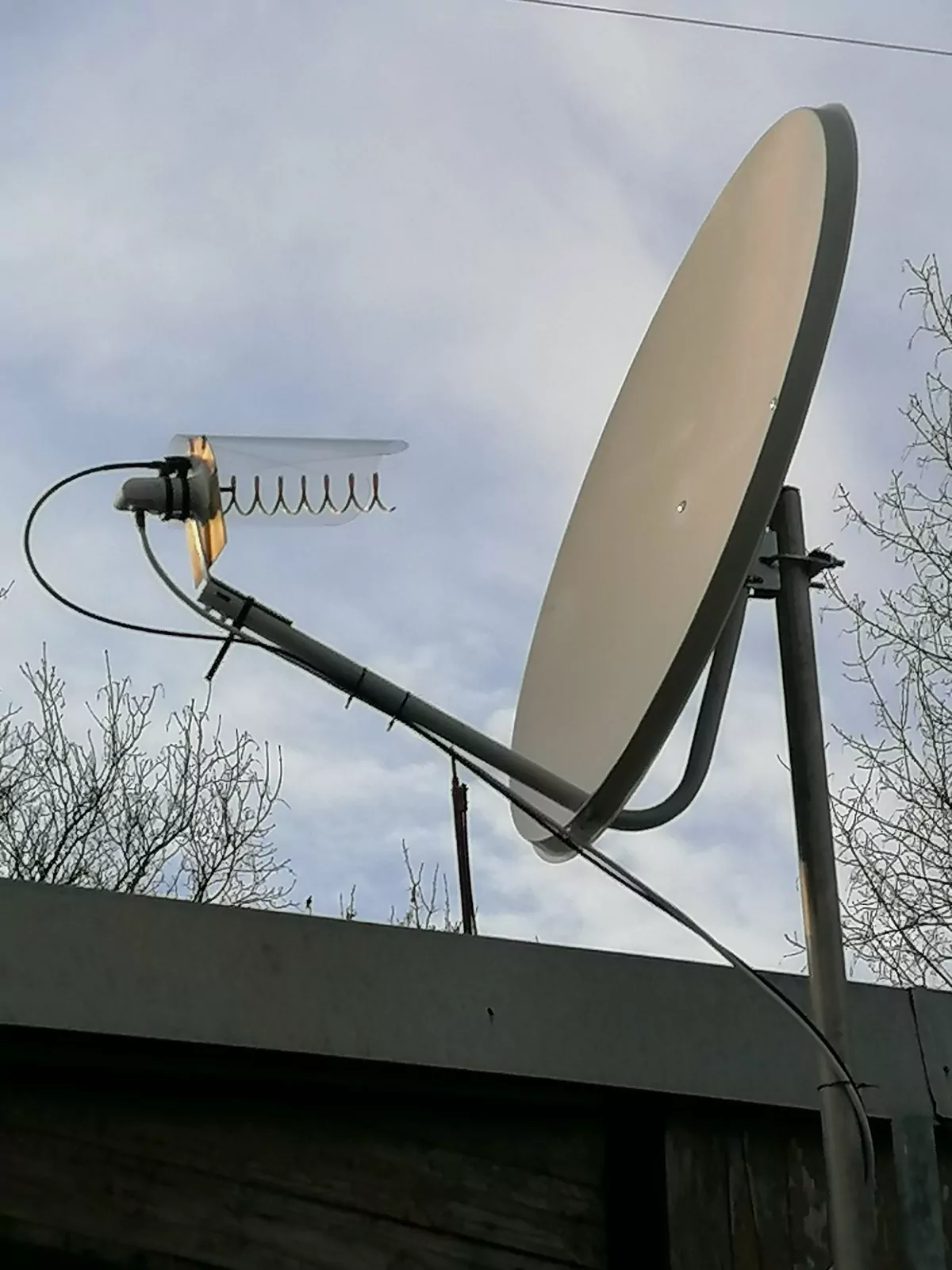
Satelit QO-100 si získal obľubu medzi mnohými rádioamatérmi a urobil tak dostupnú medzikontinentálnu komunikáciu. Konštruktéri satelitného transponádéra QO-100 geniálne nastavili frekvencie aj pásma tak, aby bolo možné použiť mnohé bežne dostupné komponenty na zostavenie príjmového aj vysielacieho setupu. Downlink je v pásme 3 cm, Uplink v pásme 13 cm.
For broadcasting, it is advisable to use circular polarization, which can be achieved as easily as possible with a parabola and an irradiator with circular polarization. The choice of a suitable irradiator depends primarily on the f/D ratio of the parabolic reflector.
Helix and patch type irradiators are most often used, respectively. by modifying it as SWEAT feed-om. Patch ožarovač je vhodný pre paraboly s f/D okolo 0,4. Regular TV dishes have a higher f/D. When using an unsuitable irradiator, the signal from the irradiator goes beyond the edges of the dish or does not use its surface.
If you want to be inspired by other feed constructions, try to browse 2ingandlin.se/Feed_comp_432_MHz.html It's a very good comparison of feeds and their features.
You will read in the article
Dimensions of patch feed for QO-100

It is best to start from the original drawing of the dimensions of the patch feed. The critical dimension is the emitter-reflector distance, which must be 3 mm. The experience of the designers of this feed confirms that even a small deviation will cause degradation of properties.
Production of patch feed
We will need an N- or SMA connector, a reflector plate and an emitter. Cut or cut out the plates and drill holes for the connector and soldering of the radiator. Determining the distance between the emitter and the reflector using a drill proved to be useful for me. After soldering, we can easily pull it out.
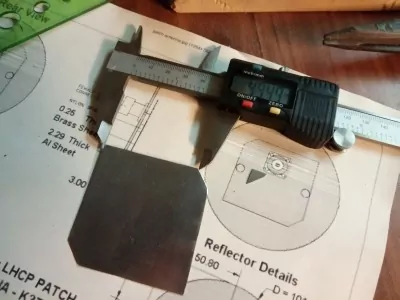
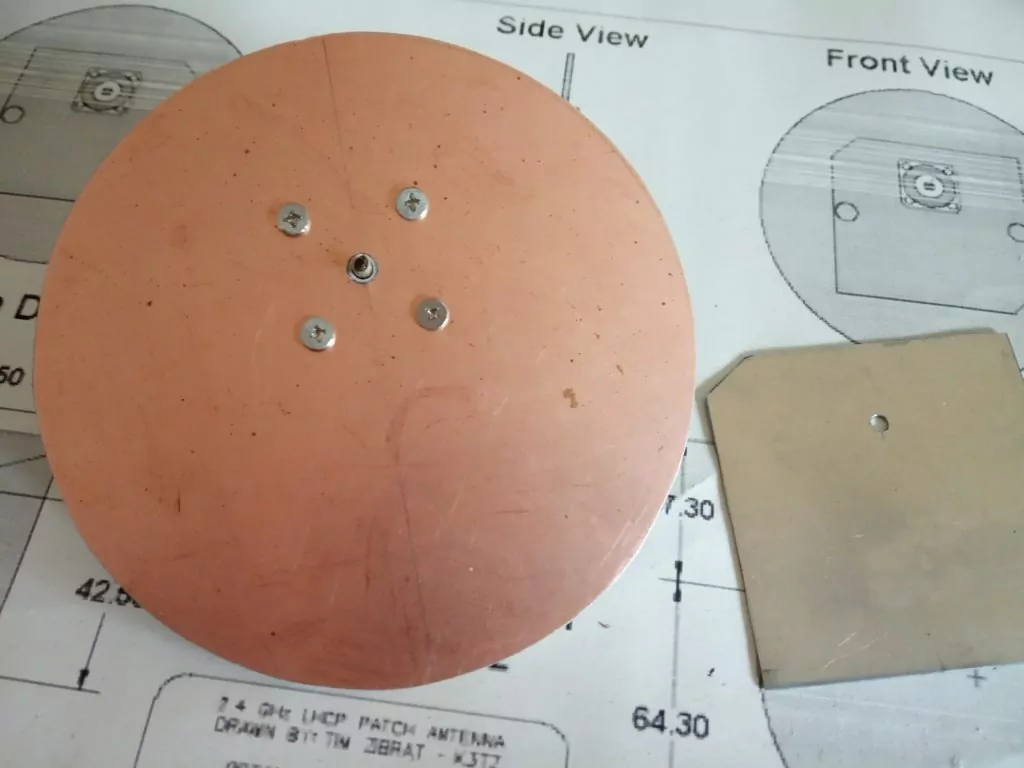
I used high-quality cuprextite as a reflector. After the circle was cut out, the edges were smoothed by hand. A tin plate from a box was used for the radiator Predzosilňovač.
Patch feed tuning
For the correct functioning of the patch feed, it is necessary that one resonant frequency is above and the other below the band, i.e. approx. 2400 MHz. Without this setting, correct circular polarization will not be achieved.
Precise adjustment can be made by pressing or pushing the corners of the radiator. If you have a measuring technique, the possible process is as follows (uncalibrated meter):
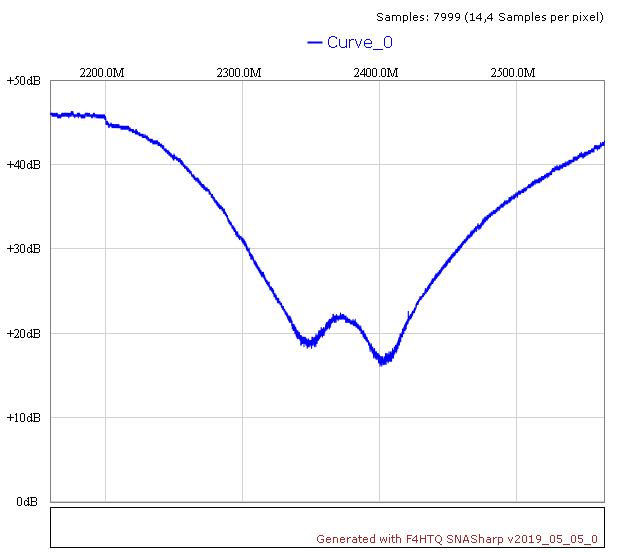
Ak vezmeme, že odraz je -27 dB, resp. -29 dB, tak pre ožarovač vyrobený „na kolene“ to nie sú zlé parametre (PSV < 1.1). Patch feed is one of the easy-to-implement feeds for the QO-100. Practical tests also confirmed that the patch feed works very well.