
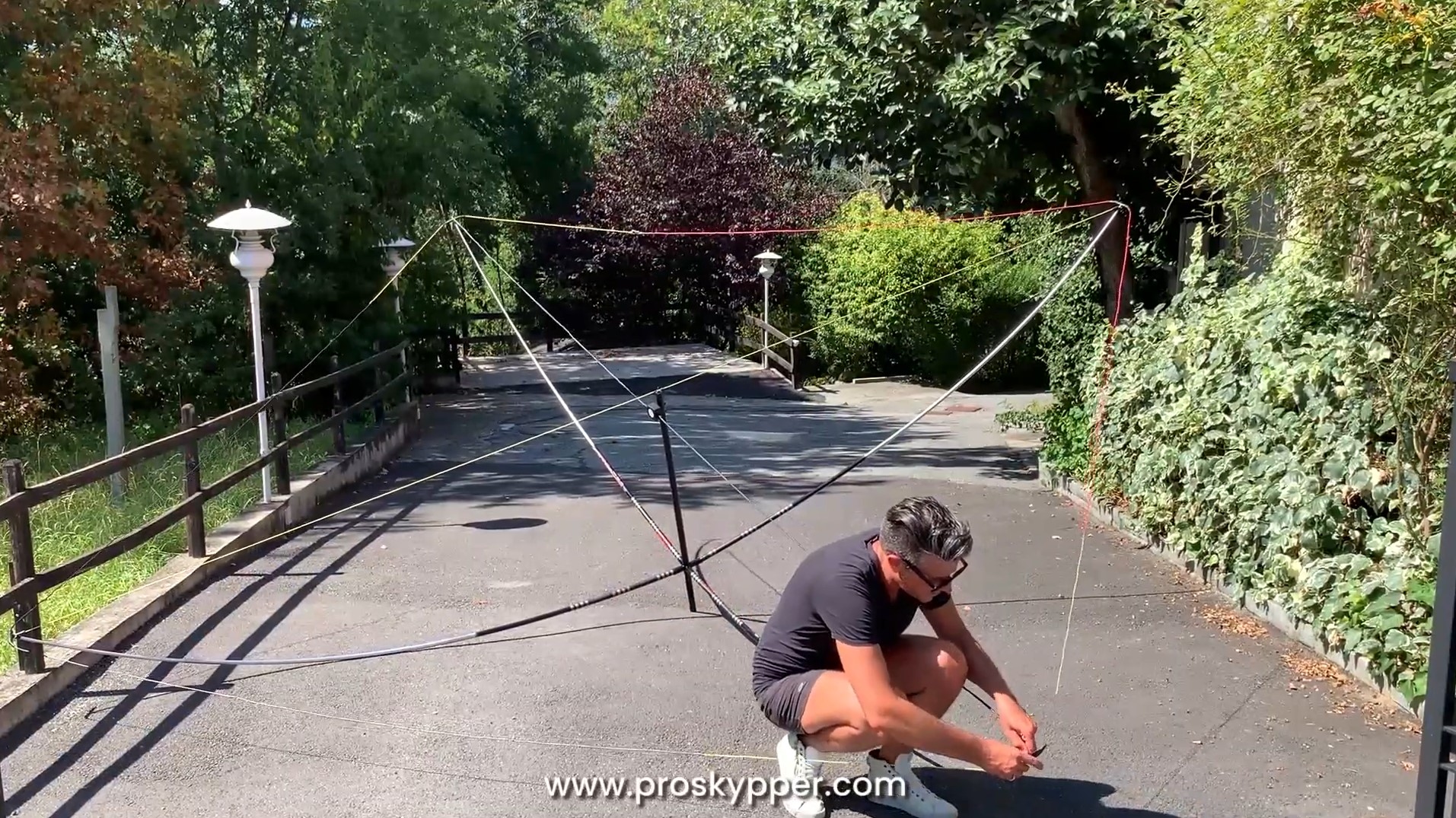
In the amateur radio community and among DX enthusiasts on short waves, there is an endless search for the holy grail: an antenna that has high gain, excellent front-to-back ratio, but is also light enough for one person to carry and raise a standard telescopic mast. The antenna falls into this category. ProSkypper.
This construction marvel, detailed on the pages proskypper.com, nie je náhodným výtvorom. Svojím princípom priamo nadväzuje na svetoznámu konštrukciu spiderbeam, popularized by Cornelius Paul (DF4SA). While Spiderbeam is synonymous with a multi-band wire directional system, ProSkypper takes this genius concept and transforms it into a single-band solution.
In the article you will read
Pedigree and Principle of ProSkypper Construction

Aby sme pochopili ProSkypper, musíme sa pozrieť na jeho „otca“ – Spiderbeam. Klasický Spiderbeam vznikol ako odpoveď na potrebu ľahkej, plnohodnotnej trojprvkovej yagi antenna for expedition purposes. Instead of heavy aluminum tubes, it uses a frame made of fiberglass rods arranged in a star shape (spider), on which wire elements are tensioned.
ProSkypper tento princíp zachováva, ale výrazne ho zjednodušuje. It is a three-element wire Yagi (radiator, reflector and director), where the elements are arranged in a horizontal plane. Due to the fact that it is designed for only one band (most often 10 m, 11 m or 12 m), the complex tying of several bands is eliminated, which dramatically reduces weight, aerodynamic resistance and the difficulty of construction.
Technical Details: Heart of Fiberglass and Copper
The construction of the ProSkypper relies on four strategically placed fiberglass arms that extend from a central cross (hub). This cross is the critical point of the entire antenna – it must be strong enough to withstand wind gusts, yet light enough not to burden the top of the mast.
The elements of the antenna are not made of aluminum, but of a special antenna wire (often with a Kevlar core for minimal stretch). The use of wire instead of tubes brings two fundamental advantages:
-
Hmotnosť: The entire antenna in the configuration for 11 m (CB) or 10 m band weighs approximately 2 až 3 kilogramy. To je zlomok hmotnosti oproti klasickej hliníkovej 3-prvkovej Yagi.
-
Q-faktor: The wire elements have slightly different properties, which, combined with the geometry of the ProSkypper, allows for a very clean radiation pattern.
TIP for Permanent Installation
Fiberglass pipes can be strengthened by filling them with PUR foam. In this way, the weight will be kept low, but the strength will increase significantly. The price for this is of course the loss of disassembly.
Performance Characteristics
Although the ProSkypper is 'just' a wire antenna, do not be fooled. Its electrical properties are identical to solid aluminum antennas. When properly tuned, it achieves:
-
Zisk: approximately 7 to 8 dBi (depending on height above ground).
-
Predozadný pomer (F/B): can exceed 20 dB, which is crucial for eliminating interference from directions you do not want to receive.
-
SWR (pomer stojatých vĺn): thanks to optimized element lengths, it achieves values close to 1:1.1 within the operating band without the need for a complex tuner.
It is precisely the narrow specialization on one band that allows the designers to proskypper.com squeeze the maximum from the antenna. Spiderbeam always has to make compromises in geometry to prevent individual bands from affecting each other. ProSkypper does not have this problem – every millimeter of wire is exactly where it needs to be for optimal resonance at the chosen frequency.
Practical use: King of the field
ProSkypper je primárne určený pre operátorov, ktorí milujú prácu z terénu (SOTA, POTA, Field Day) alebo majú obmedzené možnosti na streche domu. Vďaka svojej nízkej hmotnosti nepotrebuje drahý a ťažký Rotátor; na jeho otáčanie postačí small TV rotator or even manual rotation of the mast.
Another huge advantage is inconspicuousness. Thin fiberglass rods and almost invisible wires are much more acceptable to neighbors in urban development than massive aluminum beams. The manufacturer's site shows that emphasis is placed on the quality of materials – UV stable fiberglass and stainless components ensure that the antenna will survive even harsher weather conditions.
ProSkypper vs. Spiderbeam: Which one to choose?
The choice between these two constructions depends on your priorities:
-
Spiderbeam is a clear choice for the radio amateur (HAM) who wants to operate on 3 to 5 bands simultaneously and has space for a larger and more complex antenna.
-
ProSkypper It dominates where maximum performance on a specific band is a priority (for example, during solar maximum on 10m or for CB expeditions). It is quicker to assemble, cheaper, and mechanically simpler.
Conclusion
The ProSkypper antenna proves that even in the era of digital technologies and satellite communication, honest mechanics and antenna theory have their irreplaceable place. By adopting the best features from the Spiderbeam design - lightness, durability, and wire concept - and applying them to a single-band system, it has created a tool that is the ultimate solution for many DX-ers.
Whether you are planning an expedition to an uninhabited mountain peak or looking for a way to discreetly but effectively direct a signal from your garden, ProSkypper is proof that true strength lies in simplicity. It is an antenna built by radio amateurs for radio amateurs, where every detail serves a single purpose: to make the farthest connection.