Spring will slowly wake up and we will again be drawn to the hills, to nature, but also to broadcasting. Maybe you are thinking about a new antenna. Then let the following lines be from Zoli OM7AQ stimulating.
The term QUAGI is a compound consisting of the words quad and yagi. The Quagi antenna is also a composite because it is created from elements of the Quad and Yagi antennas. Directors are from Yagi, emitter and reflector from Quad. Quagi antennas were used in several versions – 8 and 11-element on 2m, 15 and 18-element on 70cm and 15-element on 23cm. W5UN uses a 2m longer modification for EME attempts. In this article I will describe the 11-element version at 144 MHz and, as an interesting fact, the 15-element Quagi at 1296 MHz.
You will read in the article
11 el.Quagi at 144 MHz
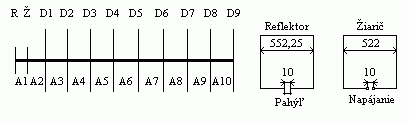
As a boom for this antenna (fig.1) we will use an armored or AlMgSi tube with a diameter of 20 mm. All elements are attached isolated from the spar. The directors have a diameter of 6 mm and are made of aluminum or AlMgSi. The reflector and emitter (fig. 2) are made of Cu or Al wire with a diameter of 4 mm. When you use copper, don't forget to protect it against oxidation by painting it. A mechanically strong material whose dielectric properties must be as good as possible must be used for the supporting clips of the reflector and the emitter. Anténu môžeme napájať priamo koaxiálom 50 ohm. PSV should not exceed 1.5 in the range of 144-146 MHz. In the case of worse PSV, we can try to move D1 towards the emitter. The dimensions of the antenna are shown in the table.
Dimensions of 11-el.Quagi at 144 MHz (in mm):
R (circuit)
2209
T
10
F (circumference)
2088
A1
533
D1
919
A2
394
D2
913
A3
838
D3
904
A4
787
D4
900
A5
787
D5
894
A6
803
D6
889
A7
914
D7
884
A8
914
D8
884
A9
864
D9
881
A10
876
15 el.Quagi at 1296 MHz
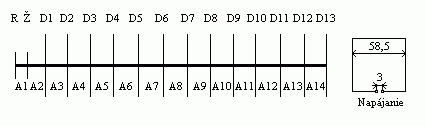
I used a 1/2″ PVC pipe for the 23cm Quagi boom (fig.3). The elements are made of Cu wire with a diameter of 3 mm. We drill a hole and fasten the directors with a suitable glue. The scheme of the radiator is in Fig. 4. The supporting clips of the reflector and the emitter must be made of insulating material with the best possible dielectric properties. We feed the antenna with a low-attenuation (!) 75 ohm coaxial. Again, surface protection of copper elements against oxidation is important. The dimensions of the antennas are in the table.
Dimensions of 15-el.Quagi at 1296 MHz (in mm):
R (1 page)
61.0
A1
60
F (1 page)
58.5
A2
51
D1
99.0
A3
93
D2
98.5
A4
50
D3
98.0
A5
74
D4
97.0
A6
74
D5
96.5
A7
74
D6
96.0
A8
102
D7
95.0
A9
102
D8
94.5
A10
95
D9
94.0
A11
97
D10
93.0
A12
78
D11
92.5
A13
105
D12
92.0
A14
116
D13
91.0
Experience
For many years I used a Quagi antenna on 144 MHz. The antenna has also proven itself in DX operation. I have established Es, MS, Aurora and tropo connections to more than 100 major locators with her.
In the radio club OM3KKF (contest brand OM7F) we are in transition QTH Poľana dobre osvedčila antenna system 2x8 el. Quagi on 2 m.
I can recommend Quagi to anyone who wants a relatively small but powerful antenna and likes to experiment in the field VHF.
Literature
[1] Hetves József, HA7PR: 11elemes Quagi antenna 2m-re; CQ HA 2/1992 [2] Dr. Kahle Frigyes, HA5KF: Quagi antenna; Radio engineering 1980