
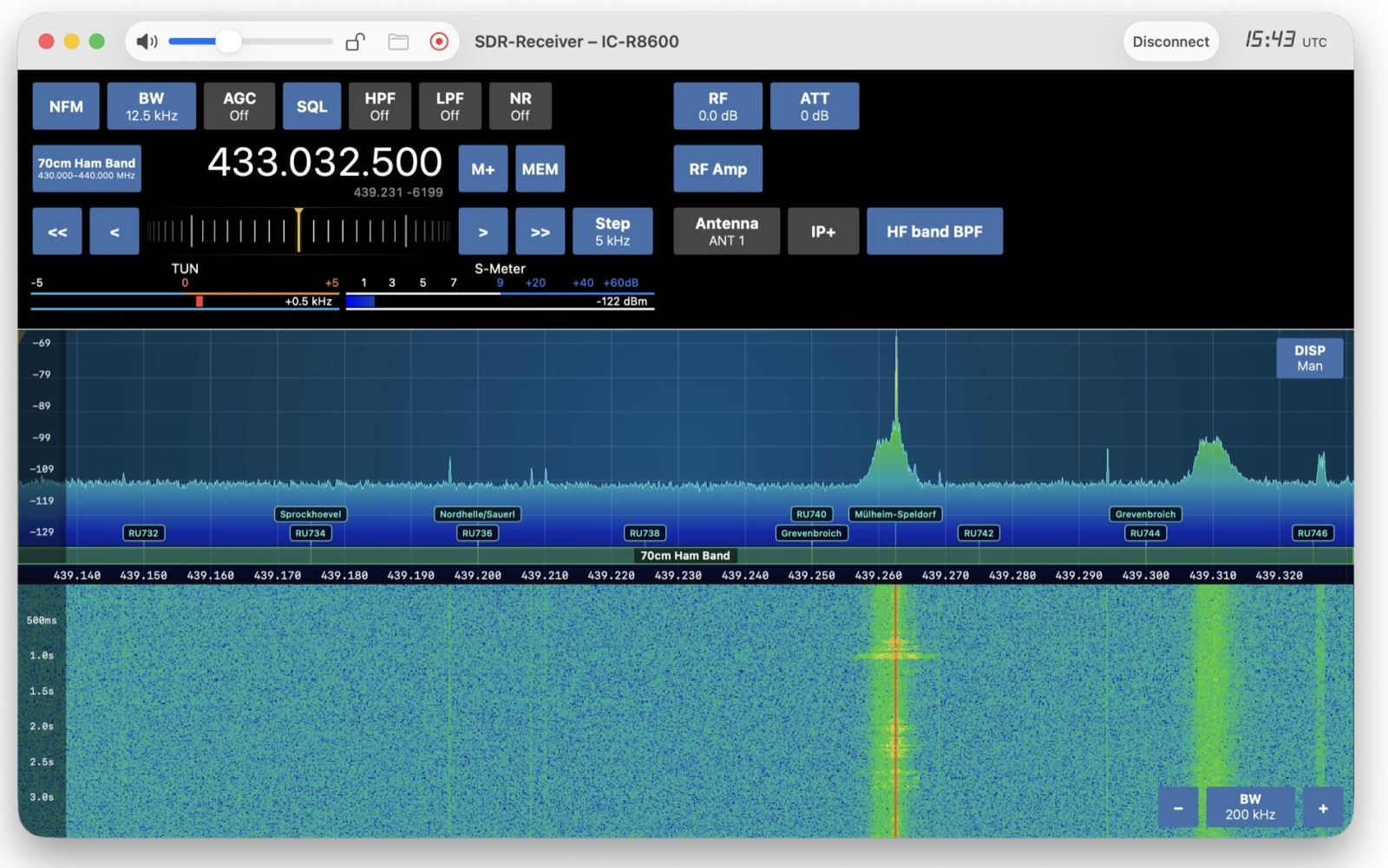
SDR-Receiver is a native application for macOS designed to work with USB SDR. Spája klasické funkcie SDR prijímača, zobrazovanie spektra a waterfallu s dekódovaním širokého spektra digitálnych signálov. Program je určený pre rádioamatérov, SWL listeners and users who want to use the SDR receiver to monitor aviation, maritime, meteorological, or other radio traffic. Currently requires macOS 26 or newer and compatible USB SDR receiver.
In the article you will read
Supported SDR hardware

SDR-Receiver supports multiple hardware platforms. The mentioned receivers include RTL-SDR, HackRF, Airspy, Airspy HF+, FUNcube Dongle Pro+, ADALM Pluto, Microtelecom Perseus, and Icom IC-R8600. The source also indicates support for RTL-SDR devices and similar receivers, as well as ADALM Pluto and similar devices.
The difference between individual SDRs lies primarily in their hardware capabilities and the range or power of the receiver. The decoders themselves are not tied to a specific SDR model. The developer states that even a cheap RTL-SDR can be used to receive, for example, pagers, aviation traffic, amateur radio digital modes, weather fax, NAVTEX, or RDS. More powerful receivers expand the capabilities of the hardware platform with which the application works.
Spectrum, waterfall, and receiver control
The basis of the user interface is panadapter zobrazujúci spektrum a waterfall. Pri ladení je k dispozícii VFO and the program allows working with memories and band plans. The spectrum also displays markers of amateur and utility bands according to activated band plans and markers of stored memories.
For regular reception, WFM, NFM, AM, USB, LSB, and CW modes are supported. Squelch, AGC, and speaker tone control are available. The combination of spectrum, waterfall, and VFO allows monitoring activity over a broader part of the received band and then selecting a specific signal for listening or decoding.
More than 25 integrated decoders
A distinctive feature of the SDR-Receiver is the number of decoders integrated directly into the application. From an amateur radio perspective, CW, WSPR, FT8, FT4, FT2, RTTY, APRS, and SSTV are particularly interesting. However, the program is not only for amateur radio operation.
Other supported decoders include ADS-B for aviation traffic, AIS for maritime traffic, ACARS, POCSAG, RDS, HF Fax, NAVTEX/SITOR-B, DSC, Selcall, and ALE. The application also includes a decoder for time signals DCF77, MSF, WWVB, JJY, and TDF. Overall, the source lists more than 25 decoders, with more in development according to the developer.
Station identification and monitoring
When monitoring short waves, the integrated EiBi frequency database can be useful. After tuning the signal, the Stations at VFO function will display stations registered on the corresponding frequency. Band plans also allow orientation directly in the spectrum and differentiate between amateur and utility segments.

The Scanner is used for searching activity. It can scan a defined frequency range, stored memories, or a frequency list. When monitoring aviation and maritime traffic, it is possible to decode ADS-B and AIS and display aircraft and vessels on a map. The application also includes ACARS and APRS decoders.
I/Q recording and reverse analysis
For technical experimentation and later analysis, the ability to record the complete I/Q stream, not just the resulting audio, is important. The recording can later be played back, and during playback, the frequency can be changed within the captured segment of the spectrum. The same decoders can be used on the recorded signal as during live reception.

This mode of operation is practical, for example, in a situation where an interesting digital signal appears in real-time, but there is no time to try different decoder settings. Recording allows returning to the captured I/Q stream and analyzing it later. An audio recording is also available, which can only record when a signal is present.
Who might be interested in SDR-Receiver?
SDR Receiver represents a software platform that combines SDR reception with decoding various types of signals in one application. For the radio amateur, the combination of classic reception in USB, LSB, CW, AM or FM s dekódovaním FT8, FT4, FT2, WSPR, RTTY, APRS či SSTV. SWL poslucháč môže využiť EiBi databázu, Scanner a nahrávanie I/Q signálu.
For the experimenter, the ability to work with various SDR receivers and later analyze recorded I/Q data is essential. Also interesting is the wide spectrum of non-amateur decoders, which allows one SDR system to be used for monitoring aviation and maritime traffic, pagers, RDS, NAVTEX, or meteorological faxes.
The SDR Receiver is therefore built as a universal SDR receiving and decoding tool for macOS. Its basis is not a specific type of SDR hardware, but a common environment for tuning, spectrum monitoring, I/Q recording, and signal decoding.