
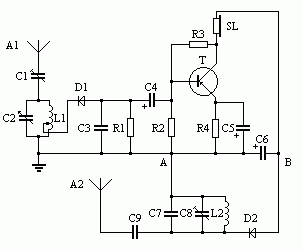
It is a construction that was described years ago by Ing. Viliam Petrík, OK3WAO (OM3WAO). I have edited the available material and present it to you today. It is not a revolutionary invention or a perpetual motion machine - it is a crystal with a single-transistor amplifier. The method of obtaining energy for the amplifier is interesting: from the air. Yes, from the air. The captured electromagnetic energy of a strong station in the medium wave band is used.
The signal from the transmitter that we want to receive is received from the antenna A1 to the circuit C2L1, which we tune to the frequency of the transmitter. After detection, the signal is applied to the base of the transistor. Its working point should be found using trimmers (R2 and R3) so that the reception is the strongest - the gain of the transistor at the given supply voltage is the greatest. High-ohm headphones are connected in the collector circuit.

The signal induced on antenna A2 is used to power the receiver. We determine this signal by selecting it from the SV band using the C7C8L2 circuit. The voltage is rectified by diode D2 and filtered by capacitor C6. If we want to avoid the second antenna, or there is not a strong enough station at the receiving location, we can power the receiver from the tkzv. ground battery. A battery of these dimensions will give us approximately 0.7V and 1mA, so we will use two to three batteries connected in series to power the receiver. The copper and iron rod must have a diameter of at least 7 mm.
The mentioned article is rather an inspiration as to how it is possible to use another source of electrical energy. It is interesting that it does not use natural (water, wind, sunlight) or electrochemical sources (batteries, accumulators). Who knows how electricity will be distributed in the future?
Parts list
| R1 | 10 k |
| R2 | 47 k |
| R3 | 470 k |
| R4 | 470 |
| C1 | 3-30pF trimmer |
| C2 | 200 to 500pF, tuning |
| C3 | 1.5nF |
| C4 | 10uF |
| C5 | 10uF |
| C6 | 100uF |
| C7 | 100-470pF |
| C8 | 3-30pF, trimmer |
| C9 | 220 pF |
| D1 | Ge/Sch diode |
| D2 | Ge/Sch diode |
| T | PNP any. |
| SL | * headphones 2×2000 ohm |