
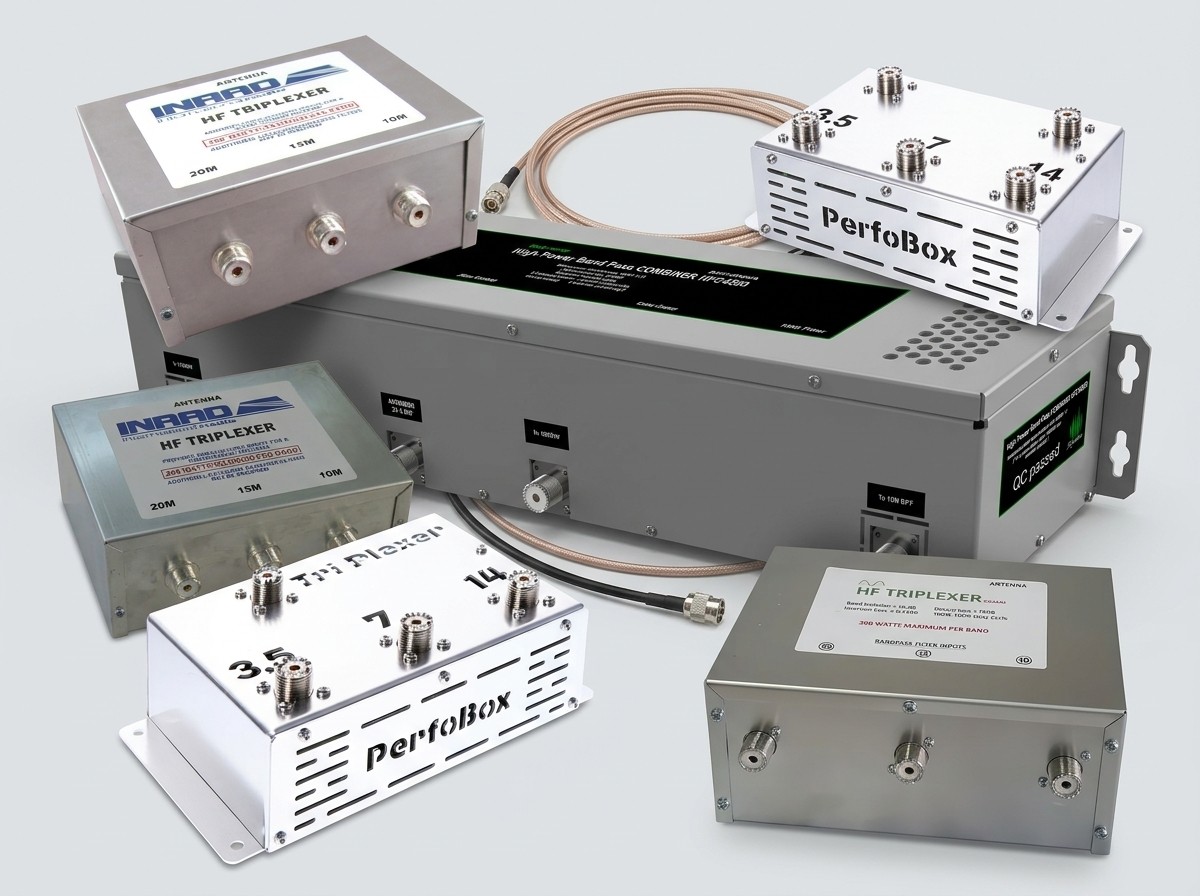
If I have one quality multi-band antenna and need to create a workspace for multiple transceivers, a triplexer is a very interesting solution. It allows to divide the common antenna system by frequency so that individual radios can operate on different bands simultaneously. Therefore, it has the greatest significance in contesting, during SO2R, Multi-Op stations, Field Day or DX expeditions.
However, it is essential that the triplexer is not just a 'splitter' or high-frequency splitter. It is a frequency-selective system of filters. And it is the quality of the filters, their attenuation in the passband, and especially the isolation between the individual ports that determine whether the resulting assembly will be truly usable.
In the article you will read
What is a triplexer?
A triplexer is a passive RF device with one common antenna port and three band ports. The transmitting signal from an individual transceiver passes through the appropriate filtering branch into the common coaxial line and further into the multi-band antenna. In reception, the system works in reverse – the signal from the antenna reaches the appropriate port according to frequency.

A typical design consists of three filters: low-pass, band-pass, and high-pass. In a classic triplexer for 20, 15, and 10 m, one branch passes 20 m, the second 15 m, and the third 10 m. The filter characteristics are designed to separate the individual bands as effectively as possible.
The result is a situation where I can have, for example, three transceivers connected to one triband antenna. Each of them primarily sees its operating band, while the common coaxial cable and antenna serve all three devices.
Is it worth considering a triplexer?

In regular amateur radio operation, a triplexer is not a necessity. If I have one transceiver and can use multiple antennas, classic antenna switching is simpler. However, the situation changes with SO2R and contesting. There, for example, I want to transmit on 20 m and simultaneously listen to 15 or 10 m without having to use a separate antenna for each transceiver.
A triplexer can significantly simplify the antenna infrastructure. One triband yagi can be connected with a single coaxial line, and the individual bands are separated only at the devices in the shack. With the right configuration, I can create three separately usable band ports from one antenna.
The advantage is also evident at stations where the number of masts, coaxial cables, or antennas is limited. It is cheaper to have one mast and one antenna than three masts with three antennas, not to mention the cost of land. In contesting, I also gain the ability to work with one antenna from multiple radios without mechanical band switching.
Tip: simultaneous operation on multiple bands
I see the most interesting use of the triplexer precisely in simultaneous DX operation. Let's imagine a tribander for 20, 15, and 10 m and three transceivers. The first radio operates on 20 m, the second on 15 m, and the third on 10 m. Each radio is connected to the respective port of the triplexer, and all three ports share one antenna.
In practice, however, a triplexer should not be mistaken for a complete system for protection against interaction between radios. The mere separation of filters is often insufficient. A strong transmission signal from one transceiver can penetrate into the receiver of another radio through inadequate isolation. Therefore, in quality contest setups, a triplexer is used together with bandpass filters (BPF) on individual ports.

This is especially important for high-power stations. Even though the triplexer provides, for example, dozens of decibels of isolation, at a power of 100 W, there still remains a relatively high signal after such isolation. The problem is even more pronounced at higher transmission power. Therefore, the BPF provides additional selectivity directly in front of the transceiver and reduces the risk of receiver overload, blocking, and intermodulation products.
Complexity of triplexer construction
At first glance, it may seem that a triplexer is a simple LC circuit. However, it is structurally a much more complex device. It is not enough to achieve good signal passage in three operating bands. At the same time, sufficient isolation must be ensured between all ports, low SWR, minimal insertion loss, and stable parameters under real load.
During the design, the individual filters influence each other. They all converge at a common antenna point, and a change in the impedance of one branch can manifest in the other two. Therefore, when tuning the triplexer, I cannot look at the individual filters in complete isolation.
VA6AM pri svojej konštrukcii používa trojicu filtrov typu LPF, BPF a HPF with resonant traps for additional bands. These traps help increase isolation between the individual ports. During tuning, it is also necessary to ensure proper termination of the other ports with 50 Ω loads. The manufacturer explicitly warns that tuning should take place with the triplexer already mounted in a metal enclosure.
Therefore, I would consider a VNA as the basic measuring equipment for my own construction. While a filter can be experimentally built without measuring S11 and S21, it is very difficult to reliably verify the resulting isolation between all three ports. At higher powers, additional requirements for voltage and current ratings of capacitors, heating of coils, and mechanical construction arise.
Wiring examples
The most well-known application is the triplexer for 20, 15, and 10 m. This combination is often used with a triband Yagi in contest stations. However, there are also other combinations. Low Band Systems offers, for example, triplexers for 80, 40, and 20 m, while VA6AM has also developed WARC triplexer pre 30, 17 a 12 m.
| Configuration | Typical use | Antenna |
|---|---|---|
| 20 / 15 / 10 m | SO2R, contesting, Field Day, DX expeditions | Tribander Yagi |
| 80 / 40 / 20 m | multi-radio HF station | multi-band antenna |
| 30 / 17 / 12 m | WARC operation | multi-band antenna |
The antenna itself must be suitable for the used bands. The triplexer is not a substitute for an antenna tuner. INRAD for example, it states directly that its HF triplexer is intended for a tribander that has low SWR on all three bands, and not for a random wire or another significantly non-resonant antenna that would need to be matched with a tuner.
An interesting example is system 4O3A. It uses a high-power combiner along with bandpass filters for 20, 15 and 10 m. In this concept, the combiner itself is not intended for standalone operation; the complete system consists of the combiner and the relevant BPF. The manufacturer also offers solutions that allow the triplex configuration to be expanded to additional bands.
KV triplexer: practical demonstration
Overview of triplexer manufacturers
Among the well-known solutions are VA6AM Projects, Low Band Systems, 4O3A Signature, INRAD and Dunestar. VA6AM focuses on its own low- and high-power triplexers and also publishes construction and tuning procedures. Low Band Systems offers triplexers and other multiplexers in various power classes. 4O3A is primarily focused on high-power contest systems.
INRAD is among the older well-known commercial solutions for 20, 15 and 10 m, and Dunestar offered a triplexer based on a concept published by K6KV in QST. Recently, newer projects, such as SO9I Engineering, have also focused on the topic, viewing the triplexer as part of a broader system for SO2R and multi-radio antenna setups.
Summary
The HF triplexer makes sense when I want to create multiple independently usable band ports from one suitable multi-band antenna. Its greatest benefit is seen in SO2R, Multi-Op contesting, Field Day, and DX expeditions, where I need to operate on multiple bands simultaneously.
However, it is important to perceive the triplexer as part of the entire filtering system. The triplexer itself may not provide sufficient isolation between transceivers. Therefore, BPFs are also used on individual ports during demanding operations. When designing or building, one should monitor not only the insertion loss but, above all, the isolation between bands, SWR, power handling capability, and stability of parameters.
For a radio amateur who has a quality triband Yagi and wants to get the most out of it, a triplexer can be a very effective solution. However, for a regular single-radio station, its complexity is often not justified. What matters is not whether the triplexer 'works', but whether it solves a specific problem in the antenna system better than a simpler solution.