
V článku sa dočítate
New American SDR transceiver built with community help
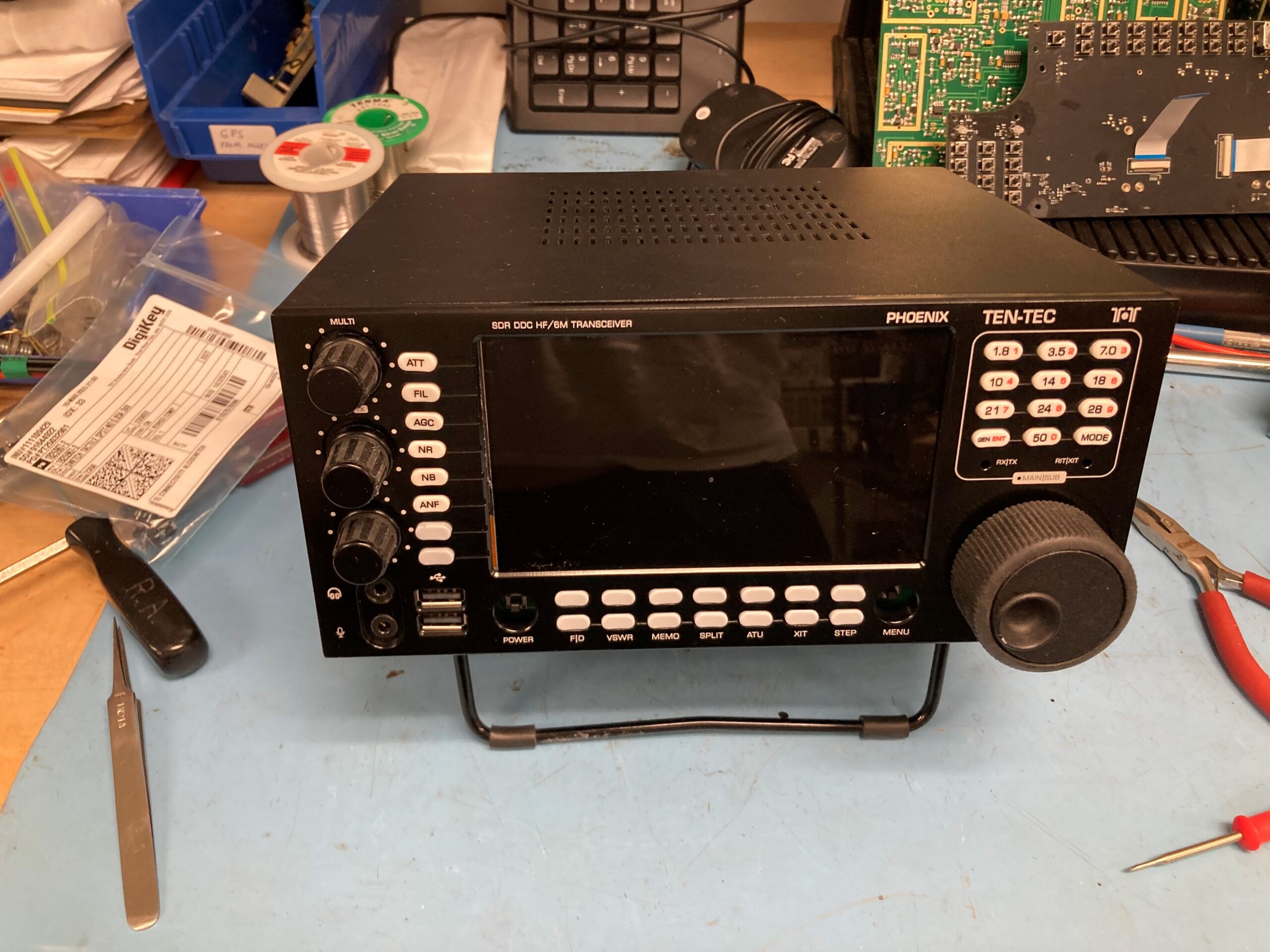
The Ten-Tec Model 594 Phoenix is a new HF transceiver with a Direct Digital Down Conversion (DDC) architecture that the American company Ten-Tec has been developing since 2025. It is the first completely new model since the company went through a series of existential crises, and the first Ten-Tec transceiver designed with direct input from the buyer community into the final design. The preliminary specification was published in May 2025, and production is planned for the first or second quarter of 2026 as of the date of publication of this article.
What does the Model 594 Phoenix have to offer?
The Phoenix is designed as a compact and portable transceiver, comparable in size to the Eagle 599AT but slightly taller. The intention is to cover the full spectrum of needs – from QRP prevádzky (plánovaná verzia s nízkym výkonom) až po plnohodnotnú stanicu s duálnym prijímačom. Podstatou konceptu je dvojkanálová DDC architektúra s dvomi ADC, dvomi FPGA a DSP modulom. Na rozdiel od bežných superheterodyn prijímačov neobsahuje analógové zmiešavanie ani medzifrekvenčný filter – vstupný signál je vzorkovaný priamo na RF, čím sa eliminuje celá trieda problémov spojených s obrazovými frekvenciami, IQ nevyváženosťou a úzkymi medzifrekvenčnými filtrami.

The heart of the signal processing is the SPU (Signal Processing Unit) module - a custom plug-in DSP module with a quad-core ARM processor clocked at 1.3 GHz with integrated DSP cores and GPU, 1 GB RAM, 32 GB eMMC memory, Bluetooth, Wi-Fi and 1 Gb/s Ethernet PHY interface. The display is 5.5″ diagonal, native resolution 1920 × 1280, AMMOLED (Active Matrix Micro OLED) technology. The modular PCB design allows for the theoretical replacement of individual boards during future hardware updates.
A distinctive feature is full remote controllability right out of the box: Phoenix includes a built-in web server with client/server architecture, so it does not require any external software for remote operation. softvér. Všetky digitálne módy vrátane RTTY sú generované priamo v rádiu – externá zvuková karta ani rozhranie nie sú potrebné.
A bit of history: how the Phoenix model came about
Ten-Tec was one of the key American manufacturers of amateur radio communications equipment. After being acquired by RF Concepts, most of the manufacturing assets – including PCB assembly facilities, tooling, plastic molding and sheet metal – were sold off and the company switched to a full outsourcing model. A financial collapse followed, the assets were transferred to liquidation company RKR, and in January 2016, Mike Dishop, N8WFF, owner of Dishtronix, took over Ten-Tec. Dishop got the inventory and service in order, restarted production of the commercial RX-340 and RX-331 receivers, and started the Omni-VII+. Then came COVID, a fire at one of the key chip factories, and a supply crisis that definitively ended the possibility of continuing with the previous models, as the analog components used simply ceased to be produced.
Dishop sa rozhodol nereprodukovať minulosť, ale navrhnúť úplne nové rádioThe contact led him to Konstantin, a Ukrainian engineer who had developed an advanced SDR kit. After long negotiations, the cooperation did not materialize – but when the war hit Ukraine, Konstantin hid in the forest near Kiev. Dishop mobilized aid, coordinated extraction plans and a prayer chain in the community. Eventually, Konstantin crossed the border with his family and five-year-old daughter. Rádio, jeho zdrojové kódy a schémy získal Dishop, a na tomto základe vznikol Phoenix – fyzický aj symbolický návrat Ten-Tecu „z popola“.
The Phoenix adopted the VFO tuning arm and low-pass filters from the Eagle model, the preselectors from the Orion II (a new version designed by Dishop), the concentric controls from the Argonaut 6, and the construction methods from the Omni-VII+.
Phoenix 594 at Hamvention 2025
Preliminary Technical Specifications Ten-Tec Model 594 Phoenix
Note: This is a PRELIMINARY SPECIFICATION, SUBJECT TO CHANGE WITHOUT NOTICE.
| Parameters | Value |
|---|---|
| General | |
| Frequency range | 300 kHz – 55 MHz (specifications guaranteed in amateur bands) |
| Supply voltage | 13.8V ± 15% |
| Frequency accuracy | ±5Hz at 25°C |
| Frequency stability | ±0.5 ppm over the entire operating temperature range |
| Dimensions (H x W x D) | 105 × 230 × TBD mm (without connectors) |
| Front connectors | Headphones, microphone: 3.5 mm stereo jack; 2× USB 2.0 |
| Rear connectors | RF: 2× SO-239 (configurable); accessories; band data; power; HDMI; USB 3.0; pre-distortion input; RX antenna input (independent) |
| Receiver | |
| Configuration (1 ADC) | Two receivers on the same band (Main + Sub) |
| Configuration (2 ADCs – optional) | Two receivers in any bands |
| MDS (Preamplifier Off/On) | -117 dBm / -134 dBm ±3 dBm, typical value |
| ADC overload point | +4 dBm without attenuation |
| IMD lock (preamplifier off/on) | 120 / 121 dBm, typical value |
| Power consumption during reception | < 2A |
| Transmitter | |
| Output power | 5 – 100W ±1dB |
| Duty cycle | Kontinuálny SSB/CW; 50 % AM, FM, PSK/digitálne módy |
| TX bandwidth | 300 Hz – 6 kHz, adjustable |
| FM Stroke | ±5kHz |
| Harmonic and spurious (1–30 MHz) | < -50 dBc at 100 W |
| Harmonic and spurious (30–55 MHz) | -60 dB at 5–100 W; -43 dBc at < 5 W |
| 3rd order IMD | -60 dB below PEP, minimum |
| Adaptive predistortion | Internal + sampling port for external amplifier |
| TX/RX switching time | < 20ms |
| Acceleration/deceleration time | 5ms |
| CW offset | Adjustable |
| CW Keyer Speed | 5 – 50 WPM, adjustable weight |
| CW keyer | Curtis Mode B; USB keyboard |
| CW memories | 10 |
| Power consumption when transmitting | 20 A, typical value |
| Antenna tuner | |
| Type | Reversible L-network |
| Frequency range | 160 – 10 m (excluding 6 m) |
| Customization range | SWR 10:1, typical value |
| Remote control | |
| Architecture | Client/Server; built-in web server, no external software required |
Where and when will the Phoenix 594 be available and at what price?
Ten-Tec has introduced the “Phoenix Club” system – pre-sale limited to a maximum of 100 units from the first series. Interested parties send a deposit of 0 to Dishtronix Inc. / Ten Tec Company, PO BOX 24222, Huber Heights, OH 45424, or via PayPal after e-mail confirmation to sales@tentec.com. The deposit is non-cancellable, but in case of non-delivery within one year from the announced date it is fully refundable. The remainder of the price for club members is ,250, for a total price of ,750 including shipping within the continental USA (CONUS). The regular list price is planned to be ,350 excluding shipping.
All Phoenix Club member pre-orders include a fully populated configuration: dual ADC (two receivers in any bands), 100 W output, and an integrated antenna tuner. As of August 20, 2025, approximately 40 of the 100 slots remained available. Current project progress information is available at groups.io/g/TentecPHOENIX. Originally scheduled for Q4 2025, after extensive PCB rework based on community requests, the date was pushed back to late Q1 or early Q2 2026, in order to be in time for Hamvention 2026.
Summary
Ten-Tec Model 594 Phoenix je ambiciózny projekt obnovy amerického výrobcu komunikačnej techniky, postavený na DDC SDR architektúre s duálnymi ADC a FPGA, quad-core ARM SPU module and a 5.5″ AMMOLED display with a resolution of 1920 × 1280. The key parameters of the receiver – MDS -134 dBm with preamplifier on, IMD blocking 121 dBm and ADC blocking point +4 dBm – are at a level comparable to top contest receivers. TX IMD -60 dB and adaptive predistortion with a sampling port for an external amplifier are features that are unmatched by regular competitors in this price category. Remote control without external softvéru, interná generácia všetkých digitálnych módov a modulárna konštrukcia sú ďalšie argumenty pre tých, ktorí Phoenix sledujú.
At the same time, one must be realistic in the assessment: this is a preliminary specification, the project has undergone extensive rework, and the deadlines are moving. Production takes place in a single plant in Dayton, Ohio, with limited capacity and dependence on the availability of key components. For those interested in Slovakia and the Czech Republic, the practical complication is payment by check or PayPal in USD and the absence of European distribution. Following the project through the group on groups.io is a recommended step before any financial commitment.