
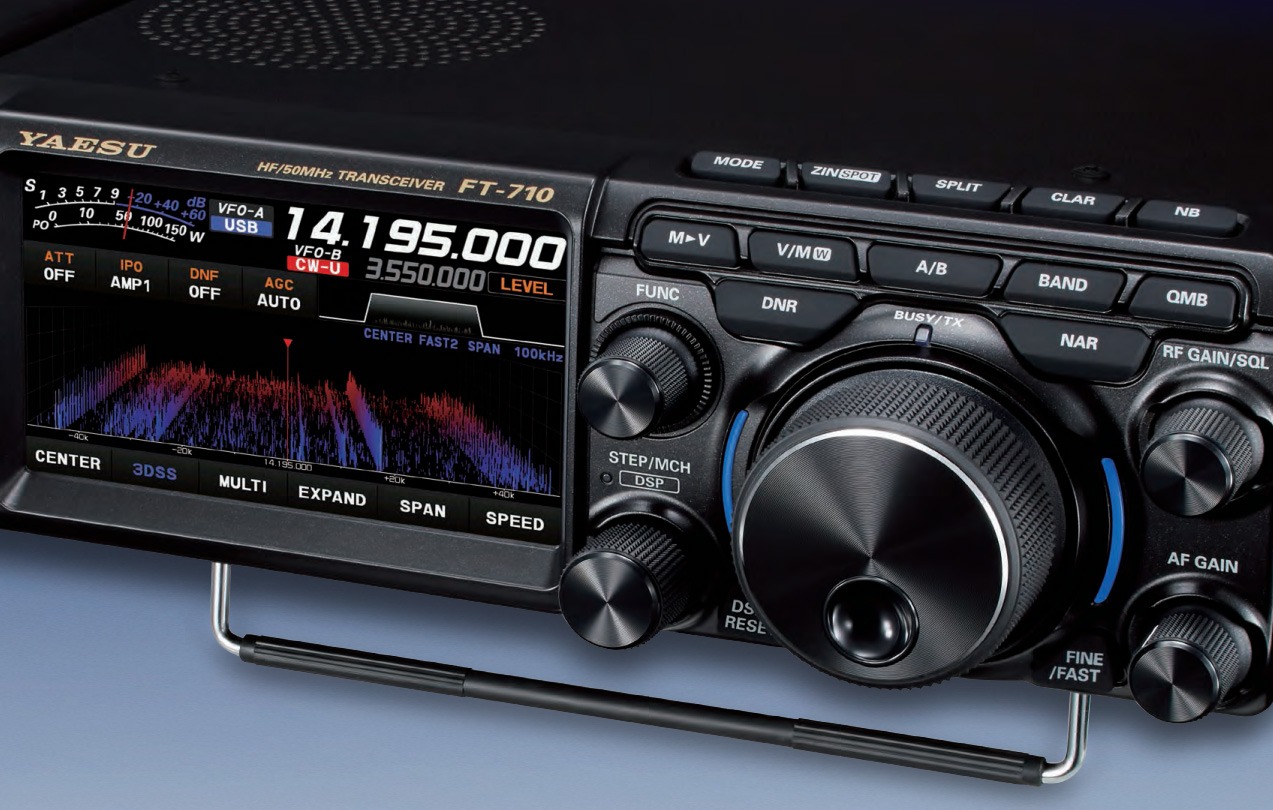
Radio amateurs like to compare technical parameters. Datasheets include IMD, Blocking dynamic range, Phase noise, ADC architecture, roofing filters, DSP and very often also MDS — Minimum Discernible Signal. It is not uncommon to see discussions in which it is argued that a receiver with an MDS of -132 dBm must automatically be better than a model with an MDS of -125 dBm.
But amateur radio reality outside the lab works differently. If your antenna is bringing noise to your receiver at -116 dBm, then the question is simple: why is your receiver capable of hearing -132 dBm?
This is where the difference between laboratory parameters and real DX reception begins.
In the article you will read
MDS vs. reality: what are you really hearing?
Let's start with a specific example.
Let's imagine a receiver with the declared:
- MDS = -132 dBm
And at the same time, an antenna system that brings ambient noise on a given band:
- Noise floor = -116 dBm
The difference is:
16 dB
This means that the external noise is 16 dB stronger than the internal limit of the receiver. In other words: the receiver is no longer listening to its own noise. It is listening to what the antenna is sending to it.
In that case, the weakest signal that can be practically detected will not be -132 dBm. It will be approximately at the level of external noise, or just below it, depending on the mode used.
Practically:
- SSB: signal must usually be a few dB above the noise floor
- CW: usable even closer to the noise floor
- FT8/MSK144/Q65: decoding possible even under noise thanks to DSP integration gain
This means:
A receiver with an MDS of -132 dBm in an environment with a noise of -116 dBm has no real advantage over a receiver with an MDS of -125 dBm.
Both are limited by their surroundings, not electronics.
What exactly is noise?
The word "noise" is used a lot in hamshack, but technically it refers to several different phenomena.

On the bands we encounter a mixture of:
- thermal noise
- atmospheric noise
- cosmic noise
- industrial and digital RFI
- local electromagnetic smog
At HF bands, the receiver's inherent noise is, in most normal situations, lower than the ambient noise picked up by the antenna. This is a fundamental observation. At HF bands, the typical limit is often defined by the environment, not by the sensitivity of the front-end.
Thermal noise
Každý rezistor generuje tepelný šum. Každý MOSFET, bipolar transistor or other active element in the input stage of the receiver increases the noise figure. ADC in SDR Receivers have their own noise floor. DSP can help with decoding, but it can't cancel out physics.
This is noise that manufacturers minimize when designing TCVRs.
Atmospheric noise
It is dominant on KV. The source is thunderstorms and electrical discharges anywhere on the planet. The ionosphere transmits these impulses over long distances. Therefore, 160 m and 80 m are often flooded with static in the summer season. This is a completely natural phenomenon.
Cosmic noise
Cosmic noise is another natural component. It is present on HF, but usually less dominant than atmospheric noise. On VHF/UHF its importance changes. EME operators know this very well.
Natural noise versus man-made noise
This is perhaps the most practical topic today.
Natural noise
It has a physical origin:
- storm activity
- ionospheric phenomena
- galactic resources
- cosmic RF background
It is essential. You don't filter it out by turning off the circuit breakers in your house.
Artificial noise
This is today's revenue killer. The modern urban environment generates enormous RFI:
- switched power supplies
- LED lighting
- solar inverters
- chargers
- VDSL
- powerline adapters
- DC/DC converters
- cheap SMPS
- inductive charging
- photovoltaics
Urban electromagnetic interference is a dominant factor in many locations today.
Both environmental noise measurements and expert EMC studies show that the urban electromagnetic environment can be dramatically noisier than in a rural location.
Mestská stanica vs stanica na vidieku: prečo remote station dáva zmysel
An excellent practical example is provided by comparing two identical FLEX-8600 stations.

City station:
- FLEX-8600
- HF-6V vertical
- 40 m
Country station:
- FLEX-8600M
- 40 m horizontal EFHW at a height of ~10 m
Both were listening to the same signal. The signal was approximately: S6. But the difference in noise floor was: approx. 10 dB at 40 m
And at 20 m even: about 20 dB
That's a brutal difference. Because SNR is what matters. Not the absolute sensitivity of the receiver. If a city operator loses 20 dB of SNR, they can have a Nobel Prize-winning receiver and still lose to a simple rural station.
What effect does the antenna have on noise reception?
Big. Huge. And often bigger than the receiver itself.

Vertical antennas
Vertikály sú výborné DX antény. Majú nízky vyžarovací uhol, fungujú dobre na lov DXCC, CQ WW contest aj low-band prevádzku. Ale majú reputáciu hlučných antén. Prečo? Pretože sú citlivé na:
- vertically polarized noise
- surface-wave interference
- local EMI
Horizontal dipoles
Horizontálny dipól je často tichší. Preferuje horizontálnu polarizáciu a menej reaguje na vertikálne mestské rušenie. To neznamená, že automaticky vyrieši mestské RFI. Praktický FLEX test to ukázal jasne. Aj horizontálny EFHW v meste môže byť hlučný.
Receive-only antennas
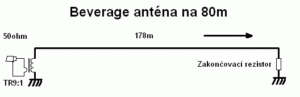
This is where serious DXing begins. Beverage, small loop, K9AY, phased RX arrays. These antennas are often not good for breaking through pile-ups, but they dramatically improve SNR. And that's exactly the point.
Better reception ≠ stronger signal.
Better reception = better signal-to-noise ratio.
S-meter He lies more than you think.
IARU Region 1 definuje:
S9 = -73 dBm
Each S-stage: 6 dB
So: S1 ≈ -121 dBm
But S-meter measures a narrowband calibrated signal. Noise is broadband. Comparing S-meter and real noise can be misleading. Especially with SDR waterfall displejoch.
Why a super-sensitive receiver may not be an advantage
If the receiver lowers its own noise floor below the ambient noise, further improvement in sensitivity becomes meaningless.

In addition, other problems arise:
- receiver overload
- intermodulation
- ADC clipping
- problem with strong radio signals
- receiver phase noise
- AGC pumping
Pre contest operátora môže byť dôležitejší:
- BDR
- RMDR
- close-in phase noise
- IMD resistance
Not an extreme MDS. That's why we don't evaluate K3S, IC-7610, FLEX, FTDX101, SunSDR and similar machines only by sensitivity.
DIGIMODES menia pravidlá, ale nie fyziku

FT8, FT4, Q65, MSK144 claim that they can decode signals below the noise level. It's not magic. It's the result:
- time integration
- DSP correlations
- FEC principles
- narrow bandwidth
But it still applies: lower external noise = more decoded stations.
So is the most sensitive receiver always the best?
No. And very often not even close.

The best receiver is the one that provides the best SNR, overload resistance, and practical usability in a particular electromagnetic environment.
A receiver with an MDS of -132 dBm in a block of flats with a noise background of -100 dBm is like an astronomical telescope pointed through a dirty window.
The potential is there. But the medium kills it. On the contrary, a simpler receiver in a quiet QTH with a good RX antenna can give phenomenal results.
Conclusion
If you have a receiver with an MDS of -132 dBm and the antenna is producing -116 dBm noise, you are effectively limited by the noise, not the receiver. The difference between a paper datasheet and real DX is right there. The biggest hamshack upgrade is often not a new TCVR.
It is:
- better location
- quieter RX antenna
- RFI elimination
- remote station
That's why an experienced DX operator doesn't just look for the most sensitive receiver. He looks for the quietest system. And that's the fundamental difference.
Potvrdzujem, na „bežnom“ QTH je limit šum / QRM. Aj preto „necítim“ na KV pásmach 80-17m úbytok signálu pri zaradení rozbočovača pre SDR v RX ceste s útlmom 3,5dB. Kolegu s QRO mám 270m blízko, takže súhlasím aj so zbytkom, sú dôležitejšie parametre RX ako citlivosť.
AI ?
AI používame ako asistenta na úpravu a generovanie textových podkladov. Technológia nám pomáha tvoriť obsah rýchlejšie, ale finálne slovo sú vždy na nás.