
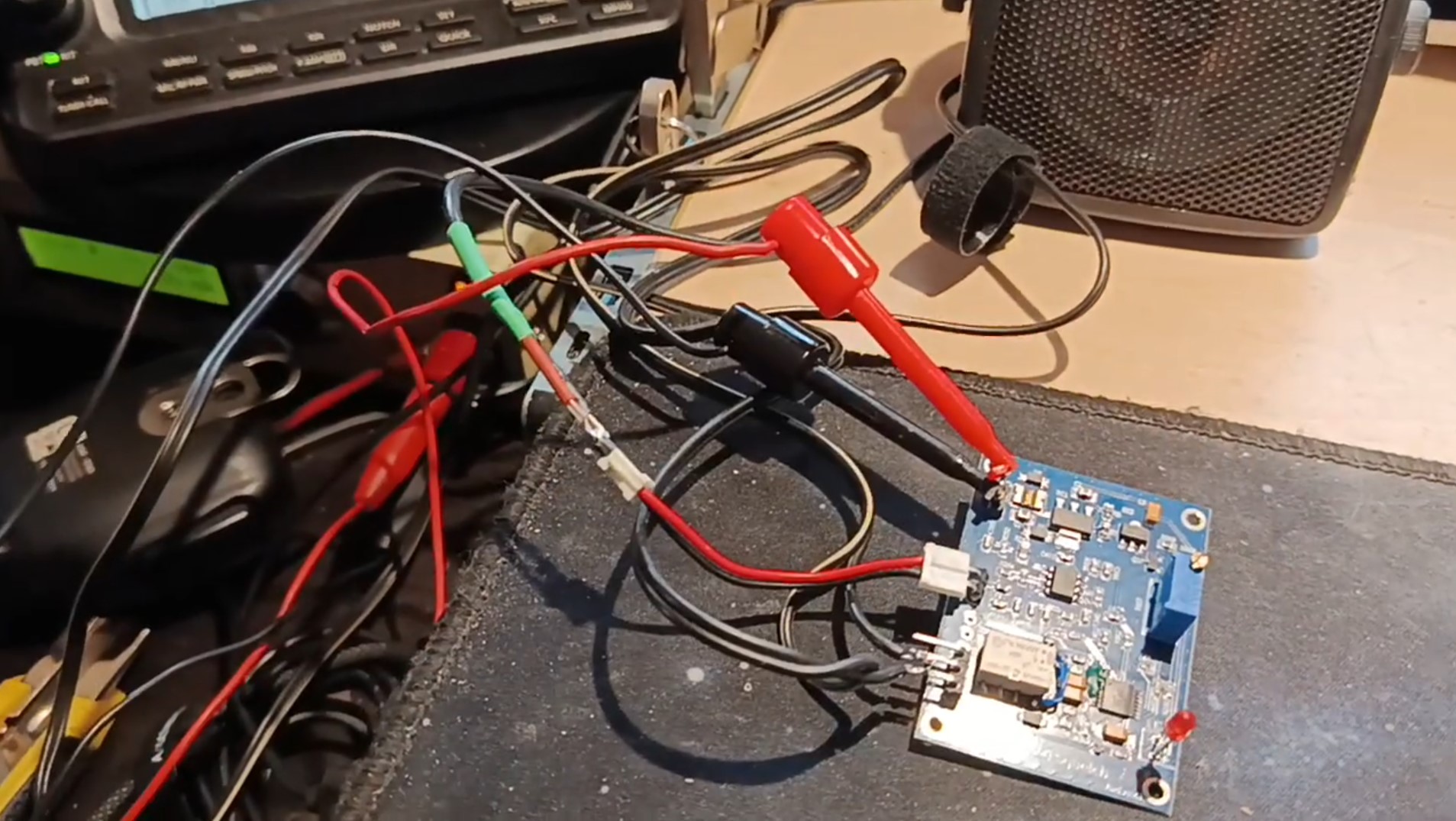
The classic squelch operates on the principle of the level of the received signal. If the signal exceeds the set threshold, the audio path opens. This principle is practical especially in FM, but can be problematic in HF. The level of noise, QRM, and QRN can vary significantly, and an increase in energy does not necessarily mean that the receiver has just captured a usable voice signal.
This project addresses this problem. Voice Activated Squelch VAS V4 by YO3HJV. Autor pôvodne hľadal spôsob, ako pri monitorovaní KV frekvencií ponechať reproduktor stíšený a otvoriť ho iba vtedy, keď sa v prijímanom audiu objaví ľudská reč. K projektu ho inšpirovali aj rádiá Codan a hlasový squelch implementovaný v DSP the Icom IC-7000 receiver.
In the article you will read
Voice detection instead of signal level
VAS V4 does not use the classic principle of 'signal above threshold = open squelch.' The analog circuit evaluates the presence of a characteristic voice signal in the audio. According to the documentation, it is designed for voice detection in AM, FM, and SSB. The advantage in SSB is that a weak station does not need to have a sufficient increase in total energy compared to noise for the classic squelch to respond reliably.

In voice detection, the absolute signal level is not only evaluated. VAS V4 is designed so that normal noise and disruptive impulses do not trigger the output as easily as a classic level squelch. However, the documentation also warns that complete separation of human voice from disruptive signals is not possible. False detections can occur with signals of varying amplitude that resemble voice energy.
Connection to the amateur radio station
VAS V4 can be used as a standalone module or integrated directly into the receiver. When installed in the radio station, the audio signal is fed to the AUDIO_IN input before the volume potentiometer. The documentation assumes that VAS will work with audio before its regulation in the receiver.
When used independently, it can be part of its own speaker box. The project author used VAS in conjunction with an audio amplifier, speaker, volume control, and MUTE switch in his design. When integrated into the receiver, an internal audio amplifier may not be necessary; the documentation describes the possibility of disconnecting it via the APWR jumper.
The power supply is suitable for standard amateur radio voltage. Technical specifications indicate a supply voltage of 11 to 14.8 V, with a minimum value of 10.5 V and an absolute maximum of 16 V. The idle current is stated in the documentation to be less than 20 mA, typically around 17 mA.
Setting the sensitivity of VAS V4
The most important setting is the CONFIDENCE potentiometer. The setting is done at a KV frequency where there is currently no voice traffic. First, the setting is turned clockwise until noise appears in the speaker and the detection indication lights up. Then the potentiometer is turned in the opposite direction until the noise disappears and the CONFIDENCE indication goes out. The documentation recommends continuing for about three to four more turns.
The goal is to set VAS so that it can detect even the weakest desired voice signal. If false detections occur during operation due to short-term interference, sensitivity can be slightly reduced further. The documentation states an additional adjustment of about one to three turns.
False detections cannot be completely excluded. Signals with variable amplitude approximately in the range of 5 to 10 Hz may resemble voice energy in their nature.
Technical parameters
VAS V4 operates with an input audio level of 250 to 800 mV peak. The default audio output gain is 20 times. Using external components, it can be increased to approximately 200 times. The detection time, that is, the time required to open the squelch, is approximately 25 ms. Hang time is approximately 1200 ms.

The module also has a galvanically isolated control output implemented with an optocoupler. This allows the use of voice detection to control external devices. The documentation states maximum values for the optocoupler output of 35 V and 50 mA.
Possibilities of use in amateur radio practice
The simplest use is a standalone speaker module connected to the audio output of the transceiver. VAS then keeps the speaker silent during noise and opens it upon voice detection. This is interesting, for example, for long-term monitoring of HF frequencies, where we do not want to have the speaker constantly on.
Another option is to integrate the module directly into the receiver. The small dimensions of the board also allow for internal mounting. Due to its low power consumption, it is also interesting for portable operation, where VAS can be powered from the same source as the radio station.
Audio does not have to come exclusively from a classic transceiver. The YO3HJV project also considers other audio sources including PCs. SDR. Modul tak môže byť zaujímavým doplnkom pri experimentovaní so SDR prijímačmi a vlastnými audio cestami.
The optocoupler output additionally allows the use of voice detection as a control signal for other devices. The project author mentions, for example, activating a recorder or external program. An interesting experimental use is also an SSB repeater, where voice detection on the receiving side could serve as a logical signal for activating the PTT transmitter.
VAS V4 is not a replacement for FM squelch
When using VAS V4, it is important to respect its intended use. The project author explicitly does not recommend using this circuit as a replacement for the classic squelch detector in FM communication. Although the documentation indicates voice detection for AM, FM, and SSB, the project is not designed as a universal replacement for standard FM squelch.
Therefore, VAS V4 is particularly interesting as an experimental supplement for voice operation, especially where the classic squelch based solely on signal level does not provide the desired behavior in noise and weak SSB signals. Its analog design, low power consumption, standalone operation, and optocoupler control output also open up space for custom amateur radio constructions.
VAS (Voice Activated Squelch), alebo inde pomenovaný VOS (Voice Operated Squelch) alebo v Icome VSC (Voice Squelch Control) má v ponuke aj IW2NDH. Namiesto analógu je to DSP a má aj redukciu šumu a filtre. https://jackdev23.wixsite.com/iw2ndh-dsp
Inou alternatívou je dekódovať signál počítačom, niektoré SDR programy majú VAS „zabudovaný“.
Je na zamyslenie, prečo v dobe SDR DSP prijímačov to nie je bežná výbava, ak to zvládol IC-7000 z roku 2005… Aj keď v praxi je prínos VSC otázny, skúsil som, nepoužíval som (na IC7000).