
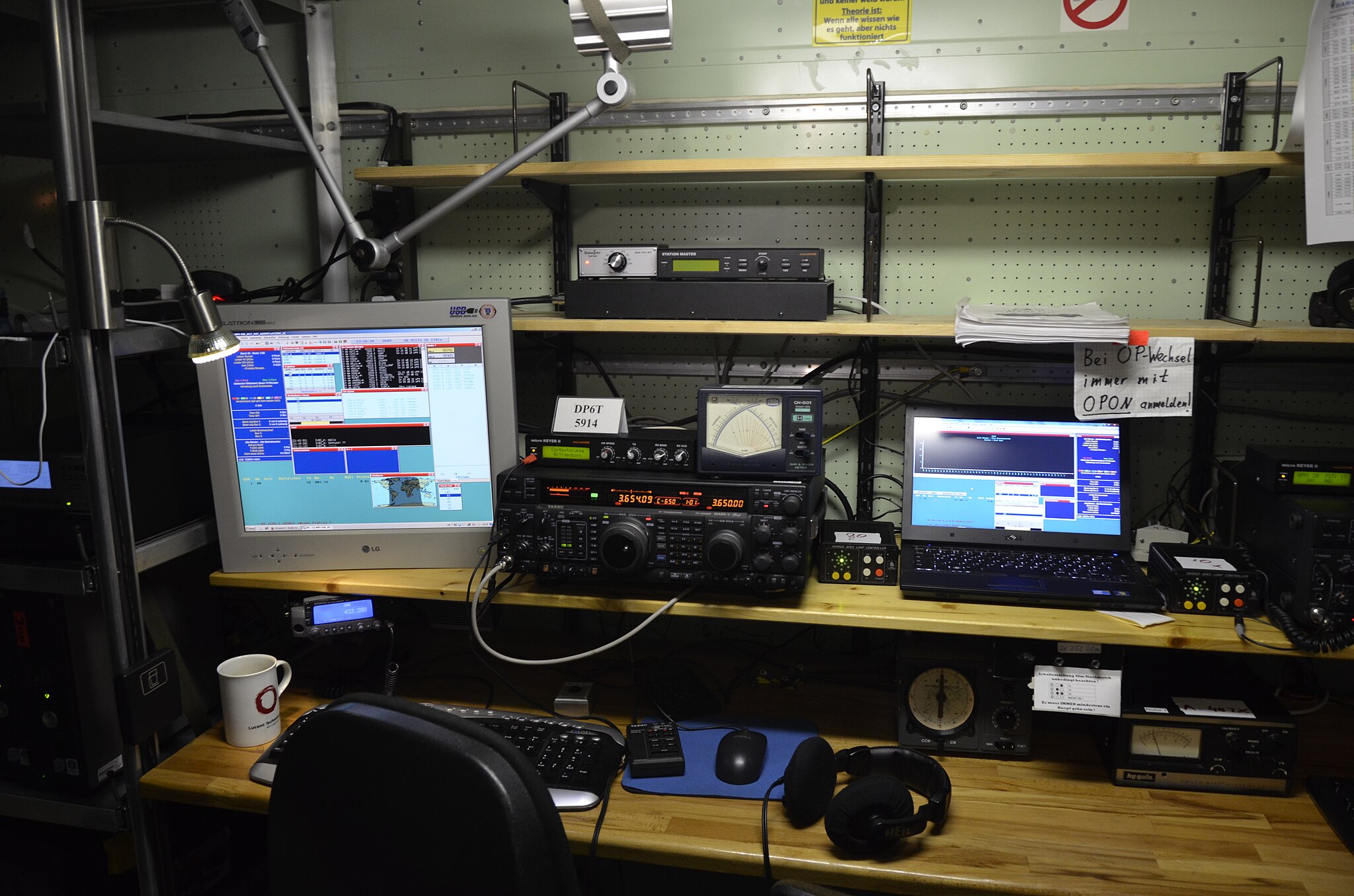
The CQ World Wide RTTY DX contest is one of the peak events of the digital contest season. It is organized by the World Wide Radio Operators Foundation (WWROF) under the auspices of CQ magazine and is the largest RTTY contest in the world in terms of participation, with several thousand stations from all continents taking part every year. It is held annually on the last weekend of September, and in 2026 it will take place on September 26–27. The contest starts precisely at 00:00:00 UTC on Saturday and ends at 23:59:59 UTC on Sunday, making it a continuous 48-hour competitive window.on five HF bands.
In the article you will read
Bands and mode
Operation is permitted exclusively on five bands: 3.5 MHz, 7 MHz, 14 MHz, 21 MHz, and 28 MHz. Any other bands are excluded from the rules. The mandatory and only allowed mode is classic RTTY - specifically the ITA2 (Baudot) format with parameters 45.45 Bd, shift 170 Hz. Rule IX.10 explicitly prohibits any other digital modes; neither PSK31, nor FT8, nor any other protocol is allowed. This is a fundamental difference compared to contests like WW Digi, which are open to multiple digital modes.
Contest code (exchange)

Formát výmeny závisí od QTH protistanice. Všetky stanice vysielajú RST (usually 599) and the number of their CQ zone. Stations from continental USA and Canada additionally attach the state or Canadian call area identifier - for example 599 05 MA for a station from Massachusetts in zone 5. Stations outside the USA and Canada transmit only RST and CQ zone, for example 599 15 for a station from Slovakia in zone 15. This two-level rule is important when logging: the program must know whether to expect a two-part or three-part exchange from the station.
QSO scoring
Each band is scored separately. On each band, one valid QSO can be made with the same station. The value of the connection depends on geographic distance:
| Type of connection | Points |
|---|---|
| Stations on different continents | 3 points |
| Stations on the same continent, different DXCC countries | 2 points |
| Stations in the same DXCC country | 1 point |
Multipliers
The multiplier system is three-part, and each part is counted separately for each band, creating a strong incentive to operate on multiple bands.
| Type of multiplier | Condition |
|---|---|
| CQ zones | 1 point for each new zone on each band |
| DXCC countries | 1 point for each new DXCC entity on each band (according to the DXCC list + WAE list + IG9/IH9) |
| W/VE QTH | 1 point for each U.S. state (48 continental + DC) and each Canadian call area (14) on each band |
The final score is calculated as the product of the total number of points for QSO and the total number of multipliers from all bands. Example from the rules: 1,000 QSO points × (30 zones + 70 countries + 35 W/VE QTH) = 135,000 points. Note: Alaska (KL7) and Hawaii (KH6) are counted only as multipliers of the DXCC country, not as states. There are fourteen Canadian call areas: NB, NS, QC, ON, MB, SK, AB, BC, NWT, NF, LB, NU, YT, and PEI. Maritime mobile stations are counted exclusively towards zone multipliers, not towards DXCC countries. When assessing DXCC countries, a combination of the DXCC list is applied:entities, the WAE multipliers list including IG9/IH9 and continental boundaries according to CQ WW standards.
Single Operator categories
In all Single Operator categories, only one operator is allowed, who performs all functions - operation and logging. At any moment, only one signal may be transmitted.
By power
| Category | Max. output power |
|---|---|
| High power | 1,500 W |
| Low power | 100 W |
| QRP | 5 W |
By assistance
Each of the power categories exists in two variants. The Single Operator (unassisted) category prohibits any form of QSO finding assistance - DX cluster, DX spotting websites, RTTY skimmer, Reverse beacon Network, or other sources providing identification of call signs. Only a single-channel RTTY decoder is allowed. The Single Operator Assisted category allows the use of these aids. This distinction significantly affects operating strategy and is crucial when selecting a category for log submission.
Introductory video: RTTY contesting - basics of operation
The following video illustrates the basics of RTTY contest operation, including software setup and working with N1MM+ Logger:
Single Operator Overlay categories

A participant in any of the basic Single Operator categories may simultaneously enter a log in one of the following overlay categories. The overlay score is evaluated separately as All Band and is divided into High Power and Low Power (QRP is included in Low Power).
Classic Operator: Only one radio, no QSO finding assistance, and a maximum of 24 hours of operation from a 48-hour window. Each break must last at least 60 continuous minutes, during which no QSO may be logged. If the log shows more than 24 hours, only the first 24 are counted in the score. Receiving during transmission is prohibited.
Rookie: The operator obtained a license less than three years before the contest date. The date of first licensing must be provided in the SOAPBOX field in the Cabrillo header. Previous winners of this category are not eligible for plaque awards.
Youth: The operator was 25 years old or younger at the start of the contest. The date of birth must be provided in the SOAPBOX field.
Multi-Operator categories
In all Multi-Operator categories, an unlimited number of operators, QSO finding assistance, and operation for a full 48 hours are allowed. The maximum power on each band at any time is 1,500 W.
Multi-Single: At any time, only one transmitted signal is allowed on a single band (Run station). Exception: one multiplier signal may operate simultaneously on a different band, but only if the other station represents a new multiplier. Both stations may change bands a maximum of 8 times per hour (within the range of 00–59 minutes). The multiplier signal must not call CQ. The log must identify which signal established each QSO.
Multi-Two: Súčasne môžu pracovať maximálne dva signály na dvoch rôznych pásmach. Každý smie zmeniť pásmo maximálne 8-krát za hodinu.
Multi-Multi: All five bands may be activated simultaneously, one signal per band.
Multi-Distributed: A maximum of five signals (one per band) from different physical locations, with all equipment must be in the same DXCC entity and CQ zone. The Cabrillo header must contain the lines CATEGORY-OPERATOR: MULTI-OP a CATEGORY-STATION: DISTRIBUTEDThis category is not subject to the restrictions of rules IX.5 and IX.6 (remote operation).
Video: Effective RTTY contesting with SDC
The following video shows practical operation in an RTTY contest using SDC:
Operating integrity rules

The rules explicitly prohibit self-spotting or asking for spotting by a third party. Passive monitoring of a DX cluster or other decoder providing signal identification is also prohibited in the Unassisted category - only a single-channel RTTY decoder is allowed. It is also prohibited to arrange or confirm QSOs by any non-amateur means - telephone, Internet, e-mail, social networks or VoIP. Correcting logged callsigns and codes after the race - using databases, recordings or any other methods - is unacceptable and will result in a penalty. Autonomous systems or robots emulating operator functions (changing frequency, calling QSO partner, logging) are prohibited; these actions must always be initiated by a human operator.
Remote operation
Remote operation is allowed on the condition that all transmitters, receivers, amplifiers, and antennas are physically located at the contest station – that is, within a circle with a maximum diameter of 500 meters. Antennas must be physically connected to the device via coaxial cable; remote receivers outside this station are not allowed. The call sign used must be issued or authorized by the regulatory authority of the country in which the station is located. The remotely controlled station must comply with all restrictions of the designated category just like operation from the location.
Request for audio recording
Every single operator participant (category V.A.1) who is applying for placement in the top five at the world, continent, or USA level – including Classic Overlay – is required to record both transmitted and received audio signals throughout the entire operating period. The recording must be continuous (not per individual QSO), in a common format (such as MP3), ideally with sound to each ear on a separate channel. The contest committee may request the recording within 90 days after the log submission deadline; the participant must deliver it within 5 days of the request. The recommended format is stereo MP3, where eachchannel carries sound to one ear – thus an auditory image as the operator heard it. The recording must be continuous; time off the air (when the station is not transmitting or receiving) does not need to be included. Failure to submit the requested recording may lead to reclassification of the log or disqualification.
Submission of CQ WW RTTY 2026 log
The log must be submitted electronically in Cabrillo format. The only accepted method of submission is the web interface at cqwwrtty.com/logcheck/. The log must contain the date and time in UTC, frequency (or band), call sign of the other station, sent code, and received code for each QSO. Incomplete logs may be classified as checklogs.
The deadline for log submission is 48 hours after the contest ends – that is, no later than 23:59 UTC on September 29, 2026. Logs submitted after this deadline may be published but are not eligible for awards. Each submitted log will be confirmed by email; the list of received logs is publicly available at cqwwrtty.com/logs_received.htm. An extension of the deadline can be requested in advance via the contact form on the organizer's website; the request must contain a valid reason and must be submitted before the deadline expires.
Complete rules for CQ WW RTTY 2026 including Slovak translation are available at cqwwrtty.com/rules.htm.