
You will read in the article
One program instead of dozens of utilities
IC-SDR is a program for SDR receiver developed by Luis López Martínez. It is written in Go, runs exclusively on Windows, and combines demodulation, waterfall spectrum and digital decoders in a single window. The development is fast: the first release v0.1.0 was announced by the website rtl-sdr.com in September 2026, at the end of October the current version is v0.25.2.

All processing runs at a fixed sampling rate of 2.048 MS/s, audio is demodulated at 48 kHz. The shown band section is thus approximately 2 MHz wide, regardless of the receiver's capabilities. Airspy R2, which works natively at 2.5 MS/s, the program internally resamples.
Analog modes and sound processing
AM, NFM, WFM, LSB and USB are available. The sound chain is completed by a five-band equalizer (120, 300, 800, 2000 and 5000 Hz), a notch filter with automatic tone detection and noise reduction that can also be used for CW. With weak SSB on KV, it will help to pull down 120 Hz and slightly raise the band around 2 kHz. Notch removes the tuning carrier without narrowing the filter.
The recorder saves in WAV or MP3 (160 kb/s) and pauses recording when the squelch is closed. When monitoring the converter all day long, a file with only sessions will be created, without hours of silence.
Integrated decoders
Most decoders consist of proven external tools supplied with the program, so there is no need to install them separately and connect them via virtual audio cables.
| Decoder | Scope | Note |
|---|---|---|
| AIS | 161.975 and 162.025 MHz simultaneously | AIS-catcher, ship map |
| ADS-B | 1090 MHz or UAT 978 MHz | map with aircraft tracks |
| Radiosondes | RS41, DFM, M10/M20 | rs1729/RS, CSV and JSON export |
| APRS | packets and station map | Direwolf |
| POCSAG | 512, 1200 and 2400 Bd simultaneously | multimon-ng 1.6. 1 |
| SSTV | M1, M2, S1, S2, R36, R72, PD50 to PD290 | recognition according to VIS, image adjustment |
| DATV | DVB-S, DVB-S2, 33 kS/s to 1.5 MS/s | LeanDVB, playback via VLC |
| RTL_433 | sensors in the ISM bands | CSV export |
From an amateur point of view, DATV is worth paying attention to: the range of symbol rates covers narrowband transmissions via the QO-100, of course with an LNB in front of the receiver. The FT8 decoder with a map of received locators will serve to quickly estimate the propagation conditions.

Digital voice traffic, TETRA and TETRAPOL
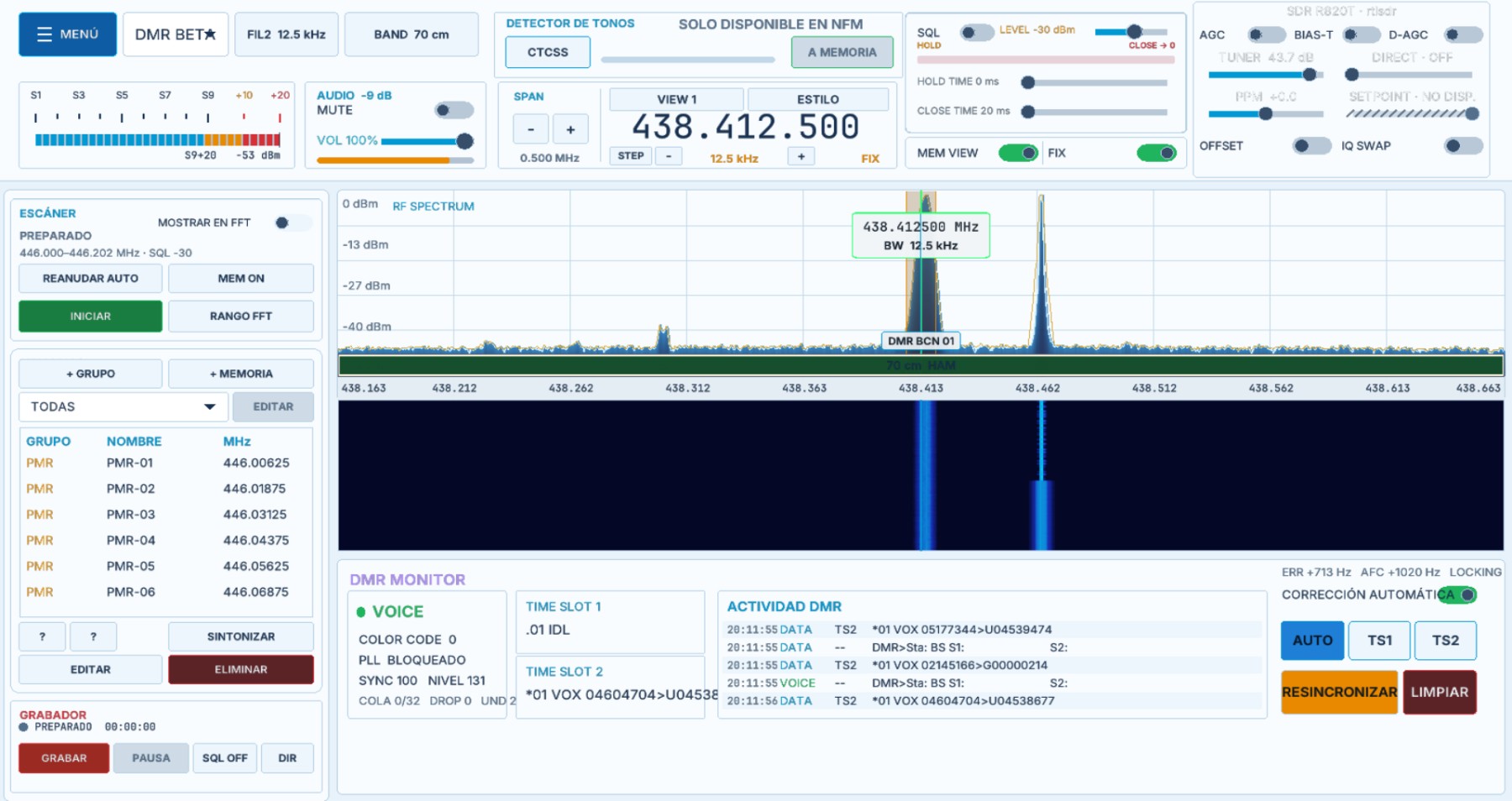
Digital Auto mode uses DSD-neo 2.9.0 and recognizes DMR, P25 Phase I and II, NXDN, D-Star, YSF, dPMR, ProVoice, M17 and X2-TDMA. In the 70 cm band, where FM, DMR and C4FM alternate, there is a practical BYPASS NFM mode: while there is no digital voice, analog NFM is heard, and with the arrival of a digital session, the sound switches itself.
TETRA and TETRAPOL have their own native receivers. TETRAPOL monitors speech channels within the received I/Q signal without retuning the receiver and plays only sessions that the protocol marks as unencrypted.
Access to non-public networks and use of their content is governed by national legislation. Before using these modules, check the applicable regulations.
Contest diary
The log contains CQ WW SSB, CQ WW CW, Oceania DX SSB profiles and a general SSB profile, others can be created in the template editor. For CQ WW, it calculates points according to the competition rules and multipliers from zones and countries on each band. Even before saving the QSO, it shows how many points and multipliers the connection will bring. It warns of duplication on the band or in the entire contest and determines the DXCC entity, CQ zone and approximate local time of the opposing station from the tag. Exports to both Cabrillo and ADIF, with validation directly highlighting the field blocking the export.

The QSO frequency is taken from the IC-SDR tuning log. When bi-directionally synced via the OmniRig, the IC-SDR tunes together with the transceiver and serves as a panoramic receiver; the SDR can be muted during a broadcast that the radio announces via CAT. With a common antenna, the SDR input must be protected from the transmitted power. It is a diary, not a contest program: CW macros, keying and DX cluster are missing.
Web interface and remote access
Vstavaný server (by default port 8080) will make the frequency, spectrum, waterfall available in the mobile, S-meter, pamäte a živý zvuk. Prístup chráni heslo s dĺžkou aspoň 12 znakov; ovládanie si vyžaduje druhé heslo a povolí sa iba jednej relácii. Na diaľku sa dá ladiť, meniť demodulátor, filter, span and squelch and manage memories. The computer is blocked for local control during the session. The audio goes as PCM with low latency (about 768 kbps per listener) or as Ogg/Opus at 24 kbps with a delay of a few seconds.
The server uses unencrypted HTTP and the author recommends using it only on a trusted local network. Use a VPN to access from the Internet instead of port forwarding on your router.
Hardware, installation and updates
Receivers are served by the program via SoapySDR: RTL-SDR, SDRplay including RSPdx and RSPduo (Tuner 1 50 Ω, Tuner 1 Hi-Z and Tuner 2 50 Ω inputs), HackRF Pro and Airspy R2 with LNA, MIX, VGA and Bias-T control. The distribution is portable: the folder with the program and the DATA directory, which contains both the runtime libraries and all user data.
The updater downloads the stable release, verifies the SHA-256 checksum, checks the package contents, and replaces the installation with a rollback option. Personal data, including the entire contest diary with templates and backups, will be preserved. Just copy the DATA directory for backup.
It is important for constructors that the repository does not yet contain a license file. To build from sources, you need Go 1.27 and external runtime libraries, which are not included repository.